Get Full Government Meeting Transcripts, Videos, & Alerts Forever!
Get email alerts on the School Bus Stop Arm Violations topic
No spam. Unsubscribe anytime.
Senate panel hears bill to raise repeat fines for school bus stop-arm violations
Summary
The Minnesota Senate Judiciary Committee heard testimony on Senate File 737, which would set escalating mandatory fines for repeat violations of the school bus stop-arm statute within a 10-year period; committee laid the bill over for possible inclusion by the transportation committee.
The Minnesota Senate Judiciary Committee on Feb. 17 heard testimony on Senate File 737, a bill to increase mandatory fines for repeat violations of the school bus stop-arm law (Minn. Stat. §169.444). Senator Nelson presented the bill on behalf of chief author Senator Housley and said the measure would set escalating fines — $500 for a first conviction, $700 for a second conviction within 10 years and $950 for a third or subsequent conviction within 10 years.
The bill’s backers said the change targets repeat offenders and is intended to reduce the risk to students boarding and leaving school buses. “We believe that any reasonable step that can be taken to reduce, to continue reducing either initial violations of Minnesota’s stop arm law or reducing repeat offenses will in fact save lives of Minnesota school children going forward,” said Eric Simonson of the Minnesota School Bus Operators Association, which provides the majority of school-bus service in the state and testified in support.
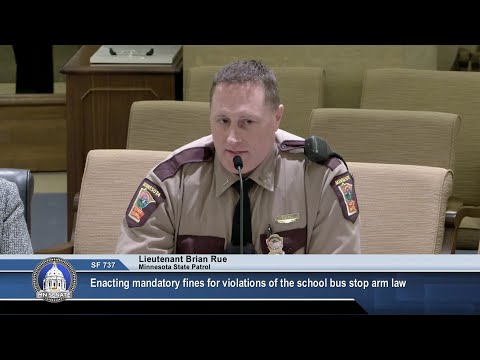
Why it matters: Committee members and testifiers discussed enforcement, evidence and whether fines will change behavior. Lieutenant Brian Rue of the Minnesota State Patrol testified that court records show roughly 1,000 to 1,200 stop-arm charges in recent years and that 2024 saw more than 1,800 charges after wider use of stop-arm cameras; he said court convictions run at about a 50–55% rate. Rue also told the committee that there were 23 repeat convictions recorded since 2015 for violations of Minn. Stat. §169.444.
Committee discussion focused on whether higher mandatory minimum fines will deter repeat offenders and on practical barriers to conviction. Senate counsel explained that owners can be charged in some cases (a payable offense for the owner carries a $100 fine plus a $75 surcharge), and the committee discussed prosecutors’ discretion and plea practices. Committee counsel and other members noted that cameras have increased the volume of evidence but that identifying the driver can still be challenging; prosecutors sometimes accept plea agreements or reduced charges for cases in which intent or identity is unclear.
Opposition and caution: Senate counsel who speaks frequently on criminal sentencing expressed skepticism that increasing mandatory minimum fines will materially reduce recidivism, saying the data indicate repeat convictions are rare and that prosecutors’ and courts’ discretion — and the probability of being caught — are the factors most likely to affect behavior. He also warned that mandatory fines can create enforcement and equity issues in court when defendants have limited ability to pay.
Next steps: Committee Chair indicated the matter is being “laid over” for possible inclusion in the transportation committee’s omnibus package; the chair said transportation will decide whether to include the measure. Senator Nelson closed by reiterating support for increasing penalties and said she would follow up on related outreach and education ideas, such as the 55-Alive driver refresher programs.
No formal roll-call vote on final passage was recorded; the committee laid Senate File 737 over for further consideration and potential inclusion by the transportation committee.