Get Full Government Meeting Transcripts, Videos, & Alerts Forever!
Get email alerts on the Elections Voting Systems topic
No spam. Unsubscribe anytime.
Wyoming committee holds lengthy hearing on HB 215 to ban electronic voting equipment
Summary
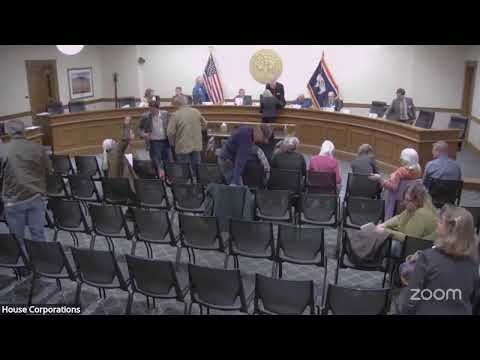
The Corporations, Elections & Political Subdivisions Committee held a public hearing on House Bill 215, which would ban electronic voting equipment and require paper ballots and hand counts statewide; the committee took no vote and left the record open for additional testimony.
The Corporations, Elections & Political Subdivisions Committee held a public hearing on House Bill 215 on an introductory agenda item, hearing more than two hours of testimony from sponsors, county residents, cybersecurity commentators and election workers about a proposal to prohibit electronic voting machines statewide.
Representative Scott Smith, the bill sponsor, told the committee HB 215 would “require the use of paper ballots for elections, requiring hand counting of paper ballots, specifying procedures for hand counting of paper ballots, repealing provisions related to electronic voting machines and electronic poll books, revising procedures for the post election ballot audit, and providing for testing of hand counting, tabulating, reporting systems, and providing for election observers, providing penalties, making conforming amendments, providing for rule making, and providing for an effective date.”
The bill drew strongly divided public comment. Supporters said hand counting restores public confidence and reduces cybersecurity exposure; opponents — including experienced election judges and civic groups — warned that the draft contains statutory conflicts, would create chain-of-custody and adjudication problems at polling places, and could cause access or timing issues for voters with disabilities.
Why it matters
Supporters said HB 215 addresses vulnerabilities they described in current electronic voting systems, citing failed or incomplete logic-and-accuracy testing in recent election cycles, software and vendor concerns, and limited ability to examine proprietary machine components. Opponents said the proposed text contains internal inconsistencies about when ballots are to be counted, how “rejected” ballots are defined and handled, and how adjudications and voter assistance would work, and urged more factual review and consultation with county clerks.
Details of the hearing
Representative Scott Smith (R-Goshen County), who introduced the bill, said the measure grew from a party convention resolution and grassroots interest across the state. Smith read the bill’s opening description and framed the measure as a return to paper ballots and hand counts to ‘‘bring confidence back to the electorate.’’
Cheryl Aguirre, chair of the Hot Springs County Republican Party and a Wyoming GOP state committeewoman, said she participates in pre- and post-election testing and that, in her view, “the machines are programmed by humans, and that’s what happened in Weston County.” She told the committee she believes hand counting is feasible for counties and noted the Teton County maintenance contract she cited as costing $12,815 a year.
Jill Kaufman, a Platte County business owner who said she represents Cause of America and local committee members, focused on what she described as cybersecurity risks. Kaufman said many components for current systems are sourced offshore, argued election systems have not been kept current with security updates and certification guidance, and said HB 215 includes provisions to preserve HAVA protections for voters with disabilities.
Multiple residents and local Republican committee members testified in favor of the bill, offering cost and time comparisons from citizen-run hand-count pilots. Lucinda Houchins, a Wheatland precinct committeewoman, said a community hand-count exercise cost roughly $5,329 and that machine maintenance fees can exceed the hand-count cost over time. Chloe Butler, a Platte County election-integrity team leader, cited Article 6, Section 13 of the Wyoming Constitution and urged the committee to proceed to full discussion.
Opponents and cautionary testimony
Janet Mader, a Campbell County election judge and canvassing-board member, testified against the bill and provided a detailed list of statutory and drafting concerns. Mader said the draft replaces the term “poll watchers” with “electronic observer” in some places and introduces language about “rejected choices recorded on a ballot exceeding the number allowed” in contexts that currently apply to machines, creating potential conflicts about who may examine or adjudicate ballots while polls remain open.
Gail Simmons of Civics 307 and Y Vote testified that statewide surveys show high voter confidence in current processes and argued that machine counting generally provides faster results and lower per-ballot processing time. She urged education and better communication to address public distrust rather than an outright ban.
Technical and audit concerns
Several witnesses identified problems during logic-and-accuracy testing and audits. A citizen reading a letter from a cybersecurity professional, Clay Parikh, summarized reviews he said he conducted in voting-system test labs; the letter stated some certified systems were shipped with outdated operating systems and antivirus definitions, and that proprietary rules prevent full public examination of device internals and source code.
Richard Weber, who identified himself as an operations manager for a voter-initiative group, told the committee that county logic-and-accuracy tests from recent cycles had failed and that the bill would strengthen audit triggers and reporting requirements.
Process, training and cost
Supporters described several hand-count pilot trainings and trials, citing short training windows (one to a few hours) and volunteer availability; one witness said organizers had recruited more than 1,500 volunteers ready for hand-count training. Witnesses gave differing cost estimates: a Platte County pilot was described as costing about $5,329 for one election cycle, while presenters also cited per-ballot figures used during training (one speaker said $1.13 per ballot for a citizen hand count versus $5.86 per ballot for machine processing in their estimate). Janet Mader and others disputed some timing and operational claims and raised concerns about reconciling complex ballots.
Accessibility
Several witnesses and Representative Smith acknowledged the need to preserve assistance for voters with disabilities and said the bill provides for marking assistance and compliance with HAVA. Opponents urged the committee to ensure any transition preserves legally required accessibility accommodations.
Committee next steps
Committee members asked sponsors and public witnesses for details on cost, the number of machines statewide (witnesses estimated “around 300+”), and the implications of upcoming software support changes cited by witnesses (several speakers said Windows 10 support ends in October 2025). After public testimony, Chairman Knapp kept the hearing record open and said the committee would continue the hearing on Monday and expected testimony from the Secretary of State’s office, the County Clerk Association and other elected officials.
No formal action
The committee took no vote on HB 215 during this hearing; members heard testimony and posed questions but did not advance the bill. The record remains open for additional written materials and scheduled testimony.
Ending
The Corporations, Elections & Political Subdivisions Committee held an extended public hearing that highlighted wide public engagement and sharply contrasting views on how Wyoming should conduct and audit elections. The committee postponed further consideration pending agency briefings and additional testimony.