Get Full Government Meeting Transcripts, Videos, & Alerts Forever!
Get email alerts on the Environment Wetlands topic
No spam. Unsubscribe anytime.
Planning board continues hearing on Mill Road micro‑hydro after site visit, orders erosion controls and outside inspection
Summary
The Rhinebeck Planning Board continued the public hearing on a proposed micro‑hydroelectric installation at 443 Mill Road after site‑visit observations of exposed streambank work, missing silt controls and outstanding Army Corps and New York DEC permit determinations.
The Rhinebeck Planning Board continued the public hearing on a proposed micro‑hydroelectric installation at 443 Mill Road, owned by Joel Perm, after board members, neighbors and staff raised concerns about erosion, turbidity and missing outside permits.
Applicant Joel Perm said the project, first submitted in November, would place a turbine and related structures in a stream channel and that changes in supplier recommendations had led to on‑site adjustments. Perm told the board he filed a joint application with the Army Corps of Engineers and New York State Department of Environmental Conservation (DEC) and that an Army Corps permit number had been logged. Planning staff said they were still waiting on DEC jurisdictional determination documentation.
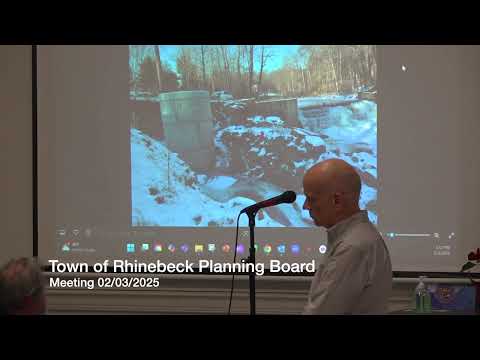
Board members and nearby residents who attended the site visit described a trench separated from the stream by a narrow berm, exposed piles of rock and clay, and corrugated culverts staged at the site. Several speakers warned that backfilling with loose rock and soil could be vulnerable to scour during heavy flows and that significant turbidity and siltation had already occurred. One resident said piles of spoil adjacent to the channel had no silt fencing and were within feet of flowing water.
Planning staff reported the applicant had submitted a joint permit application but that outstanding outside permitting questions remained; the staff recommended waiting for DEC and Army Corps determinations before final action. The board discussed requiring an independent construction inspector — paid by the applicant — to oversee remediation and restoration work, and staff said CPL (a county consultant) could perform construction inspection if retained by the applicant.
Board members asked the applicant to install temporary erosion and sediment controls immediately. The board also clarified its limited jurisdiction over stop‑work orders; a board member asked whether the stop‑work order on the site could be kept in place, and staff said that determination is made by the town’s building official, not the planning board.
After deliberation the board voted to continue the public hearing to April 7 to allow time for DEC and Army Corps responses and for the applicant to arrange the requested inspections and erosion controls. The board and staff asked the applicant to provide DEC/Army Corps documentation and to confirm plans for a construction inspector and silt‑fence installation before the next hearing.
Why it matters: The project sits adjacent to mapped wetland areas and a mapped stream channel; board members said the extent of disturbance observed at the site could affect downstream properties through sedimentation and increased flood flows. The planning board signaled that it will require outside permitting evidence and construction oversight before granting final approvals.
Next steps: The public hearing is continued to April 7. The applicant is expected to provide DEC and Army Corps jurisdictional determinations or permit decisions, evidence that spoil piles and exposed soil are temporarily protected, and a written commitment to fund an independent construction inspection. If those items are not supplied the board indicated it will not finalize site plan approval.