Get Full Government Meeting Transcripts, Videos, & Alerts Forever!
Get email alerts on the Committee Actions Roundup topic
No spam. Unsubscribe anytime.
Commerce and Labor Committee advances slate of energy, labor, health and consumer bills; several sent to finance
Summary
The House Commerce and Labor Committee on multiple roll calls advanced bills on solar and grid programs, utility consumer assistance, worker protections and health coverage. Several energy bills drew detailed debate on interconnection and cost-sharing; many measures were reported to Senate Finance.
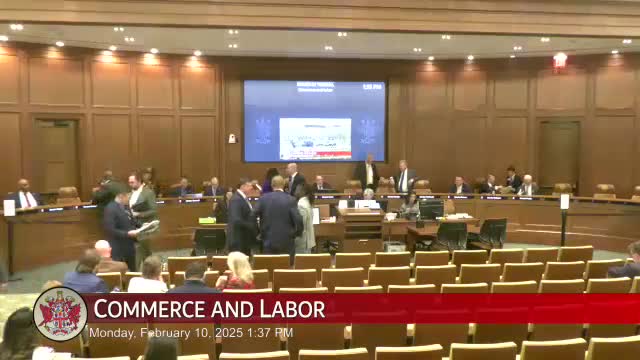
The House Commerce and Labor Committee met to consider more than three dozen bills covering energy, utility consumer protections, workforce measures and several health items, advancing a broad package of measures to the Senate Finance Committee and reporting other bills out of committee.
The panel voted in a block to report an early set of bills that were identical to measures passed by the Senate; that block was approved on an electronic roll call, 15-0. Later votes included measures reported and referred to Senate Finance and other business handled individually.
Why it matters: The committee’s action moves a large number of bills to the next stage of the 2025 General Assembly process. Several of the bills touch on statewide grid policy and customer protections that lawmakers and regulated utilities said will affect how solar, storage and distributed energy projects connect to the grid, and they could influence costs for schools, localities and ratepayers. Other measures on the agenda could change employer responsibilities, paid-leave access and state oversight of utility and health coverage questions.
Energy and grid measures
A number of energy bills drew the most sustained debate. Delegate Hernandez described a pilot program carried in a section-1 bill that would allow customers in the Dominion service area to ‘‘sign up voluntarily to put excess energy back onto the grid and get paid for it’’ during a three-year trial, with the State Corporation Commission asked to analyze outcomes and consider a permanent program afterward. The committee voted to report that measure; the roll was recorded as 9 yes, 0 no, 6 abstentions/absent on the electronic roll used for several energy bills.
Delegate Tran spoke at length about a separate bill aimed at interconnection cost sharing for projects that trigger distribution or transmission upgrades. Tran said the measure ‘‘shares those costs across all the projects that are still online in the system at that point’’ and described adjustments in the substitute to change the qualifying project size range and to allow owners to pay full upgrade costs up front if they prefer. That bill also cleared committee on an electronic roll recorded in committee as 9 yes, 0 no, 6 abstentions/absent.
A third energy measure on long‑duration storage and technology demonstration language drew questions about cost, commission discretion and whether the State Corporation Commission should set follow‑up targets. Proponents said the bill is technology‑agnostic and includes a commission review so the commission can determine feasibility, cost‑effectiveness and timing before any ratepayer impact. The committee voted to report and refer the bill to Senate Finance.
Utility consumer protections and oversight
The committee approved a bill to create an ombudsman‑style resource for utility customers; advocates and local school systems said an ombudsman would help households and public bodies navigate complaints and large interconnection costs. The Department of Energy and other agencies testified on interactions with existing programs and the need for clear roles.
Labor and workforce
The committee considered several workforce items. Delegate Ward’s package included bills on maternal care provider reimbursement and paid sick leave. The committee approved a substitute on midwifery reimbursement to align reimbursement for licensed certified midwives with certified nurse midwives and adopted a delayed effective date during discussion about credentialing and implementation timelines; that bill passed committee on a unanimous voice/electronic vote. Delegate Ward also presented a bill to create a statewide paid sick leave standard; proponents said it would give low‑wage workers access to earned leave and opponents raised concerns about costs, recordkeeping and exemptions for employers covered by federal statutes (for example, air carriers under the Railway Labor Act).
Health and benefit oversight
House bill 17 24, to create a Prescription Drug Affordability Board, drew extended testimony on both sides. Supporters said an independent board could review rapidly rising drug prices and potentially limit prices if manufacturers cannot justify increases; opponents — including industry and some provider groups — argued the model has not yet demonstrated reductions in out‑of‑pocket costs at the pharmacy counter in other states and warned of supply‑chain impacts. The committee voted to report the bill and refer it to finance.
Other items and next steps
The committee also advanced bills on minimum wage reenactment language, farmworker coverage under the minimum wage act, solar interconnection grant funding for public bodies, offshore wind workforce development, and a statutory framework for a Clean Energy Innovation Bank to restore oversight guardrails for a state clean energy financing institution. Many of these bills will be considered next by the Senate Finance Committee.
Quotes
"This is the bill that sets up a pilot program, over the next three years, whereby customers in the Dominion service area can sign up voluntarily to put excess energy back onto the grid and get paid for it," Delegate Hernandez said during debate.
"What this bill tries to address is the fact that the interconnection cost if you're the last one in requiring the upgrade to the system, it is super prohibitive," Delegate Tran said. "So what it does is that it shares those costs across all the projects that are still online in the system at that point."
What’s next: Most of the major energy and health bills the committee advanced were reported and referred to Senate Finance. Committee staff and agency witnesses signaled several items will require memoranda of understanding or follow‑up work between state agencies (for example, DEQ and the State Corporation Commission) to finalize implementation details should the measures become law.
Meeting details: The committee handled dozens of bills in a hybrid session; some votes were grouped and passed unanimously, and multiple measures required substitute language adopted on the floor before reporting. Specific roll call tallies are recorded in committee minutes and on the committee’s electronic roll records for bills referred to Senate Finance.