Get Full Government Meeting Transcripts, Videos, & Alerts Forever!
Get email alerts on the Sobering Crisis Center topic
No spam. Unsubscribe anytime.
County outlines Pathway Center expansion and plan for permanent 24/7 sobering and crisis stabilization center
Summary
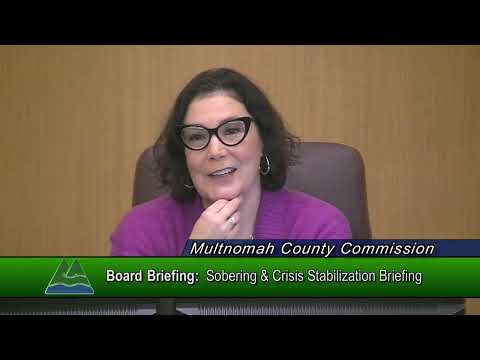
Multnomah County presented updates on expanding a temporary Pathway Center and planning for a permanent 24/7 sobering and crisis stabilization center that officials say will provide medical screening, peer support and withdrawal-management services.
Multnomah County presented updates on an expanding temporary Pathway Center and planning for a permanent 24/7 sobering and crisis stabilization center that county leaders say will divert people from jails and emergency departments and provide medical screening, peer support, and withdrawal-management services.
The county said it is expanding the Pathway Center (a temporary site) to operate 24/7 and add 13 sobering recliner beds in a Phase 2 opening scheduled for March; the expanded temporary site will provide medical screening, peer support, comfort medication protocols developed with Oregon Health & Science University (OHSU), transportation and care coordination. Anthony Jordan, senior manager of addictions and prevention services, said the Pathway Center launched field-based deflection services on Sept. 1 and opened the center in October to centralize deflection referrals and medical screening.
For the permanent facility, Heather Mirasol, Behavioral Health Division Director, and Greg Hocker from the Department of County Assets said the county has executed a purchase-and-sale agreement for property at 1901–1907 Southeast Grand Avenue and is in a 60-day due diligence period that concludes April 3. Hocker said staff have started final program work and are evaluating a construction manager/general contractor (CMGC) procurement; six CMGC proposals are under evaluation and staff expect to execute a contract in the coming months. The county expects to return to the board later in spring for FAC-1 authorization to proceed with design work.
Services and operations: the permanent facility is planned to provide sobering and withdrawal-management services with continuous (24/7) admission and up to 50 beds to accommodate both sobering and withdrawal-management needs. Anthony Jordan said the center’s model seeks to integrate sobering and crisis stabilization services and to develop coordinated pathways into treatment and other services, but staff noted that some downstream services remain subject to community provider capacity and are not guaranteed on discharge.
Governance, procurement and budget: staff are preparing a request for proposals to identify an operator and expect the RFP process to be completed in June. Mark Harris, from the health department director’s office, said operating-cost estimates are based on local market rates for similar facilities and that county-operated deflection services will continue inside the center while most day-to-day operations would be performed by a contracted partner. Harris said acquisition costs for the property will remain confidential until closing. Staff also said the city of Portland has set aside some funding and the county has received certain state capital funds and other deflection-related state dollars but that the operating model and sustained revenue sources are still under development.
Community engagement: staff described a phased neighborhood-engagement plan. Phase 1 (underway) includes an online sign-up form and information materials; staff said they will mail flyers to businesses and residents within a half mile of the site by mid-February and plan a community meeting in March. Phase 2 (after due diligence closes) calls for convening a Good Neighbor Advisory Group to co-create a neighborhood agreement outlining roles and responsibilities. Staff described a broader advisory structure that would include culturally specific providers, hospital and behavioral-health partners, first responders, providers with lived experience and other stakeholders to advise service delivery and operations.
Board feedback and outstanding topics: commissioners raised issues the county said it will continue to address, including closer coordination with homeless-service providers and outreach teams, transportation and nonmedical transport options to and from the facility, data- and HIPAA-related release-of-information processes for continuity of care, and sustainable operating funding. Commissioner Loretta Singleton asked how the county will ensure that street-based outreach and shelter providers can coordinate with the center; staff said those connections will be part of the program and implementation teams. Commissioner Sharon Moyer asked about the balance between sobering and crisis stabilization functions and about revenue-recovery options; staff said incorporating withdrawal-management services creates billing opportunities that can support operations but that multiple funding sources will need to be braided to sustain the center.
Next steps: staff said they will continue due diligence on the property through April 3, finalize programming and issue the operator RFP with an anticipated June completion, evaluate CMGC responses and return to the board in March and June with further updates and decisions about design, procurement and neighborhood engagement.