Get Full Government Meeting Transcripts, Videos, & Alerts Forever!
Get email alerts on the County Fair Funding topic
No spam. Unsubscribe anytime.
Carroll County Fair leaders ask board to maintain FY26 funding as costs rise
Summary
Fair officials told the Carroll County Board of Supervisors they are requesting the same county support for fiscal year 2026 as the current year, citing rising insurance costs, volunteer shortages and steady exhibitor participation.
Carroll County Fair officials asked the Carroll County Board of Supervisors to maintain their current county funding for fiscal year 2026, reporting that rising insurance costs and volunteer shortages are increasing operating pressure even as attendance and exhibitor participation remain steady.
Brian Sander, president of the Carroll County Fair, told the board that the fair is debt-free after paying off its loan this year and is not seeking an increase in county support: "I am happy to say that we are debt free after this year." He said rising insurance premiums and higher deductibles are creating a larger expense burden: "Twelve years ago when I got on the board, our insurance was about $10,000 a year. This year is between the $26,000 and $27,000, and our deductible went from a $1,000 deductible on wind and hail events to a $10,000 minimum deductible."
The fair’s presentation emphasized youth programming. Cammy Hill, identified as the ISU Extension county youth coordinator, accompanied fair leaders, and 18-year-old 4-H member Casey Bogue described how fair participation builds life and leadership skills. "Through 4‑H I’ve been able to learn basic electricity, sewing, leadership and communication," Bogue said, adding that county-level experience helped him serve as a delegate at state and national 4‑H events.
The fair provided exhibitor statistics to the board: 223 total exhibitors; 126 static exhibitors; and livestock counts listed as 64 beef, 24 dog, 28 goat, 29 poultry, 19 rabbit, 23 sheep and 22 swine. The presenters said 35 Clover Kids displayed projects out of 73 eligible, there were 27 FFA exhibitors, 149 4‑H exhibitors, and 17 livestock exhibitors advanced to the state fair. Officials also noted the fairgrounds generate revenue by renting buildings and by camper storage (about 75 campers currently stored) and that volunteers remain critical—fair organizers estimate 50 to 60 volunteers are needed per figure‑8 race to generate that income stream.
Sander said the fair is taking steps to reduce costs where possible, for example bringing Friday-night entertainment “in house” instead of hiring a promoter, and raising adult gate admission on Friday and Saturday to offset rising expenses. He also handed supervisors a financial statement and an economic-impact study for Iowa county fairs that highlighted statewide trends in county funding.
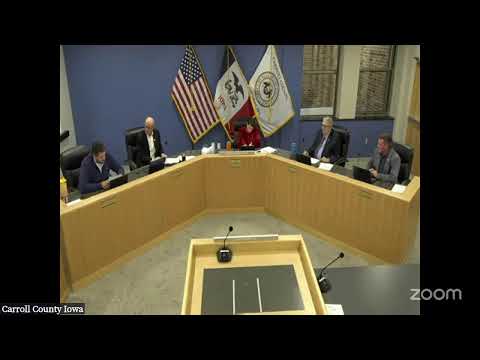
Board members did not take a funding vote at the hearing. A supervisor told fair leaders the board will consider the request during the upcoming budget-planning session and would notify the fair when the board decides. No formal appropriation or commitment was recorded at the meeting.
Fair officials stressed the youth-development role of the county fair and framed the funding request as an investment in county children and skills training. The presentation ended with a request that the board maintain current funding levels when it finalizes the county budget.
The board’s next steps are to review the request in its budget planning session in the coming weeks and decide whether to recommend or adopt funding in the FY26 budget process.