Get Full Government Meeting Transcripts, Videos, & Alerts Forever!
Get email alerts on the Planning And Zoning topic
No spam. Unsubscribe anytime.
Washington County committee postpones new planning and zoning ordinance after hours of debate
Summary
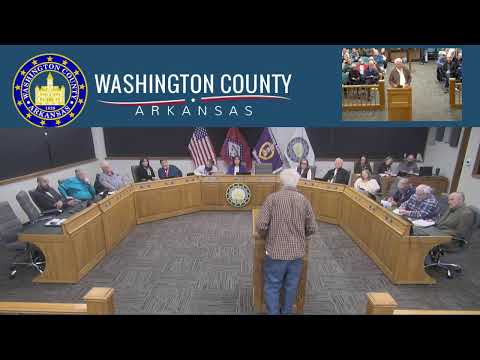
After more than three hours of public comment and internal debate, the Washington County Quorum Court County Services Committee on Dec. 2 voted to postpone consideration of a new county planning and zoning ordinance for two months to allow additional outreach and revisions.
Washington County Quorum Court County Services Committee members voted on Dec. 2 to postpone consideration of a proposed comprehensive planning and zoning ordinance for two months, following extended debate among justices of the peace, planning staff and members of the public.
The committee had been scheduled to consider an ordinance that would replace the county's 2006 planning code, relocate certain appeal steps, and attach an updated zoning map to the ordinance. Justice Rios Stafford, presiding as chair of the County Services Committee, moved to postpone the ordinance for two months; Justice Pond seconded the motion and the committee approved it by roll call.
Why it matters: the draft ordinance would change how conditional use approvals and rezoning requests are processed and where appeals are heard, and it includes a new countywide zoning map. Supporters said the rewrite clarifies an outdated code and speeds some permitting steps; opponents said it concentrates authority and was circulated with insufficient public outreach.
Committee debate and key points Supporters, including Justice Lyons, argued the ordinance gives the county a clearer method to "plan where we want commercial to be" and to align infrastructure with likely growth. "I support this ordinance. I think we need as a county to plan for commercial and where it should be so we can plan the infrastructure to be there," Lyons said during debate.
Planning staff and the county planning director, Sam Atta, described the rewrite as a consolidation of many scattered ordinances into a single, modern code with clearer definitions, updated technical standards and a required zoning map. Atta said the proposed changes replace the existing conditional-use permit (CUP) workflow with a rezoning-first approach in some cases so applicants know earlier whether a legislative rezoning would be supported. "If you apply for rezoning, we will need to find the neighbors surrounding the property...and they are notified twice," Atta said, adding that the office conducts an extensive technical review involving utilities, road and environmental reviewers before a project reaches the planning board.
Concerns from committee members and the public Opponents in the committee and in the room raised a range of concerns: that the new code would vest too much discretionary authority in the county judge; that the attached map initially posted in March and updated repeatedly had created confusion; that residents had not been given consistent, countywide town-hall-style briefings; and that "commercial" zoning shown on the map could be misread as immediately forcing changes in property use.
Justice Koger, who led several objections, summarized a frequent worry: "This ordinance vests too much power in the county judge, and I don't want to see us give up any of our legislative power." Justice Lemming and others urged additional district-level engagement and professional studies before a countywide change.
Staff responses and clarifications Planning staff repeatedly emphasized that an owner's current land use would not automatically be changed and that commercial zoning without a change of use does not obligate an owner to develop or sell. Atta explained several technical points repeatedly during the meeting: county property taxes are based on actual end use, not zoning; the planning office posts technical reviews and staff reports online; and many processes remain unchanged except for the CUP/rezoning flow one item staff said the draft specifically revises.
Public comment More than a dozen residents spoke during the public comment period, representing rural property owners, conservation advocates and residents who said they had not had enough time or consistent information to evaluate the map and code. Speakers asked the committee to slow the process and provide uniform, district-by-district outreach. Several committee members agreed that additional outreach was needed before final action.
Formal action After debate and multiple procedural motions (including an earlier failed motion to postpone indefinitely), the committee voted to postpone consideration of the ordinance for two months. The committee recorded the roll-call vote; the motion carried, and staff were instructed to continue outreach and provide updated maps and materials to committee members ahead of the next hearing.
What happens next The committee directed planning staff to continue making map edits that had been requested by individual justices and to prepare updated public materials. The ordinance as drafted remains on the committee's schedule but will return after the two-month pause for further consideration and possible amendment.