Get Full Government Meeting Transcripts, Videos, & Alerts Forever!
Get email alerts on the Attendance topic
No spam. Unsubscribe anytime.
Township of Ocean School District presents state-required attendance action plan after 2022–23 data flag
Summary
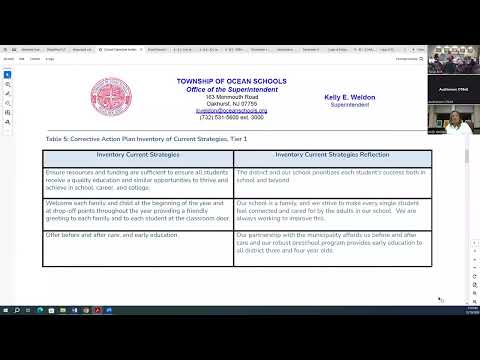
District leaders presented a state-required chronic absenteeism action plan after 2022–23 data showed rates of 10% at Wayside and TOIS and 16% at Ocean Township High School; administrators outlined parent-survey findings and stepped interventions, and said the district will formalize progress in early 2025.
Township of Ocean School District administrators presented a required action plan on chronic absenteeism during the board's Dec. 10 workshop, citing 2022–23 data that showed chronic absentee rates of 10% at Wayside Elementary School, 10.8% at the Township of Ocean Intermediate School (TOIS) and 16% at Ocean Township High School (OTHS).
The plan responds to guidance from the New Jersey Department of Education that asks districts with 10% or more of students considered chronically absent to develop interventions. Superintendent (unnamed) told the board the state “is looking more closely at student attendance” since the pandemic and that the district has prepared the required document to show actions underway.
Miss Conway, who led the presentation, said chronic absenteeism is calculated when a student misses more than 10% of enrolled school days — “roughly, if a student is enrolled in our district for 180 days… once they hit 18 days absent … they are considered chronically absent.” She described a district watch/warning/at-risk approach and tiered interventions tied to ranges of absences (for example, 5–10 days, 10–15 days, more than 15 days).
District administrators cited subgroup patterns in the 2022–23 data: Wayside — Asian/Native Hawaiian/Pacific Islander subgroup; TOIS — students identifying with two or more races; OTHS — Hispanic students, students identifying with two or more races, students with disabilities, economically disadvantaged students and 12th graders. The administration said 2023–24 data are embargoed and were not shown.
The board heard results from a parent survey the district administered to three school communities. Illness was the most-cited reason for absences, and the next-largest category was “other,” much of which administrators said respondents wrote was family vacation. Miss Conway said the survey suggested inconsistent parental reporting of absence reasons and gaps in parents’ knowledge of excused-absence pathways. She noted specific excused-absence rules we can confirm from the presentation: students in grades 11–12 may be excused for up to three college visits per year; “take your child to work day,” veterans-day participation and certain election-day activities can be recorded as excused absences when parents provide appropriate information.
Planned and ongoing interventions described in the presentation include: improved communication to families about how to report absences and the difference between excused and unexcused absences; principals’ data-cycle meetings aligned to marking periods to review attendance and intervene earlier; increased use of tiered intervention teams (including the district’s INRS team) to connect attendance work to behavior and academics; and exploration of more intensive supports such as mentoring and counseling. The administration said it expects to evaluate implementation around February or March and to formalize results at the end of the school year.
Board members asked for clarification about how course-level high school attendance probation (used to determine credit) relates to the state’s chronic absenteeism measure. Miss Conway clarified that course-level probation and credit-loss rules are separate from the district’s chronic-absence reporting and the state’s 10% threshold.
The presentation did not include a board vote. Administrators said the attendance action plan is a required document to be shared with the board and public and that the district will continue to develop communications and interventions and report back on progress.
Next steps described to the board: principals will drill down into survey responses and contact families where responses included identifying information; the district will continue to communicate excused-absence pathways and improve absence coding at school offices; and district teams will evaluate interventions midyear to measure implementation.