Get Full Government Meeting Transcripts, Videos, & Alerts Forever!
Get email alerts on the Committee Launch And Workplan topic
No spam. Unsubscribe anytime.
Miami-Dade committee on efficiency and transparency seeks department metrics, public input and "WISE 305" support
Summary
The new Government Efficiency & Transparency committee outlined plans to request departmental presentations on procurement, small-business development, RER permitting and other services, to solicit public input via a proposed website and to examine processes such as IT centralization and enterprise-fund procedures.
MIAMI-DADE COUNTY
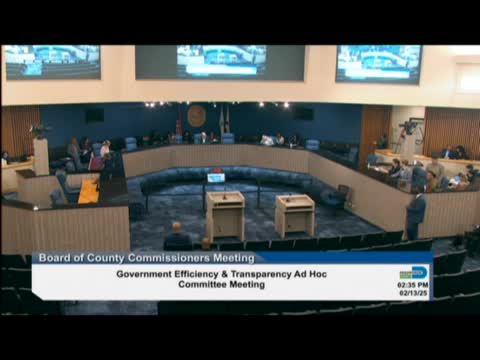
The newly formed Miami-Dade County Government Efficiency & Transparency (GATT) Committee used its first meeting to outline an agenda focused on department metrics, procurement speed and public input, and to ask administration teams to prepare presentations the committee said should go beyond "business as usual."
Chairman Bermudez opened the meeting by thanking the commission leadership for creating the panel and said the group would focus on "how we can be more efficient and effective," including soliciting ideas from residents through a proposed website where the public could submit suggestions.
Committee priorities and requests
Members said they want at least three to four departments to present at the next meeting and requested that presentations include measurable metrics and internal-process details rather than general accomplishments. Commissioner Rebeca Sosa Regalado suggested starting with departments that provide direct public services and cautioned against imposing identical performance metrics across departments.
Regalado advocated digitizing permitting systems and said streamlining would significantly reduce staff time and delay for residents and businesses. "It would be life changing for this county to do that," she said.
Commissioner Jeanette Cohen Higgins and others raised enterprise-fund distinctions: some entities (for example, the airport, water and sewer, the port) operate as enterprise funds, a status that can affect how procurement or fees are structured and how savings or costs are realized.
Administration and program context
Carla Denise Edwards, the county's chief administrative officer, said the administration supports the committee's goals and is working on elements of the mayor's WISE 305 plan that the committee can leverage, including red-tape reduction and procurement improvements. Edwards said administration teams have already automated processes in response to prior audits and stand ready to present concrete data and improvement plans.
Commissioner remarks on scope and next steps
Several commissioners emphasized the need to examine not only administration processes, but also the volume of ordinances, resolutions and policies the commission itself has passed over time that may create procedural "red tape." Commissioner Eileen Higgins (recorded as Commissioner Conells in the transcript) and others said part of the committee's work should be analyzing how the board's own directives affect administrative efficiency.
Commissioners also discussed IT and organizational design, noting past centralization of IT and procurement functions may not suit every department. "There are certain departments that could do their own procurement, like the airport, and that would probably be beneficial," Regalado said.
Ending and outlook
Committee members agreed to prioritize procurement, small-business development, Regulatory and Economic Resources (RER) permitting and a department listed in the transcript as "Durham" for initial presentations; they asked the administration to coordinate those briefings so the committee can examine metrics ahead of the county budget cycle. The chair said timelines will be important and indicated the committee will press for measurable follow-up and for collaboration, not confrontation, between commissioners and administration.