Get Full Government Meeting Transcripts, Videos, & Alerts Forever!
Get email alerts on the Procurement Audits topic
No spam. Unsubscribe anytime.
Committee amends procurement-audit resolution, raises minimum audits for vendor pools to three annually
Summary
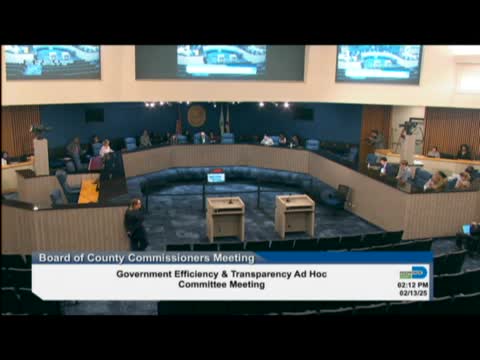
At a Miami-Dade County Government Efficiency & Transparency Committee meeting, commissioners approved sponsor amendments to a procurement-related resolution that increase the commission auditor's minimum reviews of vendor/prequalification pools and set a timeline for the first required status report.
MIAMI-DADE COUNTY
At a Miami-Dade County Government Efficiency & Transparency Committee meeting, commissioners approved sponsor amendments to a procurement-related resolution that increase the commission auditor's minimum reviews of vendor/prequalification pools and set a timeline for the first required status report.
The committee accepted an amendment from Commissioner Rebeca Sosa Regalado to item 2e clarifying that subsequent status reports called for in section 4 of the resolution "shall initially be provided within 365 days of the effective date of the resolution, and then every year thereafter." Regalado also moved an amendment to item 2f that changes the minimum number of commission-auditor reviews of prequalification pulls from "no less than 1 review per fiscal year" to "no less than 3 reviews per fiscal year," and that requires the commission auditor to disclose to the board within 30 days of the resolution how many reviews it can perform annually, with a floor of three.
The amendments were introduced during the agenda-setting portion of the meeting and carried forward with no recorded objection; the chair noted the record should reflect the setting-of-agenda approvals were unanimous by voice vote.
Why it matters
The changes increase formal oversight of the county's procurement pools, a mechanism county officials said speeds project delivery compared with repeated, standalone RFPs. Commissioners who sponsored the amendments said more frequent audits would strengthen accountability and guard against mistakes or weak record-keeping in smaller pools.
What commissioners and staff said
Commissioner Regalado explained staff recommended increasing the reviews after examining the number and variety of pools the county now maintains: "When I went through all the pools that we have and the ones that we've been adding, I think it's better to have more than just one." (Commissioner Rebeca Sosa Regalado)
Commissioner Jeanette Cohen Higgins questioned whether audits should be purely random or weighted by pool size, noting some pools are far larger than others and asking whether the sponsors were indifferent to that distinction. Cohen Higgins said she favored truly random audits because she has found smaller pools sometimes yield problems "because people don't pay as much attention to them." (Commissioner Jeanette Cohen Higgins)
Carla Denise Edwards, the county chief administrative officer representing Mayor Daniela Cava, asked that the administration be given the routine opportunity to provide a management-letter response when the commission auditor issues findings. Edwards described the usual audit process where the audited entity reviews draft observations and submits a management response.
Regalado and other sponsors declined to add a formal, binding management-letter requirement at this stage, saying the commission needs direct access to audit findings to carry out its oversight function. "The whole purpose of this is to have accountability that comes directly to the board," Regalado said.
Yinka, the county commission auditor, told the committee his office already provides notice of inquiry and shares observations with administration during the audit process. He said the recent office-supplies audit had expanded scope elements that lengthened the work, but that the pool audits will focus on procurement paperwork and should be quicker: "We find it feasible for us to complete the recommended amount of audits for those pools." (Yinka, Commission Auditor)
Outcome and next steps
The amendments to items 2e and 2f were accepted during agenda setting and moved forward by the committee to be considered at the appropriate future board meeting; the chair said the items would be placed on a subsequent Board of County Commissioners (BCC) agenda unless something urgent required an earlier appearance. Committee members indicated they expect the commission auditor to provide the disclosure required by the amendment within 30 days of the resolution's effective date and also debated setting timelines for administration responses in future versions of the policy.
Clarifying details
- Revision to item 2e: initial status report required within 365 days of the resolution's effective date, then annually thereafter.
- Revision to item 2f: commission auditor minimum reviews of pools increased from 1 per fiscal year to 3 per fiscal year.
- Additional language (as read in committee): within 30 days of the resolution, the commission auditor shall disclose to the board how many reviews it can perform on an annual basis, but in no event shall the commission auditor perform less than 3 reviews per fiscal year.
Speakers and attributions in this article are limited to those appearing in the meeting transcript; direct quotes are verbatim and attributed to the named speaker.
Ending
Committee members said they will continue to refine audit timelines and the interaction between the commission auditor and administration as the item proceeds to the full commission.