Get Full Government Meeting Transcripts, Videos, & Alerts Forever!
Get email alerts on the Israeli Palestinian Peace Activism topic
No spam. Unsubscribe anytime.
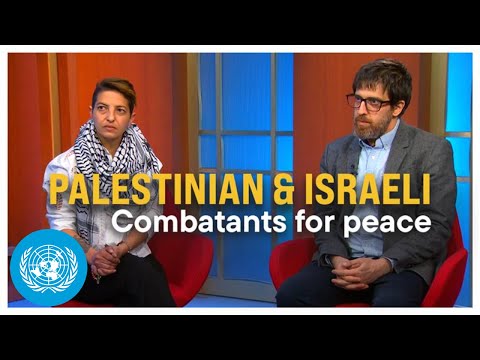
Combatants for Peace members tell UN they survived Oct. 7 and press nonviolent, shared future
Summary
At a UN News event in late January 2025, members of Combatants for Peace described how the group continued joint nonviolent work after the Oct. 7, 2023 attacks and the subsequent bombardment of Gaza, urged dialogue over violence, and said the movement offers a political horizon even as official politics largely ignore it.
NEW YORK — At a United Nations event in late January, members of the grassroots group Combatants for Peace said the movement survived the Oct. 7, 2023 attacks and the heavy military response that followed and continues to pursue nonviolent, joint Israeli–Palestinian work.
"We are together even though there might be disagreements, there might be conflicts," said Mai Shaheen, a Palestinian peace activist and therapist, describing long-running cooperation with Israelis in the group. Shaheen said Combatants for Peace met immediately after Oct. 7 and used established lines of communication to support one another and to continue outreach to their communities.
The group's continued existence matters because it represents a cross-community alternative to violence at a time when the region is marked by mass casualties and deep grievance. At the UN News studio, Shaheen and Alik Elhanan, a former Israeli special forces member who said he later refused to take part in military action, described years of joint nonviolent dialogue and mutual support that, they said, helped the organization survive past crises and the most recent escalation.
Elhanan, who described long personal ties with Palestinian members, said the movement's work produces shared grief as well as shared purpose. "The immediate result of our work is, how should I say, not less pain, but more pain because now we're grieving for two communities and fighting for two communities," he said.
Both speakers traced their commitments to long-term contact with members of the other community. Shaheen said meeting Israelis in nonviolent-communication trainings and hearing co‑founder Suleiman al Fatib's story helped shift her toward nonviolent resistance. Elhanan recounted meeting Palestinian students while he was a student in Paris and described a gradual political transformation away from violence.
The two said the movement includes members who have family in Gaza and Israel and that Combatants for Peace has been active since about 2005. Elhanan said he lost his sister in a Hamas suicide bombing in 1997 and credited Palestinian colleagues in the movement with providing space for his grief. Shaheen described family ties that cross the separation wall: "My daughter has the Israeli citizenship. I have the Palestinian citizenship. We are still separated by what is happening now." She also said the movement's original position was in line with PLO and past United Nations resolutions favoring a two-state outcome, but added that long experience working together has led some in the movement to consider a one‑land approach.
Asked whether mainstream politics listens, the guests said public, visible political support is limited. Shaheen cited a solidarity camp recently attended by some Knesset members, while Elhanan said most Israeli politicians who back them do so from the far left and that broader, open political support remains rare.
Both guests emphasized that Combatants for Peace does not present itself as a shadow government or a blueprint author: "We don't have a position paper on what should be the result," Elhanan said. He added that the path to any agreed solution must be through negotiation and a peace process rather than violence.
The session at UN headquarters was convened after several Combatants for Peace members were invited by the UN Office of Rule of Law and Security Institutions. The speakers said the group's long-term, grassroots nonviolent engagement offers, in their view, a continuing alternative to the cycles of violence now affecting both Israeli and Palestinian communities.