Get Full Government Meeting Transcripts, Videos, & Alerts Forever!
Get email alerts on the Racial Justice topic
No spam. Unsubscribe anytime.
Tulsa Human Rights Commission highlights DOJ report on 1921 race massacre, frames it as evidence of systemic racism
Summary
Members of the commission discussed a U.S. Justice Department review of the 1921 Tulsa Race Massacre and said the report’s findings — that the attack resembled a coordinated, military-style assault on Greenwood — underscore ongoing systemic racism and the importance of civic engagement and human-rights oversight.
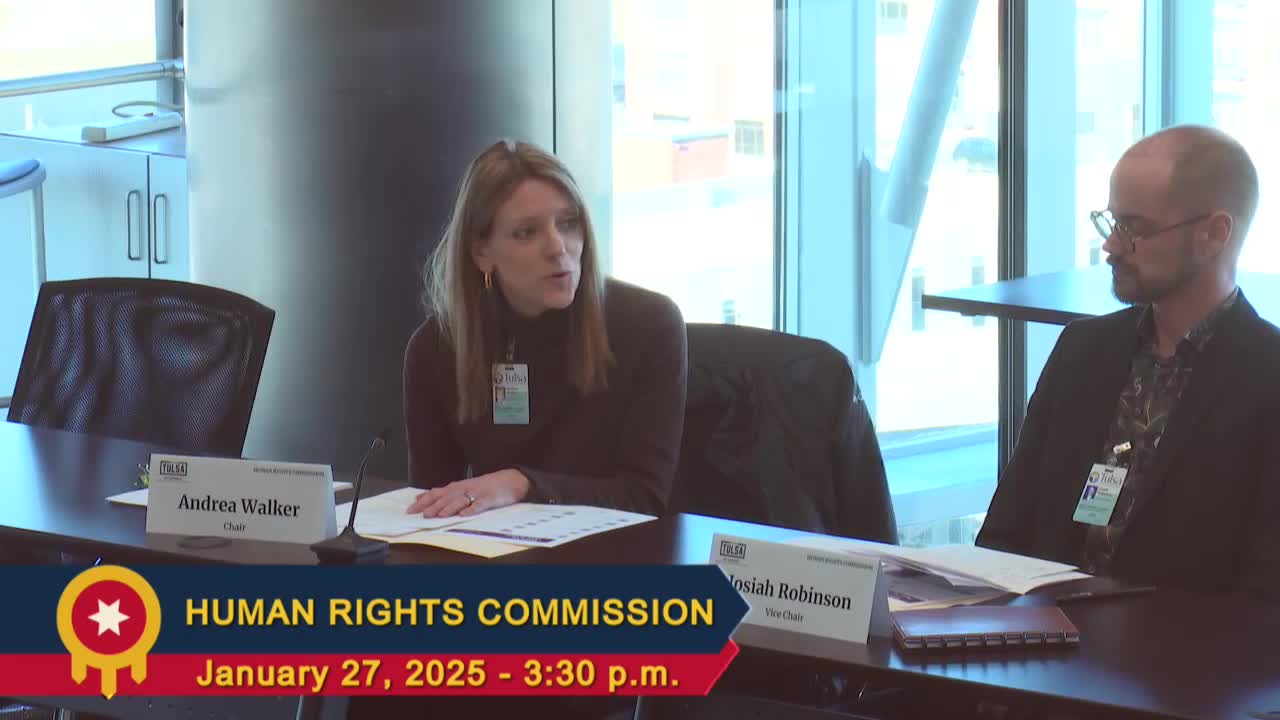
At the Jan. 2025 meeting of the Tulsa Human Rights Commission, commissioners discussed a recent U.S. Justice Department review of the 1921 Tulsa Race Massacre and said the report underscores systemic racism and the continuing need for historical reckoning and civic engagement.
A commissioner read from the Justice Department review attributed to Assistant Attorney General Kristen Clarke, saying the report "breaks that silence by rigorous examination and a full accounting of the darkest episodes of our nation's past" and that it concluded the massacre was not simply uncontrolled mob violence but "a coordinated military style attack on Greenwood." The speaker said the report describes a large-scale attack that included murder, arson and forced internment of survivors in camps.
Commissioners tied the report to present-day policy debates. The speaker said recent national and state actions — mentioned in the meeting as the revocation of an executive order from the Johnson administration (identified in the transcript as Executive Order 11246) and other state moves — indicate that debates over systemic bias and civil-rights protections continue to be politically contested. The speaker characterized systemic racism as "pervasively and deeply embedded in systems, laws, written and unwritten policies, and entrenched practices and beliefs" and said the DOJ review's findings support that assessment.
Commission materials included a recap of prior briefings to the commission on civic participation, turnout and other research, and commissioners said that the findings increase the urgency of civic-engagement work and human-rights education in the city. "There's never been a more important time for you to serve on the city of Tulsa's human rights mission," the speaker said later in the meeting, urging commissioners to consolidate lessons from recent briefings and pursue actionable steps to increase engagement.
The discussion was framed as policy and historical context; no formal motions or votes were recorded on the DOJ report during the meeting.