Get Full Government Meeting Transcripts, Videos, & Alerts Forever!
Get email alerts on the Education Literacy topic
No spam. Unsubscribe anytime.
Teach For America presenters urge Tulsa leaders to act on low third-grade literacy, cite 26% on grade level
Summary
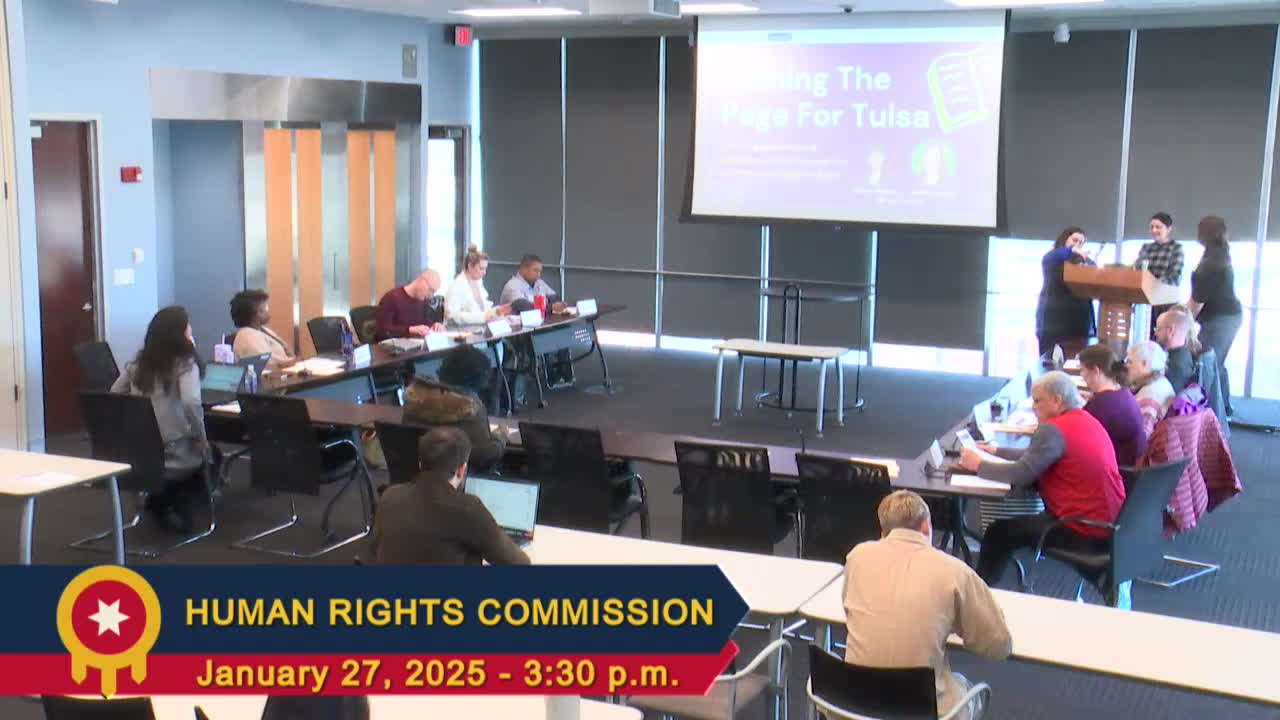
At the Jan. 2025 Tulsa Human Rights Commission meeting, Teach For America representatives and local partners warned that only about 26% of Tulsa County third-graders were reading on grade level at the end of 2023 and urged volunteer mobilization, better implementation of state literacy policies and community action to support reading.
At the Jan. 2025 meeting of the Tulsa Human Rights Commission, Teach For America officials and local partners urged commissioners and community leaders to treat third-grade literacy as a civic priority, saying only about 26% of Tulsa County third-graders were reading on grade level at the end of 2023.
The presenters said low literacy has broad implications for civic engagement, public safety and economic mobility and urged action at the community level. "I have a bit of a fear that we have become numb as a community to the status quo," said Amber Masters, vice president of leadership partnerships at Teach For America.
Masters and Human Rights Commissioner Crystal Tyler-Bar (identified in the meeting as a commissioner and managing director of alumni and impact for Teach For America) described research showing that when research-based approaches are used, about 95% of students can reach grade-level reading. They said Oklahoma has enacted most recommended state policies but that implementation lags: presenters cited an analysis showing Oklahoma had 17 of 18 nationally recommended policies on the books yet only about 11 of those 18 were being implemented with fidelity.
Presenters named specific gaps and local opportunities. They said the missing policy example is an assessment for teachers that measures the science of reading practices; current general teacher licensure tests such as the Praxis do not test those evidence-based reading practices, the presenters said. They also cited the recent Strong Leaders Act as progress on state policy.
The meeting included concrete asks: volunteer to tutor with Reading Partners (identified in the meeting as having roughly 250 volunteer vacancies), serve as a substitute teacher, incorporate literacy activities into existing community events, and advocate for school-based staff and resources. "It's 1 hour a week," Masters said of the volunteer tutoring model described by Reading Partners staff, adding that curriculum, students and teacher support are in place.
Presenters supplied resources for commissioners and community members to share: the documentary Right to Read (produced by LeVar Burton) and the podcast Sold a Story were suggested as accessible ways to explain the evidence base. They also urged commissioners to view literacy as connected to other priorities — absenteeism, student belonging, safety — and to use a root-cause lens when developing programs.
The presentation closed with an offer of partnership from Teach For America staff and local partners and a request that commission members and their networks consider short-term, low-barrier actions (volunteering, promoting resources, adding literacy components to events) alongside longer-term advocacy for implementation and funding.
No formal motions or votes were taken on the item during the meeting.