Get Full Government Meeting Transcripts, Videos, & Alerts Forever!
Get email alerts on the Office Of Inspector General topic
No spam. Unsubscribe anytime.
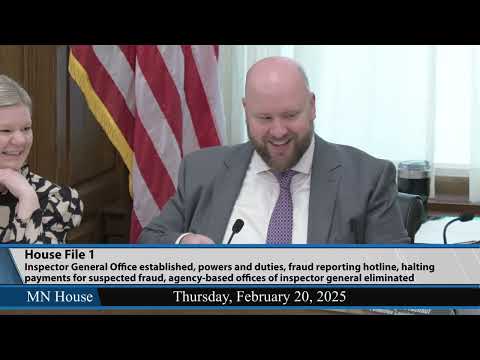
House committee advances bill to create statewide Office of Inspector General amid questions over federal funding and employee protections
Summary
The House Human Services Finance and Policy Committee adopted a DE2 amendment and re‑referred House File 1, a bill that would create a statewide Office of Inspector General to investigate waste, fraud and abuse, after extended debate over potential effects on federal Medicaid funding and employee protections.
The House Human Services Finance and Policy Committee on Feb. 24 considered House File 1, a bill authored by Representative Patty Anderson that would establish a statewide Office of Inspector General (OIG) in the legislative branch to investigate waste, fraud and abuse in state programs. The committee adopted a DE2 amendment and, after debate and a roll-call, re‑referred the bill to the Committee on Education Finance (9 ayes, 8 nays).
Representative Patty Anderson, the bill's author, told the committee: “This is the bill that creates the Office of Inspector General,” and said the proposal is intended to “mimic the office of the Legislative Auditor” while adding an investigative capacity focused on grant and program integrity. Anderson said the draft has been revised multiple times in conversations with all four caucuses and the Senate and that the aim is to stop large-scale fraud and direct program dollars to eligible Minnesotans.
The bill prompted sustained questions about three main issues: (1) whether moving investigative functions into a legislative OIG would jeopardize federal funding tied to program integrity work, especially Medicaid; (2) whether positions in the new OIG should remain in the classified civil service or be unclassified (and thereby lose certain collective-bargaining protections); and (3) operational details such as data sharing, the scope and frequency of unannounced site visits, and how embedded OIG staff would interact with existing agency staff.
Devin Bruce, director of legislative and political affairs for the Minnesota Association of Professional Employees (MAPE), opposed parts of the DE2 on employee-protection grounds. Bruce told the committee the amendment “strips OIG employees of their classified service designation and union protections” and warned the change could make staff more vulnerable to political replacement. He also cautioned that consolidating investigative functions could “functionally impair the state oversight” of programs — particularly Medicaid — if federal authorizations and interagency responsibilities are not preserved.
Department of Human Services (DHS) officials also raised concerns. Elise Bailey, DHS budget director, told the committee that DHS, as the state’s Medicaid agency, has federal program-integrity responsibilities and that if staff performing those duties were moved out of the agency the state could lose an associated federal administrative match: “if some of our staff were to move to another agency…we also pull down a 32% federal match for all of our admin,” Bailey said, adding that losing that match would increase the state's net cost.
Representative Revson Hicks and others pressed that point repeatedly, saying federal rules require certain oversight to be embedded in the state Medicaid agency and that moving investigative authority could jeopardize the federal 75%/25% funding structure for the Medicaid Fraud Control Unit (MFCU) and other matches. Anderson replied that the bill envisions embedded OIG staff in agencies who would answer to the statewide OIG while operational duties that “don’t rise to the level” of statewide OIG investigation could remain in agencies.
On employee classification, Representative Frederick offered an amendment (A7) to keep new OIG employees classified; Anderson said the intent was to mirror the Legislative Auditor’s office and that many staff there are in the commissioner's plan. The committee rejected A7 in a voice vote. MAPE and others warned that declassification could remove merit‑based hiring and just‑cause protections for investigators.
Committee members also pressed for detail on the practical workload the bill would create. Director Bailey said DHS currently manages more than 1,500 grants over $50,000 and more than 1,000 grants over $250,000; she estimated the DE2 language could affect more than 2,500 grants a year and said that while DHS performs site visits now, many are scheduled rather than unannounced. Representative Keeler and others emphasized that an increase in unannounced monitoring visits would require added staffing and that the fiscal note should account for any new positions and for potential loss of the federal match if staff transfer out of DHS.
Representative Noor, Representative Knorr and others asked about data-sharing constraints and whether an OIG located in the legislative branch could reliably access federally restricted Medicaid data; Anderson said legal and drafting staff are continuing to refine data-practice and sharing language and that memoranda of understanding would likely be required for embedded staff.
Representative Noor also asked whether the bill would undercut recent grants-management reforms enacted by the Legislature; Anderson said the bill does not negate last session’s work but would allocate 1% of grant administrative fees to the OIG for oversight while leaving the remaining administrative fee authority with agencies.
After extended discussion and two unsuccessful amendment votes (A7 rejected; A9 rejected by roll call 8 ayes, 9 nays), the committee approved the DE2 amendment and then voted (roll call) 9–8 to re-refer House File 1 as amended to the Committee on Education Finance. Committee members asked that the authors and nonpartisan staff produce fiscal notes and further drafting on federal match, data practice, site-visit scope and the classification status of OIG staff before the bill progresses.
The committee record shows ongoing collaboration: Anderson said she and members of all caucuses and Senate authors would continue to meet to refine the bill’s language and fiscal impacts.
Votes at a glance: The DE2 amendment was adopted by voice vote; the A7 amendment (classification) was not adopted (voice vote); the A9 amendment (retaining DHS program integrity functions) was defeated on a roll call (8 ayes, 9 nays); House File 1 as amended was re‑referred to Education Finance on a roll call (9 ayes, 8 nays).
The committee’s action does not by itself enact policy; committee members repeatedly requested a fiscal note and further legal/drafting work to clarify federal funding impacts, data‑sharing limits and the precise staffing and operational model for the proposed OIG.