Get Full Government Meeting Transcripts, Videos, & Alerts Forever!
Get email alerts on the Utilities Billing topic
No spam. Unsubscribe anytime.
Upland council directs staff to explore placing unpaid residential utility charges on county tax roll
Summary
The Upland City Council voted unanimously to begin a process to consider placing unpaid residential utility charges on the San Bernardino County tax roll, after staff said state law and COVID-era policies left the city with roughly $2 million in uncollected utility revenue.
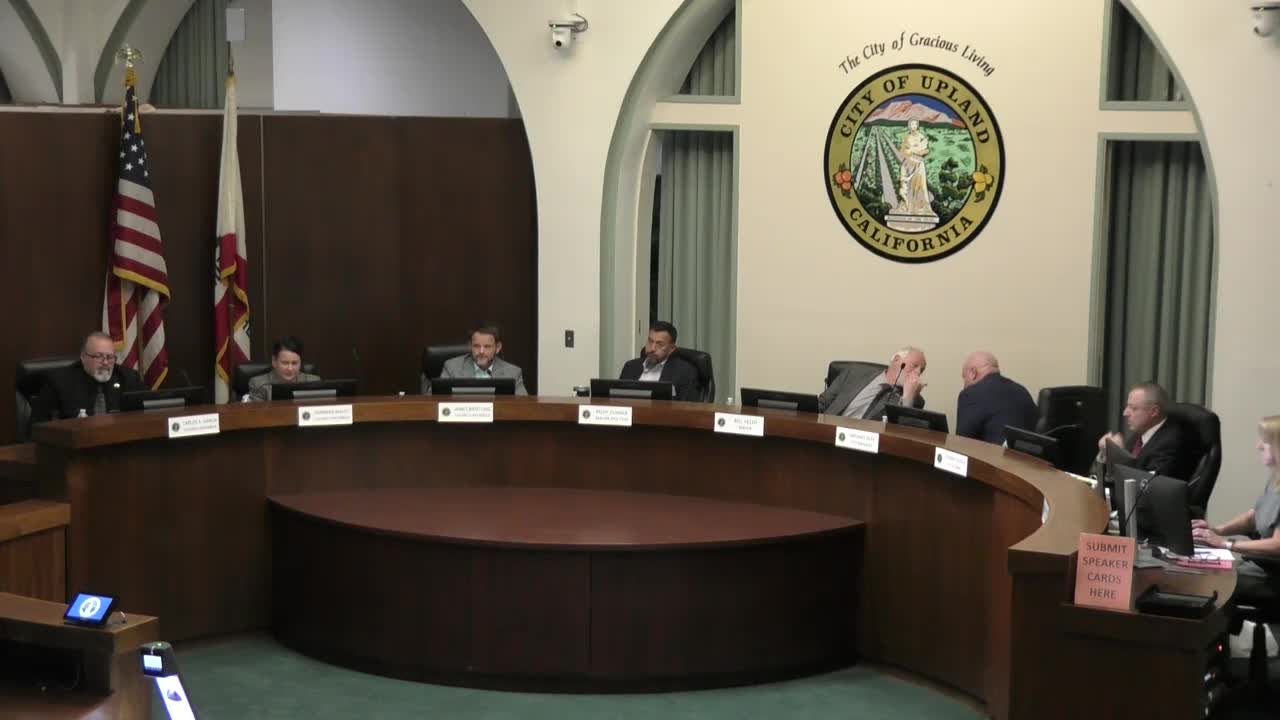
At its Feb. 10 meeting, the Upland City Council voted unanimously to authorize staff to begin the process of evaluating whether delinquent residential utility charges can be placed on the San Bernardino County property tax roll and to bring the matter to the Public Works Committee and a public hearing in May.
Public Works Director Chris Saloni told the council that state and pandemic-era actions reduced the city’s ability to use shutoffs and late fees to collect unpaid bills. “Back in 2018, Senate Bill 998 was signed into effect,” Saloni said. “That coupled with the COVID measures that Gavin Newsom introduced, which prohibited late fees from being billed to all of our customers, has created almost $2,000,000 worth of uncollected utility bills for services rendered.”
The motion approved by the council is exploratory: staff will analyze options and bring details to the Public Works Committee, with a public hearing planned for May. Saloni said the committee discussion is scheduled for April 8. The council also directed staff to use social media and other outreach channels to notify residents about upcoming committee and hearing dates; staff said a mailed notice would likely be prohibitively expensive.
Council members pressed for clarity about who would be affected and whether commercial accounts would be included. Saloni said the current proposal applies to residential accounts only, and that commercial collection methods differ: “For commercial the way that we go after them is through liens on the property,” he said. He said staff can explore applying the county tax-roll approach to commercial properties as part of the study but that the immediate proposal is residential-focused.
Council members also asked about the budgetary impacts. Saloni said unpaid utility revenue is currently borne by the city’s enterprise fund and that those funds are used for utility operations and rehabilitation projects; he noted that moving unpaid charges to the tax roll would change timing and collection mechanics. Saloni also explained that some utility costs — for example, payments to the Inland Empire Utilities Agency (IEUA) and waste vendors — are currently paid by the city even when individual customers do not pay their bills and that shifting collection to the tax roll could affect cash flow and accounting for those vendor payments.
Several council members and the city manager asked staff to analyze alternatives, including whether the city would subsidize uncollected revenue or pursue other collection methods, and to include potential effects on mortgage escrow and property owners’ impound accounts. Saloni described lawsuits to recover small balances as usually cost-prohibitive and said the staff analysis will compare options and trade-offs.
The council’s vote instructs staff to return with more detailed analysis to the Public Works Committee and to set a public hearing in May. The motion was moved and seconded and passed unanimously.
Next steps: staff will prepare the analysis for the April 8 Public Works Committee meeting and schedule a public hearing in May. The city indicated it will publicize meeting dates and material through social media and its usual channels.