Get Full Government Meeting Transcripts, Videos, & Alerts Forever!
Get email alerts on the Zoning Urban Village Downtown topic
No spam. Unsubscribe anytime.
Commission workshop reopens Urban Village Downtown zoning: setbacks, heights and multifamily options discussed
Summary
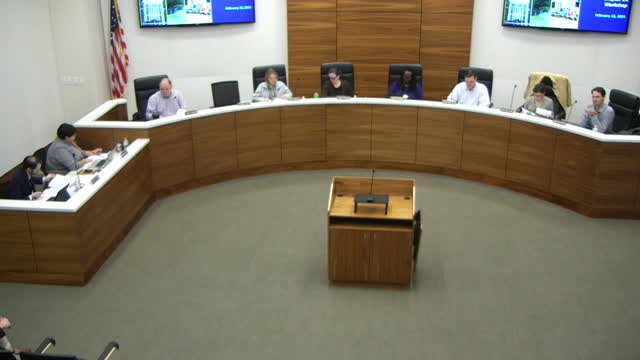
At a Feb. 13 workshop the planning commission and staff reviewed the Urban Village Downtown (UVD) zoning, revisiting a 2014 framework and debating options including a 10-foot setback, maximum heights and whether multifamily should be allowed by right or only via planned development.
The Bellaire Planning & Zoning Commission on Feb. 13 held a workshop focused on Chapter 24's Urban Village Downtown (UVD) district and possible code amendments, with staff outlining the history of the district and commissioners debating setback, height and multifamily provisions.
City planning staffer Gary Mitchell led the presentation, reviewing the UVD district's origins (adopted in 2014) and the policy background that aimed to spur reinvestment while protecting adjacent single-family neighborhoods. Mitchell summarized prior changes, including the removal of a minimum two-story requirement and adoption of a height-setback plane to limit impacts on homes that back on to commercial parcels.
Staff presented key issues under review: whether to require a minimum front setback (staff floated 10 feet as a starting point to allow greenery along streets), how to treat shallow parcels (many UVD properties are roughly 125 feet deep), the role of the district's height limits (the code includes a plan-development maximum cited as 79 feet while recent redevelopments such as the HEB site peak around 50 feet), parking expectations, and whether multifamily residential should remain permitted by right, capped, or allowed only through planned development (PD).
Mitchell reviewed the height-setback plane adopted previously: a 15-foot starting point on the nonresidential side with a stepping plane that increases the required rear setback as building height increases. The intent, he said, was to allow additional floor area on small lots while limiting privacy, shadow and noise impacts to adjacent single-family lots.
On setbacks, staff noted the trade-offs: reintroducing a minimum front setback (for example 10 feet) could add greenery but would reduce developable area on shallow parcels and could force more variance requests unless tailored exemptions or tiered standards for smaller lots are adopted.
On height, commissioners raised concern about the higher plan-development maximums in the code. Staff noted the pre-2010 zoning had potential for up to six stories through plan development; commissioners said buildings similar to the HEB redevelopment (about 50 feet at the highest point) were a useful benchmark and that a 79-foot cap would likely prompt public opposition.
Regarding multifamily, staff described the existing approach (multifamily permitted as part of mixed-use; a cap limiting multifamily to a percentage of district floor area; a density metric of roughly 30 units per acre was noted in discussion). Commissioners suggested options ranging from retaining multifamily with tighter limits, shifting multifamily to planned development only, or removing multifamily outright for the district. Several commissioners said they favored a planned-development route to give residents a public process on large mixed-use proposals.
Staff also described an option to treat properties on major corridors (Bissonnet, Bel Air Boulevard, South Rice) differently from interior parcels; one suggested approach is distance- or frontage-based subrules that allow different setbacks or drive-through allowances along busier streets.
Mitchell asked commissioners for direction; staff said it would draft specific amendment language for review, starting with the setback question. The commission and staff agreed to continue the UVD and Corridor Mixed Use discussions over additional meetings before forwarding recommendations to city council. Staff noted that separate Chapter 24 amendments recently approved by the commission will go to council for a public hearing on March 3.
No formal votes were taken in the workshop; the discussion was advisory as staff prepares draft code language for future action.