Get Full Government Meeting Transcripts, Videos, & Alerts Forever!
Get email alerts on the Ambulance Delays topic
No spam. Unsubscribe anytime.
EMS report: ambulance delays rising, hospitals and crews working on APOT fixes
Summary
Deputy Chief Simon Pang told the Fire Commission ambulances experienced frequent offload delays in January and outlined ongoing work with hospitals and partners to reduce ambulance patient offload time (APOT).
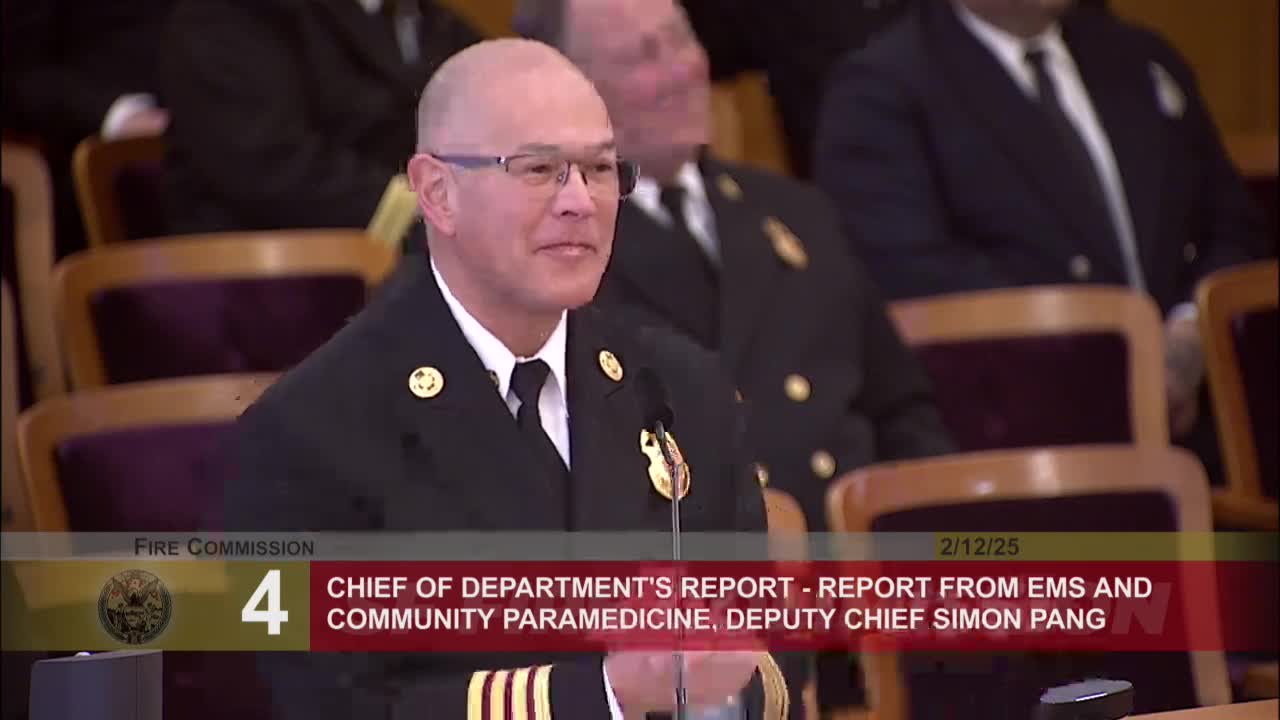
Deputy Chief Simon Pang reported to the San Francisco Fire Commission on Feb. 12 that ambulance patient offload time (APOT) and hospital delays are creating operational strain and reducing ambulance availability.
Pang said ambulance call volume was up and that the department’s ambulances handled more than 9,000 responses in January, giving the department roughly a 78% market share of ambulance dispatches. He said APOT problems in January included 1,366 delays between 45 minutes and one hour, 863 delays between 60 and 90 minutes, 146 delays up to two hours and 87 delays over two hours. “That's the equivalent of 8 ambulances per day,” Pang said of events where ambulances were delayed more than 45 minutes.
Pang described the local policy tools the department uses to respond to delays: an APOT extended delay report (which documents extreme delays for state review) and an APOT alert, which can be declared when delays leave five or fewer ambulances available systemwide and allows captains to redirect ambulances to less-congested hospitals after safety checks.
He said the department is seeking more streamlined triggers for APOT alerts and planned to work with the local emergency medical services authority (LEMSA) and the hospitals’ APOT working group to propose changes, including earlier thresholds for declaring an alert.
Pang highlighted clinical and operational changes: naloxone (Narcan) administration remains common with roughly 200 uses monthly, and the department added ketamine to its analgesic options in October for patients who cannot receive opioids. He said paramedics performed 135 “advanced skill” interventions in January, such as airway procedures and intraosseous access.
Pang also reported on community programs that aim to reduce 9-1-1 demand. Lifeline, a nonprofit started by department paramedics, visits senior housing to help ensure seniors’ medical histories are accessible to first responders. Community paramedicine and the street crisis response team reduced emergency-system use among frequent users and, in January, helped keep 55% of contacts in the community rather than transporting them to hospitals.
Pang described the new Sixth Street Triage Center’s soft launch (Feb. 7) and clarified it is not a supervised consumption site but a staffed place with restrooms, hygiene supplies and referrals; it was operating weekdays at the time of the report and the department is prepared to support it if it expands to 24/7 operations.
Commissioners asked for more detail on root causes of APOT delays and for continued reporting; Pang said hospital administrators have signaled willingness to work on solutions and that the department will continue monthly APOT working-group meetings and pursue policy changes with LEMSA.