Get Full Government Meeting Transcripts, Videos, & Alerts Forever!
Get email alerts on the Parking And Transportation topic
No spam. Unsubscribe anytime.
Consultant urges 'parking reset' for downtown Eau Claire: paid on-street pricing, parking department and benefits district recommended
Summary
A consultant's downtown parking study recommends on-street paid pricing, a parking department, a parking benefits district and operational changes to bring parking operations toward break-even; council scheduled a work session and public engagement ahead of any implementation.
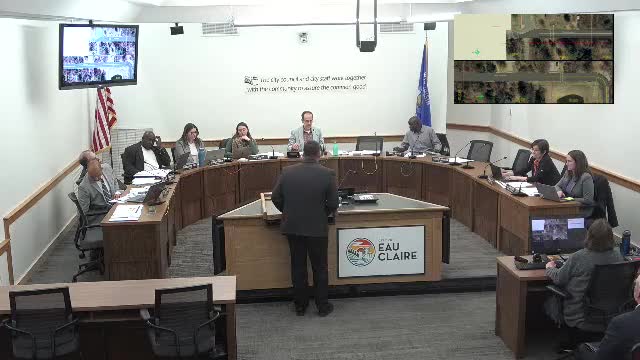
City officials and a consultant on Monday presented a draft downtown parking study that recommends a broad “parking reset” including on‑street paid pricing, a consolidated parking leadership role, and a parking benefits district to keep parking revenue in the downtown system.
Deputy City Manager David Solberg introduced consultant John Forster, who said the city’s current pricing sends customers to free visible on‑street spaces while under‑utilizing paid off‑street ramps. “What your pricing strategy has kind of led you to is people feeling there’s a parking problem even when there are unused ramp spaces,” Forster told the council.
Forster outlined a series of recommendations intended to increase on‑street availability, encourage employees to use off‑street ramps and stabilize parking finances: initiate on‑street paid parking (Forster suggested $1 per hour from 9 a.m. to 9 p.m., Monday through Saturday as a starting point), lower off‑street ramp rates to encourage use, make employee monthly permits meaningfully cheaper than on‑street pricing, implement regular rate adjustments for inflation and maintain clear monitoring of occupancy.
The consultant said parking revenues totaled roughly $800,000 in the most recent fiscal year while operating expenses exceed $1 million, producing an annual shortfall the city covers from the general fund. Forster said a successful reset could eliminate the operating deficit but that funding new structured parking remains a tougher challenge; he estimated replacement garages cost roughly $40,000–$50,000 per space.
Forster also recommended creating a single parking leader or department—whether in‑house or contracted—who would be accountable for parking policy, operations and long‑range planning; and establishing a parking benefits district so downtown parking revenues would stay in the district to fund operations, capital maintenance and—potentially—transportation alternatives.
Forster reported the city faces near‑term changes: two ramps (Riverside and Gibson) are expected to be demolished in the next five years, increasing the need to plan supply and service. He advised patience and a one‑year monitoring window after any major changes to allow data‑driven adjustments.
Council members asked whether removing parking minimums for development would affect the recommendations; Forster said eliminating minimums would not fundamentally alter the reset recommendations but would place greater responsibility on the city to provide adequate parking and to plan ahead.
On implementation questions, Forster encouraged a mix of mobile payments and a smaller number of kiosks for equity and public acceptance, noting many communities now process a majority of payments via mobile apps but that kiosks remain important for people without smartphones.
The study prompted multiple public comments. Diane Lueder, vice chair of the Downtown Neighborhood Association, asked the city to prioritize safety improvements on ramps, paths and parks, saying survey results had flagged safety as a central concern and warning that “safe parking areas are needed to support a vibrant downtown.”
Leaders from the Unitarian Universalist Congregation (Nate Otto and Susan Beadles) said an open surface lot at Gray and Farwell is used by several churches and community organizations for larger services and events; they urged the city to preserve weekend access and noted mobility and accessibility concerns for elderly and disability‑limited attendees. Forster said his draft recommendations suggested keeping Sundays free.
Business owner and downtown parking committee member Julia Johnson said she supported studying paid parking but urged caution on the geographic boundary for paid on‑street parking, arguing the proposed paid zone feels too large and could remove a practical, free walking option for some customers and part‑time employees.
Deputy City Manager Solberg and Forster said the study is at the draft stage; council scheduled a short work session following Monday’s meeting and will consider accepting a final study at a meeting two weeks later. Forster and staff told council any move to paid parking would follow additional public engagement and further analysis before implementation.
No formal council action was taken at the presentation; the consultant and staff will return with a final study and implementation recommendations.