Get AI Briefings, Transcripts & Alerts on Local & National Government Meetings — Forever.
Eau Claire council hears public input on six alley improvement projects
Loading...
Summary
Engineering staff presented six alley reconstruction projects proposed in the 2025 CIP, describing utility replacements, typical cross sections and outreach; one nearby resident objected to being assessed because she does not use the alley.
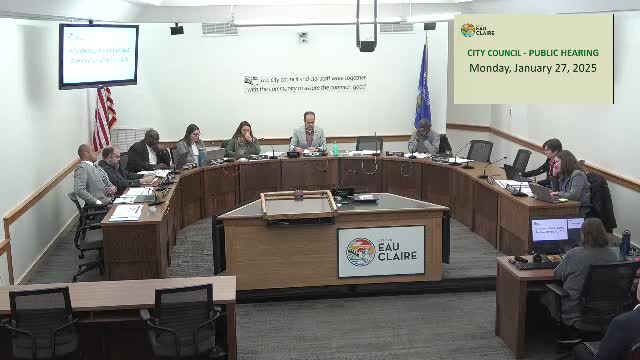
The Eau Claire City Council on Monday received public comment and staff presentations on six alley improvement projects proposed in the city’s 2025 Capital Improvement Program.
Engineering Director Lea Ness told the council the projects were selected primarily from the pavement index, alley use and an effort to balance projects across neighborhoods. Each alley project would include grading, gravel base to improve drainage and a 2-inch-thick asphalt surface 12 feet wide; restoration of adjacent boulevard or lawn is included, and four of the six alleys also include utility work.
Ness said the alley east of Bellinger Street from Cameron to Maxon, in the Cannery District, has six abutting properties and will include replacement of sanitary sewer and water main and services, noting those utilities date to the early 1900s. The alley east of Bellinger from Maxon to Platt has 14 abutting properties and similar utility replacement. An alley south of Claremont Avenue (Patton Street to East Lexington Boulevard) in the Putnam Heights neighborhood has eight primarily commercial abutting properties and will address sanitary sewer, water and storm sewer that were installed around the 1950s; staff told the council businesses would be contacted about access during construction and that this location will take longer—roughly four weeks—because of utility work.
Other alleys proposed are: south of Cleveland Street (Shawtown neighborhood, seven abutting properties, no utilities), south of Cedar Street (Upper West Side, 18 abutting properties, no utilities noted) and an alley west of Ninth Avenue in the Randall Park historic neighborhood (seven abutting properties, no utilities). Ness said affected property owners received mailed notices and that the projects are not petition-driven but come from the CIP prioritization.
During public comment, Jean Miller, who identified herself as a resident at 915 Cedar Street, said her property does not access the alley behind her lot and that she does not use the alley. “I cannot see why I should have to pay for it. I don’t use it,” Miller told the council, adding that her garbage is picked up at the front of her house and she lacks access to the alley.
Ness said the department recorded one recent inquiry for the Cedar Street alley and described typical pavement section details; she said a 6-inch base with a 2-inch asphaltic surface was proposed to withstand trash-haul operations where trash trucks use the alley.
There were no council motions or votes on the projects during the hearing; the presentation was intended to allow staff to proceed to detailed design and later bidding. Ness told the council that the alley projects will be combined into a bid package separate from the city’s street projects.
Staff said final cost details and assessment information are in the engineer’s reports included with the council packet and that assessments and final schedules would be mailed to affected property owners as the projects move to design and construction.
If the council proceeds after design, construction timing and assessment notices will follow the city’s standard CIP and assessment processes.