Get Full Government Meeting Transcripts, Videos, & Alerts Forever!
Get email alerts on the Equestrian Preserve Guiding Principles topic
No spam. Unsubscribe anytime.
Wellington EPC narrows draft guiding principles, prioritizes land preservation and bridle-trail safety and defers formal definition of “equestrian lifestyle”
Summary
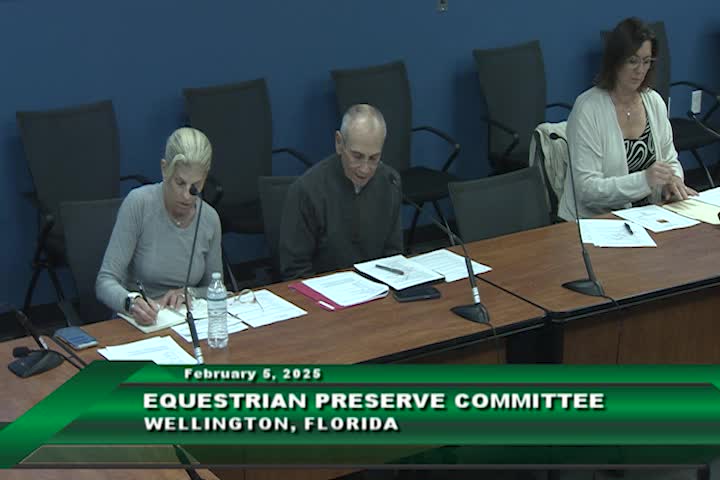
The Equestrian Preserve Committee on Feb. 5 advanced a revised draft of guiding principles focused on preserving equestrian land, improving safety where horses meet traffic, and building infrastructure to support Wellington’s equestrian community while postponing a formal definition of “equestrian lifestyle.”
The Equestrian Preserve Committee on Feb. 5 advanced a revised draft of guiding principles focused on preserving equestrian land, improving safety where horses meet traffic, and building infrastructure to support Wellington’s equestrian community while postponing a formal definition of “equestrian lifestyle.”
Committee members said the document is meant as guidance the Village Council can use when proposals touch the Equestrian Overlay zoning district, not as a regulatory code. "The intent here was...they've asked us to give them guidance so that as anything equestrian related within all of Wellington comes before them," the committee chair said during the meeting.
That context guided most of the evening’s discussion: participants moved language that places preservation of equestrian land and the bridle‑trail network at the top of priorities; clarified that minimum lot sizes in the Land Development Regulations (LDRs) should be enforced (2, 5 and 10 acre minimums are cited in the LDRs); and sought language that would discourage dense residential or country‑club style development inside the Equestrian Overlay.
Committee members and staff debated how directive the guidance should be. Jonathan, a staff member who prepared the draft, told the group that the committee’s wording would not, by itself, create binding legal definitions: "This will not be a binding definition by any means. This is the Equestrian Preserve Committee's definition of the equestrian lifestyle." He also urged that if the committee did not want the phrase retained, they should remove it: "If it's not your will or desire to define the equestrian lifestyle, then remove it." The committee chose to defer adopting a formal definition and to bring the item back as a separate agenda topic at a future meeting.
On land‑use specifics, members said the guiding principles should explicitly call for enforcement of the LDR‑stated minimum lot sizes for each subarea of the Equestrian Overlay, and they discussed adding language to discourage aggregation of parcels to create higher‑density development. Committee members suggested sample wording to prohibit "dense residential development, such as cluster housing and country clubs," with enforcement of the applicable LDR minimum lot sizes called out as a separate implementation point.
Safety and public interactions with horses were elevated in the draft. The committee recommended that the Village Council and staff pursue measures to make roads safer where horses and vehicles meet: examples discussed included stronger signage, road‑crossing signals where appropriate, clearer enforcement of the state law requiring drivers to yield to horses and targeted public education. Members also urged stronger enforcement of prohibitions on motorized vehicles where a path is designated as a bridle trail and asked staff to examine whether bicycles should be excluded from some horse trails because of safety concerns.
Infrastructure items the committee prioritized included maintaining and upgrading the bridle‑trail network (appropriate footing, drainage, fencing and signage), planning for trailer‑friendly road and parking designs, and encouraging viable manure removal and disposal services. Committee members noted county‑level constraints for some items but asked staff to explore cooperative procurement or other options that could lower construction and equipment costs. The committee was told that an earlier set of crossings proposals came back as expensive (a contractors’ package that was previously reviewed had a low bid near $600,000 for a full set of beaconed crossings, while individual signal units had been quoted at about $15,000–$20,000 apiece); staff said they would pursue alternative procurement routes and phased installations.
Members also discussed supporting housing and local services for stable employees and grooms as part of sustaining Wellington’s equestrian economy, and they asked that the committee include advice on preserving major equestrian venues and encouraging the village brand as a destination for multiple equestrian disciplines (show jumping, hunters, polo, western and others).
The committee directed staff to reformat and circulate the working draft, to seek lower‑cost procurement options for trail crossings and signage, and to invite manure‑haul vendors to a future meeting for discussion of operational constraints. The group did not take a formal policy vote on the guiding principles; it did unanimously approve the meeting minutes at the start of the session.
The committee set two items for the next meeting: finishing the guiding principles draft and returning to the separate issue of defining "equestrian lifestyle." Staff also said it will bring an update on several crossing installations as parts and vendors become available.
The meeting concluded after members agreed to continue editing the draft and to circulate a revised version to commissioners and staff for additional comment before a planned follow‑up workshop.