Get Full Government Meeting Transcripts, Videos, & Alerts Forever!
Get email alerts on the Military Licensure Portability topic
No spam. Unsubscribe anytime.
Panel advances expedited licensure bill for military members and spouses; committee adds experience-based reciprocity option
Summary
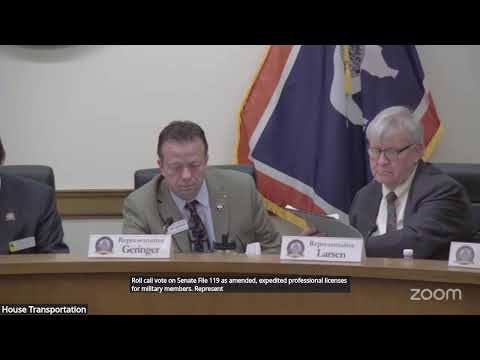
The committee advanced Senate File 119 to expedite licensure for active-duty military, recently separated service members and military spouses and approved a committee amendment allowing an experience-based reciprocity pathway for applicants who document five years of substantially similar practice in other jurisdictions.
Senate File 119, a bill to consolidate and expand expedited professional licensure for active-duty service members, military spouses and recently separated veterans, was presented, amended and advanced by the Transportation, Highways & Military Affairs Committee.
Sponsor Senator Bonner said the measure consolidates prior military licensure provisions, clarifies covered categories (including uniformed services beyond the armed forces) and implements a 30-day federal timeframe for issuing a license or temporary permit when an applicant holds a current license in another jurisdiction. The sponsor said the aim is to reduce uneven application of previous law and expedite licensure for service members and spouses who relocate for military orders.
Multiple witnesses and stakeholders testified in support. Chris Smith of the Wyoming Military Department said the bill extends prior reforms (2017 and 2021) and that the department supports the bill. Connor Norris, director of labor policy at the Regulatory Research Center (West Virginia University), cited research showing licensing recognition laws increase employment for military spouses. Mark Kilman Burnham of Global Medical Response supported the bill and suggested administrative efficiencies to reduce vendor costs for application processing.
Mayor Patrick Collins of Cheyenne said military families face protracted licensing delays that hinder spouse employment and that federal law (the relevant 2025 NDAA provision) requires states to issue licenses within 30 days for qualifying applicants. Katie Brown, a licensed professional counselor and military spouse who testified, described repeated relocations and contrasted Wyoming’s process with Florida’s faster, fully online reciprocity approach; she told the committee she submitted a complete application in late 2024 but remained without a Wyoming license because verifications from third parties were outstanding.
Joanne Reed, administrator for the professional licensing service referenced by several boards, explained practical limits: a small number of boards require fingerprint-based background checks, and boards have sometimes paused rule revisions while awaiting legislative action. Reed noted boards can issue temporary permits now (the statute uses permissive "may" language) but lack written rules and consistent processes to do so statewide.
Representative Nicholas offered a committee amendment that the committee adopted: a completed application can be satisfied by documentation showing five years of substantially similar consecutive practice in other jurisdictions (an experience-based reciprocity pathway). The committee debated but did not adopt an amendment to shorten a separate two-year recency requirement to one year. The committee also approved a motion to make the bill effective immediately. After amendments the committee voted to advance the bill to the floor; the roll call recorded nine affirmative votes.
Committee members pressed for clarity on boards’ ability to issue temporary permits, fingerprint-background-check timing and how military medical training maps to civilian credentialing. Witnesses and staff said the bill does not change substantive licensing standards; it prioritizes application processing and creates specified timelines for eligible applicants, while leaving boards responsible for confirming qualifications and imposing discipline if later warranted.
—
Sponsor: Senator Bonner. Supporters included the Wyoming Military Department (Chris Smith), the Wyoming Military Department and Wyoming Veterans Commission, the Wyoming School Boards Association (where relevant), municipal leaders (Mayor Patrick Collins) and multiple health-care and EMS representatives. Committee adopted an experience-based reciprocity amendment (five years) and moved the bill to the floor with nine affirmative votes.