Get Full Government Meeting Transcripts, Videos, & Alerts Forever!
Get email alerts on the School Fund Investments topic
No spam. Unsubscribe anytime.
SITFO officials tell subcommittee Amendment B will raise school-fund distributions; no new agency funding sought
Summary
Officials from the School and Institutional Trust Fund Office briefed the Public Education Subcommittee on Jan. 24 on portfolio size, governance and how Amendment B (2024) raises the annual distribution cap from 4% to 5%. SIPFO officials said they are not requesting additional state funding this year.
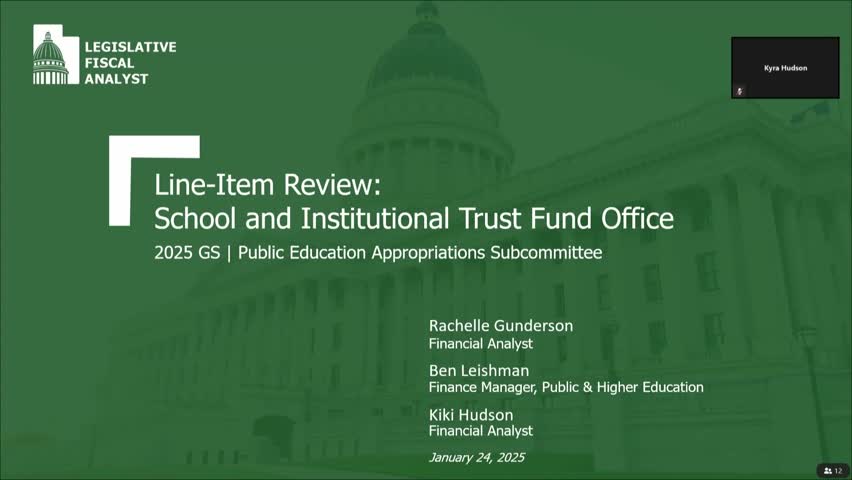
Rochelle Gunderson, a fiscal analyst with the Legislative Fiscal Analyst’s office, introduced a staff budget review of the School and Institutional Trust Fund Office on Jan. 24, 2025, during a Public Education Subcommittee meeting at the Utah State Capitol.
The School and Institutional Trust Fund Office (SITFO) manages roughly $3.8 billion in assets across 11 trusts and invests earnings from land revenues contributed by the School and Institutional Trust Land Administration (SITLA). Peter Madsen, director and chief investment officer for SITFO, told the subcommittee the school fund represents about 95% of the office’s assets and that distributions now approach the low hundreds of millions of dollars annually.
The discussion centered on the effect of Amendment B, approved by voters in November 2024, which raised the statutory cap on annual distributions from 4% to 5%. Ryan Kulig, finance and operations officer for SITFO, thanked legislators for the amendment and said the office has “coined” the term intergenerational equity to describe the change: raising the cap to smooth distributions across current and future beneficiaries. Kulig said the new distribution amount will be calculated as of June 30, 2025, and noted the school fund’s increased distribution will be reflected in the 2026–27 school year. He told the committee, “If Amendment B were in place this fiscal year, the school fund would have received an additional $14,000,000 in distributions.”
Madsen and Kulig described SITFO’s governance and risk posture. Madsen said trustees are chosen for investment expertise and that the state treasurer serves as chair of the board of trustees. He stressed the distinction between corpus (contributions from SITLA) and earnings, noting corpus cannot be spent and that the corpus/earnings structure constrains how much investment risk the office can accept. “Every dollar that’s contributed to the trust goes into what’s called the corpus,” Madsen said, adding that changing that approach would require a constitutional amendment.
SITFO’s presentation included staff and expense information: the office currently budgets for about 13 full-time positions and uses third-party managers and service providers for parts of portfolio implementation. The largest operating expense is personnel. Madsen said SITFO has set performance measures that track portfolio returns, distributions to beneficiaries, staff retention and development.
Gunderson closed the staff review by reiterating the LFA’s presentation of SITFO’s historical funding and recent line-item changes. SITFO officials told the committee the agency is not seeking additional appropriations in this budget cycle and said the office has sufficient resources to operate under current assumptions. Committee members asked about near-term risks, and Madsen said the main challenge is managing volatility within the constraints of the corpus/earnings distribution framework.
No formal committee action was taken on the SITFO presentation; SITFO staff answered committee questions and left the committee to continue its agenda.