Get Full Government Meeting Transcripts, Videos, & Alerts Forever!
Get email alerts on the Land Use Development topic
No spam. Unsubscribe anytime.
Lakeville boards weigh open‑space zoning to block 40B buildout on Rocky Woods parcel
Summary
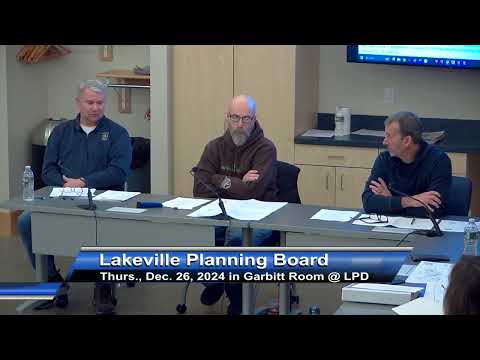
The Town of Lakeville Planning Board and several town commissions on Dec. 26 discussed a developer proposal to pursue an Open Space Residential Development (OSRD) zoning change for the roughly 300‑acre Rocky Woods parcel as an alternative to a Chapter 40B comprehensive permit.
The Town of Lakeville Planning Board and several town commissions on Dec. 26 discussed a developer proposal to pursue an Open Space Residential Development (OSRD) zoning change for the roughly 300‑acre Rocky Woods parcel as an alternative to a Chapter 40B comprehensive permit. Planning Board Chair Michelle McEachern said the developer has “decided to put it on hold until after spring 2025 town meeting” and would pursue OSRD only if voters approve the bylaw.
The proposal as presented would allow up to about 204 (the developer later referenced 214) housing units on approximately 308 acres, including about 36 single‑family lots and 68 duplexes targeted for 55+ residents. Under the developer’s concept, single‑family lots would be no smaller than 15,000 square feet, the plan would add a third access on County Street, and a wastewater treatment plant would serve parts of the project. The developer also indicated willingness to phase build‑out and to enter a development agreement with the town before town meeting.
Why it matters: the parcel is large and includes wetlands, upland outcrops and sites the Narragansett tribal representative and conservation members said have cultural and ecological value. The boards and residents framed the choice as: accept a locally governed OSRD and try to negotiate protections and a development agreement, or allow the developer to resume the Chapter 40B process, which can preempt local bylaws and would be decided by the Zoning Board of Appeals and state review.
Discussion highlights
• Planning and process: McEachern (Planning Board) told the group the developer would only pursue OSRD if the town adopted a bylaw specific to Rocky Woods and voters approved it at spring town meeting. She said the town would need a development agreement and bylaw language in place before the warrant closes. Several board members and the town administrator said the Planning Board would continue the conversation at its Jan. 9 meeting and asked other boards to provide written comments.
• Unit counts and comparisons: Participants compared the OSRD concept to a previously submitted Chapter 40B plan. The 40B filing earlier described about 200 units on an 85‑acre portion; the OSRD concept spreads development across roughly 308 acres and increases the projected unit count to about 204–214. Multiple speakers questioned why the OSRD plan would allow more units than the 40B alternative.
• Wastewater, water supply and health: Chris Spratt (Board of Health) and other Board of Health members said their primary concerns were accurate perk (percolation) testing for each lot, nitrogen loading and whether duplexes would connect to the proposed wastewater treatment plant or use individual septic systems. Spratt said the board had raised that it did not want lots to be “credited” for areas that are not developable (ledge, wetlands) when computing the number of buildable lots. Board of Health members also requested that the community wastewater facility be located farther from nearby homes to reduce odor complaints; a preliminary figure of roughly 49,000 gallons per day for a treatment system appeared in materials and drew concern about setbacks from residences.
• Conservation and ecological concerns: Nancy Yates (Conservation Commission) and Open Space Chair David Zolonis said conservation reviewers had only examined the earlier 40B plan in detail and had not yet performed a full delineation for the broader OSRD concept. Zolonis and others urged the planning board to require current, site‑specific topographic, wetland and habitat overlays before completing any bylaw language. Conservation members said fragmented “pocket” open space is less protective ecologically than larger contiguous blocks.
• Tribal and cultural resources: Cora (identified in the record as a Tribal Historic Preservation officer for the Narragansett Indian Tribe) urged the town to overlay known tribal sites, ledge outcrops and caves on any plan and said both the 40B and OSRD concepts threatened intact ecosystems and cultural sites. She recommended involving federal agencies (EPA, HUD) if federally regulated resources or subsidized housing components require review.
• Access, phasing and Lot 1 commercial possibility: The OSRD concept adds a third access point on County Street, which residents said may be delayed to later phases. The developer identified a roughly 10‑acre parcel (Lot 1) it owns near County Street that it may seek to rezone commercial in the future but said it would include a commitment not to pursue 40B on that lot if a commercial rezoning failed.
Public comment
Several residents spoke during public comment. Mary Jean Libertore of 32 Freetown Street said she was torn between wanting conservation and fearing that rejecting OSRD would simply return the town to the 40B process; she said, “I don't want any of it happening,” and asked for clearer, earlier communication to residents about options and likely impacts. Other residents raised concerns about blasting for ledge removal, potential effects on private wells, endangered species and the currency of ecological data used in earlier plans.
Decisions, next steps and outstanding information
The boards did not adopt a bylaw or take a formal vote on the OSRD concept. The Planning Board agreed to continue the conversation at its Jan. 9 meeting and requested written comments from Conservation, Open Space and Board of Health. Officials said they will seek (1) up‑to‑date topographic and wetland delineation maps, (2) lot‑level percolation/perk testing where proposed, (3) details on the wastewater treatment plant siting and capacity, and (4) clarification whether the developer will accept phased build‑out commitments and specific deed restrictions for 55+ units. McEachern told the meeting that the developer has “put [the 40B filing] on hold while we work out this.”
What was not decided: no bylaw language, no development agreement, no formal town‑meeting warrant article and no final determination of whether the town should move forward with drafting an OSRD bylaw for Rocky Woods. Several boards plan to provide memos or hold follow‑up meetings and the Planning Board will reconvene the topic on Jan. 9.
Votes at the meeting
The only recorded formal action in the transcript was the routine motion to adjourn, which passed by voice vote.
(End)