Get Full Government Meeting Transcripts, Videos, & Alerts Forever!
Get email alerts on the Economic Development Loans topic
No spam. Unsubscribe anytime.
Board reviews Opportunity Fund economic development loan program: loans prioritized, grants capped at 25%
Summary
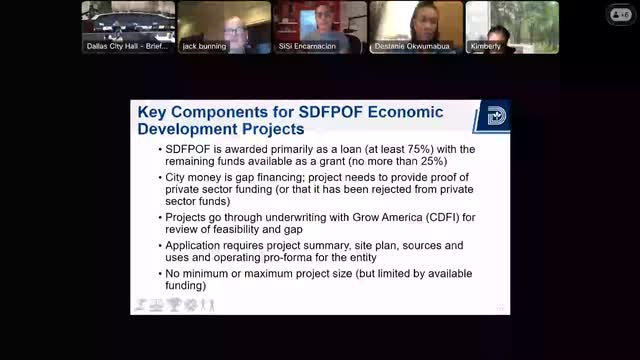
Staff described the Fund’s economic development loan program: at least 75% of city awards must be structured as loans (repayable and recycled), up to 25% may be grants; funds act as gap financing and underwriting is performed by a CDFI. Administrative approval thresholds depend on location within target areas.
At the Feb. 24 meeting the South Dallas Fair Park Opportunity Fund Board received a detailed presentation on the fund’s economic development program from Office of Economic Development staff. Staff said the fund is intended primarily to support economic development through repayable loans that return capital to the fund; up to 25% of an award may be provided as a grant where warranted.
Staff said city funding is intended as gap financing: applicants must demonstrate other project financing or that they attempted to obtain it from commercial lenders. Projects go through underwriting by Grow America (a community development financial institution contracted to perform third-party underwriting for the department) to assess feasibility and repayment capacity. Staff said project applicants will be asked for a project summary, site plan, renderings, a sources-and-uses statement and a five- to seven-year operating pro forma.
There is no stated minimum or maximum project size in the program statement, staff said, but projects will be limited by available fund balance and the most appropriate city programs; very large projects may be better served by other economic development tools. Staff said loans are typically funded in advance and grants are paid on a performance basis after work is completed. The department does not generally underwrite or fund the purchase of property as an eligible project cost; property may count as owner equity but purchase itself is not an eligible cost for loan underwriting.
Staff described a separate city predevelopment loan program that provides 0% interest loans to MWBE and community developers on a 12-month term; that program serves predevelopment needs and is distinct from the Opportunity Fund’s construction and finish-out focus. Board members asked whether applicants can apply to both programs; staff confirmed applicants may pursue both programs where appropriate.
On approvals and process, staff said economic development applications are accepted on a rolling basis. After a completeness review and underwriting, staff prepares an offer letter; smaller awards in designated target areas can be processed via administrative action rather than full city council consideration. Staff showed a map distinguishing the Opportunity Fund’s green service area and the city’s blue target areas: projects in the blue target areas can be approved administratively up to $1 million; outside those target areas administrative approval thresholds are lower (staff said $100,000). Projects above the administrative limits go to the Economic Development Committee and then city council for approval.
Board members requested examples and templates to help community applicants prepare competitive submissions; staff said templates and blank application attachments exist and that department staff are working to build resource partnerships for technical assistance so applicants can access business-plan and pro forma support through nonprofit partners and financial institutions. The board’s business and strategic development subcommittee will continue to coordinate outreach and resources to prepare applicants for the loan process.