Get Full Government Meeting Transcripts, Videos, & Alerts Forever!
Get email alerts on the Homelessness topic
No spam. Unsubscribe anytime.
Pueblo mayor asks council to dissolve housing and homelessness commission; council split on next steps
Summary
Mayor Graham proposed dissolving the citycommission on housing and homelessness, citing low participation and limited impact; council members debated whether to scrap the panel or restructure it and directed staff to draft options.
Mayor Nick Gradisar asked Pueblo City Council on Feb. 22 to dissolve the city—ommission on Housing and Homelessness, saying the group had failed to produce the regular advisement and sustained participation the city needs.
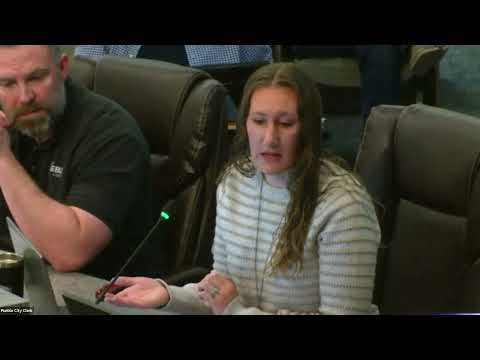
The request followed a briefing by interim housing administrator Melissa Cook and program coordinator Alexis (Lexi) Romero Stewart, who outlined the commissionhistory and costs, and described several work groups that have pursued housing-needs assessments, developer summits and public narrative work.
Why it matters: Councilors and the mayor argued that Pueblo needs a sustained, accountable vehicle to identify and advance housing and shelter projects, but they disagreed on whether that vehicle should remain under the mayor dministration or be reconstituted to report directly to council. The meeting produced no final vote; council asked staff to return with a plan.
Most of the briefing came from Melissa Cook and Alexis Romero Stewart, who described the commissionhistory and recent restructuring. Cook said the commission began in 2018 and was formalized by Resolution 14,151 in January 2019. She told council the city has spent roughly $158,600 on administration of the commission since inception — including payments to outside facilitators and an estimated $25,000-a-year portion of a city staff positionthat she estimated at about $26,400 per year on average.
Cook also told council the commission has struggled with attendance and quorum: nine of 22 appointed members attended fewer than half of meetings in recent records and, after an appointment freeze during restructuring, the body had only six appointed members on the rolls at the time of the briefing.
Several council members said they were not aware of the commissionwork items or outcomes and asked why earlier recommendations had not come through council. Councilman Mark Aliff argued the commission had once produced useful proposals and should be reconnected to the council process rather than dissolved, while other members said frequent leadership and facilitator changes had left the commission unfocused.
Mayor Graham said she had not received actionable advisement from the commission during the recent shelter transition and asked council to consider dissolution. Council members were split: some supported scrapping the commission and reconstituting a council-directed body, while others urged preserving the existing work groups and improving communication, membership and lines of authority. Council President Mark Aliff volunteered to lead drafting of a revised structure or a plan for dissolution and return options to council within a short time frame.
What council asked staff to do: Council directed staff to prepare options that would either (a) dissolve the commission and transfer duties to other municipal processes, or (b) restructure the commission with clear bylaws, membership rules and reporting protocols that would increase accountability to council. Staff was asked to return with proposed language and implementation steps for council consideration.
Background and details: Melissa Cook identified three continuing work groups within the commission: a housing work group (which pushed for an updated housing needs assessment), a "Shift the Narrative" work group (which has proposed public information and narrative pieces about homelessness) and a "Neighbors in Need" group focused on immediate services. Cook said a housing needs assessment was completed in late 2024 at staff direction, and that the commission had previously supported a developer summit concept and projects related to non-congregate sheltering.
The commission was originally chartered as a joint city-county advisory body; Cook said county participation has largely lapsed after turnover in county appointments. She recommended any revived commission be given a clear home in city government and clear expectations that match the commissionrole (for example, whether it should advise the mayor and staff or report directly to council).
Not a final decision: The council took no formal vote to dissolve the commission. Instead members gave staff direction to prepare options for either dissolution or revision, with clearer membership rules, reporting expectations and deliverables. The council asked that any reconstitution reduce churn, define a realistic scope (for example, whether the commission is idea-generation, implementation support, or both) and identify measurable outcomes.
Ending: Council members said they want a faster, clearer path to get proposals that they can act on. Several urged better coordination among city departments, the mayorand community partners so that when the commission concludes work groupsproductions they will be actionable and timely. Staff will return with draft options for council review.