Get Full Government Meeting Transcripts, Videos, & Alerts Forever!
Get email alerts on the Tourism Promotion Districts topic
No spam. Unsubscribe anytime.
Committee holds first hearing on House Bill 138 to allow tourism promotion districts
Summary
Sponsors told the Arts, Athletics and Tourism Committee House Bill 138 would allow local creation of tourism promotion districts funded by visitor assessments; sponsors and members discussed revenue use, local control, board composition and consumer lodging costs. No vote was taken.
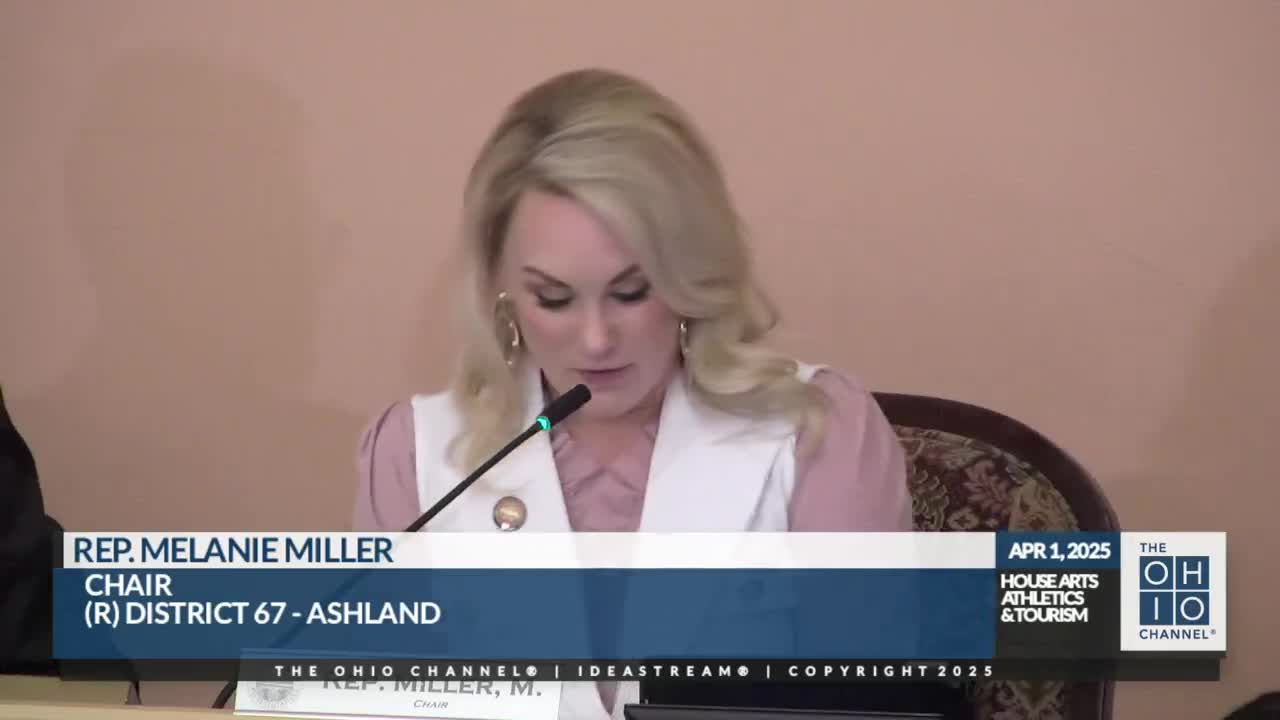
Chair Miller opened the Arts, Athletics and Tourism Committee and invited sponsors to present House Bill 138, legislation to authorize creation of tourism promotion districts in Ohio. Representative Davila and Representative Santucci described the proposal as a permissive, industry-led mechanism that would let local hotel owners form self-funded districts to pay for marketing and tourism activities with no state or local general-fund cost.
Sponsors said the districts would raise revenue through assessments passed through to visitors and would be formed by a written plan developed by hotel owners, include a protest procedure requiring hotel-owner approval of a local ordinance, and could authorize tourism nonprofits to manage a district with term limits for board members. "TPDs are a proven source of stable, dedicated funding for tourism promotion," Representative Davila said, adding that across the United States there are currently 218 tourism promotion districts in 23 states.
The committee discussed how the assessment revenue would be used and governed. Representative Santucci said the dollars are intended to be spent locally by hoteliers to market the area and promote events and sales. He described flexibility in district boundaries—districts can be city-, county- or multi-county-based and may not overlap other districts. "Those dollars are then used in a local sense to help promote whatever it happens to be for the area," Santucci said.
Members asked about measurable returns, lodging-price effects on consumers, and conflict-of-interest protections. Sponsors said they did not have statewide ROI figures available at the hearing but offered to provide them later. In response to concerns about higher consumer lodging costs, sponsors said planned stakeholder meetings with the Ohio Hotel & Lodging Association and others will consider assessment levels so they do not impose undue burdens on travelers or residents. Representative Upchurch asked whether assessment costs could be passed to consumers; sponsors said they will study and report on that question.
On governance and conflicts of interest, sponsors noted the bill requires a majority of district management boards be lodging business owners but includes a protest provision: if 40% of owners object, the district can be dissolved. Representative Jerrells and others asked how that structure would guard against larger businesses steering funds toward self-interest; sponsors said the protest and local-formation procedures are designed to secure buy-in from multiple owners and other local partners, such as convention and visitors bureaus.
Several members raised implementation questions. Representative McNally asked whether an existing entity could serve as the district management body; sponsors said they would check statutory language and follow up. Members also discussed using districts to support industry clusters such as viticulture in northeastern Ohio and whether districts could cross municipal lines.
The committee did not take formal action; the hearing concluded with the sponsors offering to provide additional data and meet with stakeholders. "We'd be happy to share that as we move forward here," sponsors said when asked about lodging-price impacts and ROI data. The first hearing closed with no vote.