Get Full Government Meeting Transcripts, Videos, & Alerts Forever!
Get email alerts on the Open Meeting Law topic
No spam. Unsubscribe anytime.
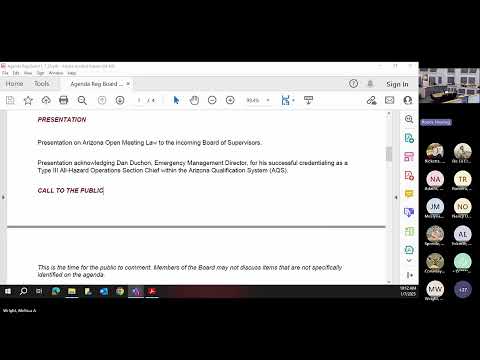
Attorney briefs supervisors on Arizona open meeting law, emphasizing notice and remedies
Summary
An attorney gave a presentation to the Cochise County Board of Supervisors on ARS open meeting requirements, including notice rules, definitions of legal action and remedies for violations.
Bisbee, Ariz. — A legal briefing on Arizona's open meeting law was delivered to the Cochise County Board of Supervisors during the Jan. 7, 2025 meeting, outlining notice requirements, the definition of legal action, and possible remedies and penalties for violations.
Paul Correa delivered the presentation for the board, explaining that the statute requires that meetings of public bodies be open and that ‘‘all persons so desiring shall be permitted to attend and listen to the deliberation and proceedings.’’ Correa summarized key statutory elements including what constitutes a meeting, what constitutes a legal action, and the notice requirements tied to agendas.
Correa told supervisors that notice and agenda specificity are fundamental so members of the public can know what will be discussed and take part if they wish. He explained the statute’s broad application to electronic communications: if two supervisors exchange text messages that result in an agreement about county business, ‘‘you've had a meeting,’’ he said, and that could constitute a legal action that must occur in public.
He discussed remedies and enforcement paths for alleged violations, saying complaints may be investigated by the county attorney or the Arizona attorney general and noting civil penalties for knowing violations. Correa quoted a policy principle from the law: "sunshine is the best disinfectant," and said courts can require ratification procedures or, in some cases, impose fines or other penalties when violations are proven.
Why it matters: Understanding the open meeting law is central to county governance. Correa said a knowing violation can expose officials to fines and potential personal liability for attorneys’ fees, and he urged careful adherence to notice and agenda rules to avoid protracted litigation and cost to the county.
The presentation was offered as an overview; Correa declined to give formal legal advice in the public session and invited supervisors to ask follow-up questions individually or in a work session should they want advice that could require an executive session.