Get Full Government Meeting Transcripts, Videos, & Alerts Forever!
Get email alerts on the Summer Nutrition Assistance topic
No spam. Unsubscribe anytime.
Committee advances summer nutrition assistance bill after amendment; agencies outline costs, eligibility and timeline
Summary
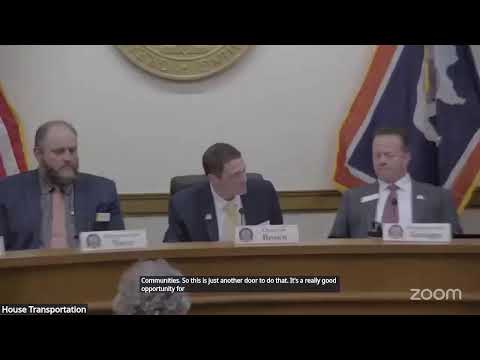
House Transportation, Highways & Military Affairs Committee Chairman Brown on Wednesday advanced House Bill 341, a summer nutrition assistance measure commonly called summer EBT or "SunBucks," after the panel adopted an amendment tying state administration to federal SNAP eligibility rules and other limits.
House Transportation, Highways & Military Affairs Committee Chairman Brown on Wednesday advanced House Bill 341, a summer nutrition assistance measure commonly called summer EBT or "SunBucks," after the panel adopted an amendment tying state administration to federal SNAP eligibility rules and other limits.
The bill, sponsored in committee by Representative Greg Larson, would create a summer electronic benefit transfer (EBT) program to deliver grocery benefits to children who qualify for free or reduced-price school meals. Representative Larson told the committee the program requires an annual application and, if approved on the usual schedule, the first operational summer would be 2026.
The bill's sponsors said the state request includes one-time technology and startup funding and temporary staff. Director Corinne Schmidt of the Wyoming Department of Family Services said the administration requests $1,000,141.93 in general funds and an equal amount in federal funds to stand up the program and estimated ongoing annual costs around $700,000. Schmidt said the request funds two temporary full-time Department of Family Services positions and one at-will contract position to run the initial application and enrollment system, with the contract ending June 30, 2027. She told the committee that the program would deliver roughly $3,800,000 of federal benefit directly to communities through grocery stores if the program reaches its projected eligible population.
Schmidt described the program as "SNAP-like" but administratively distinct. She said two groups would be categorically eligible (children already enrolled in SNAP and children who qualify for free or reduced-price school meals) and that the bill establishes an application pathway for children who do not attend participating schools, are homeschooled, or otherwise are not on school lists.
Schmidt said the estimate is about 32,500 children would be eligible and that the benefit level contemplated in the bill is $40 per child per month for three months (about $120 per child for the summer). She said administrative costs are shared with the federal government on a 50/50 match for the program. "There is an application for some of the kids, which is why the request comes in with a price tag for the IT system to help us do that," Schmidt said.
Advocates and business groups testified in support. Jackie Simmons, government relations director for Wyoming for the American Heart Association, said research from other state programs shows summer EBT reduces hunger and increases purchases of fruits, vegetables and whole grains. "Summer EBT gives families the ability to put food on their table themselves," Simmons said. Travis McNevin, representing the Northern Aptahoe Business Council, said the program would help families in rural areas who face barriers reaching food banks or summer feeding sites.
Opponents and commenters asked about controls on purchases, federal funding continuity, and program overlap with SNAP. Jeff Daugherty, representing FGA Action, suggested adding a termination clause if federal participation ends and urged aligning eligibility with SNAP income thresholds; he said he worried Wyoming would be "left holding the bag" if federal funding changed. Schmidt replied that the state had received no notice that the federal program would end and that the Department of Education would provide lists of students who qualify for free or reduced-price meals to the Department of Family Services to support enrollment and eligibility verification.
The committee debated draft language proposed by Vice Chairman Tarver that would (1) require the department to administer the program consistent with "7 US Code 214 for the regular supplemental nutrition assistance program," (2) limit benefits to Wyoming-produced foods, and (3) prohibit purchases of soft drinks as defined by USDA regulations (transcript references: "7 CFR 2,712"). Members divided the amendment into parts: the committee adopted the division that required alignment with federal SNAP eligibility and added rulemaking and termination language, but rejected the provisions restricting benefits to Wyoming-produced foods. The committee adopted the division prohibiting purchases of soft drinks (the committee later discussed taking that restriction to the whole body).
Procedure and vote: Representative Benjamin Nicholas moved and Representative Larson seconded moving the bill out of committee. The committee called a roll and approved HB 341 as amended by recorded vote (see "Actions").
Implementation timeline and next steps: Committee members stressed the timing constraint in federal program rules and the application's annual cycle. Representative Larson and Representative Chestick (original bill sponsor) warned that delaying the bill to the interim would cost an additional year of benefits because the application window for federal acceptance opens in August; if the state misses the 2025 application cycle, the earliest operational summer becomes 2027 rather than 2026.
The bill will proceed out of committee to the next step in the legislative process with the committee's recommendation.
Ending: Supporters framed the measure as a targeted anti-hunger tool that also brings federal dollars to local economies; critics emphasized the state's limited ability to enforce purchase restrictions and recommended safeguards tying state obligations to continued federal funding.