Get Full Government Meeting Transcripts, Videos, & Alerts Forever!
Get email alerts on the Downtown Parking topic
No spam. Unsubscribe anytime.
Council asks staff to return with financial, operational analysis of one‑hour free downtown parking trial
Summary
After mixed testimony from downtown businesses and parking experts, the council on Feb. 4 unanimously directed staff to report back on fiscal and operational impacts of offering one hour free parking in two‑hour zones downtown and on implementation logistics, including enforcement technology constraints.
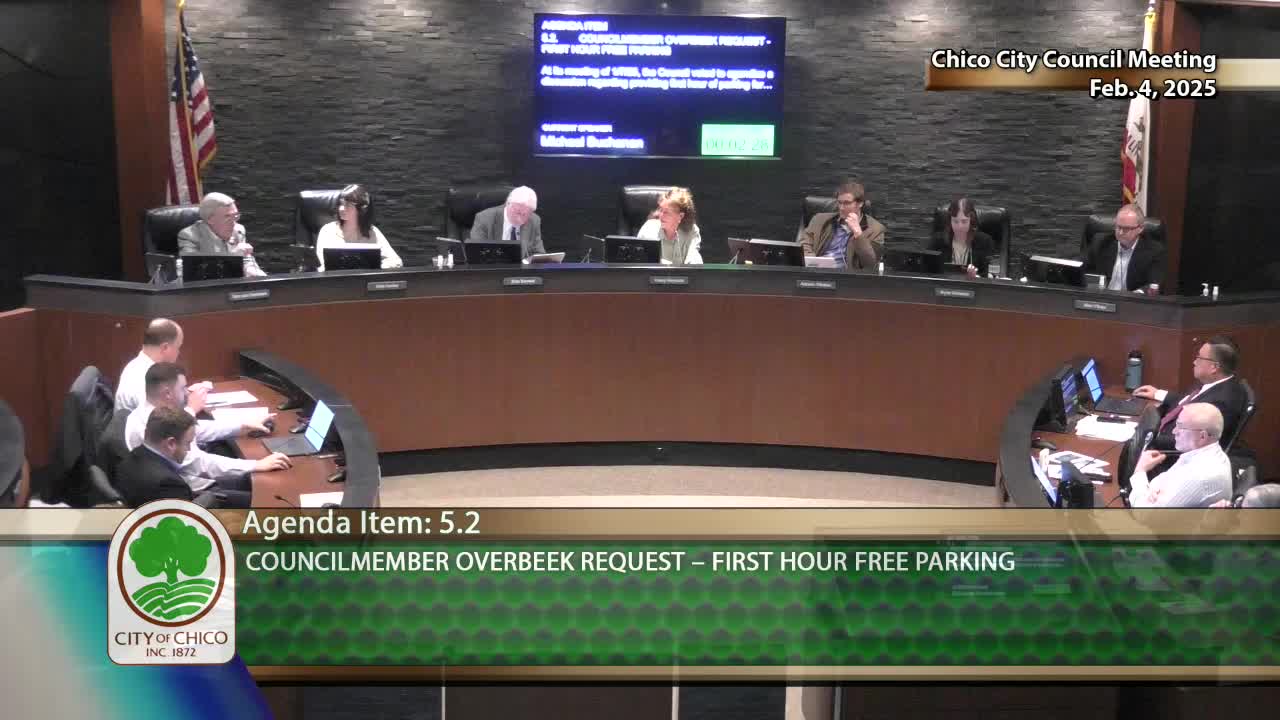
The Chico City Council on Feb. 4 directed staff to return with a financial and operational analysis of a proposal to offer one hour of free parking in two‑hour meter zones in downtown Chico. The motion passed unanimously.
Councilmember Van Overbeck proposed the item, saying first‑hour free parking had been used by other small downtowns to encourage quick visits and that a free‑hour experiment run between Thanksgiving and Christmas was well received. Business owners and the Downtown Chico Business Association told the council they supported another trial; several said the free hour helped customer access and reduced anxiety about kiosk payment.
Parking and transportation professionals cautioned against unintended effects. Jesse Horgan, a parking manager and consultant, said free parking can increase dwell time for a minority of users and raise "circling" time, reducing turnover and increasing search traffic; he said paid parking supports turnover and funds maintenance. City staff said the December experiment cost roughly $50,000 for the month and that premium downtown parking currently charges $1 per hour (economy or peripheral lots are about $0.50 per hour). Staff said the premium downtown zone represents a material share of parking fund revenues and noted that parking fund reserves have declined in recent years.
Staff also flagged operational constraints: enforcement relies on virtual "chalking" via license‑plate reader (LPR) sweeps that circulate every 30–60 minutes; the city uses multiple software platforms (kiosk vendor IPS and a mobile app vendor) and not all features (for example, automatic first‑hour free enforcement tied to the kiosk) are available on the IPS system. Staff recommended an analysis comparing options such as LPR enforcement, app‑based first‑hour free features, targeted perimeter zones, or a limited trial period.
Councilmembers acknowledged the competing perspectives: several expressed support for a trial period and for protecting core downtown turnover by focusing free time in outer two‑hour blocks; others asked staff to report back with December sales‑tax comparisons and a more detailed revenue estimate. The motion to direct staff to return with an analysis passed 7‑0.
Staff will return with a written report on projected revenue impacts, enforcement/logistics options, and recommended trial parameters for council consideration.