Get Full Government Meeting Transcripts, Videos, & Alerts Forever!
Get email alerts on the Wildfire Resilience topic
No spam. Unsubscribe anytime.
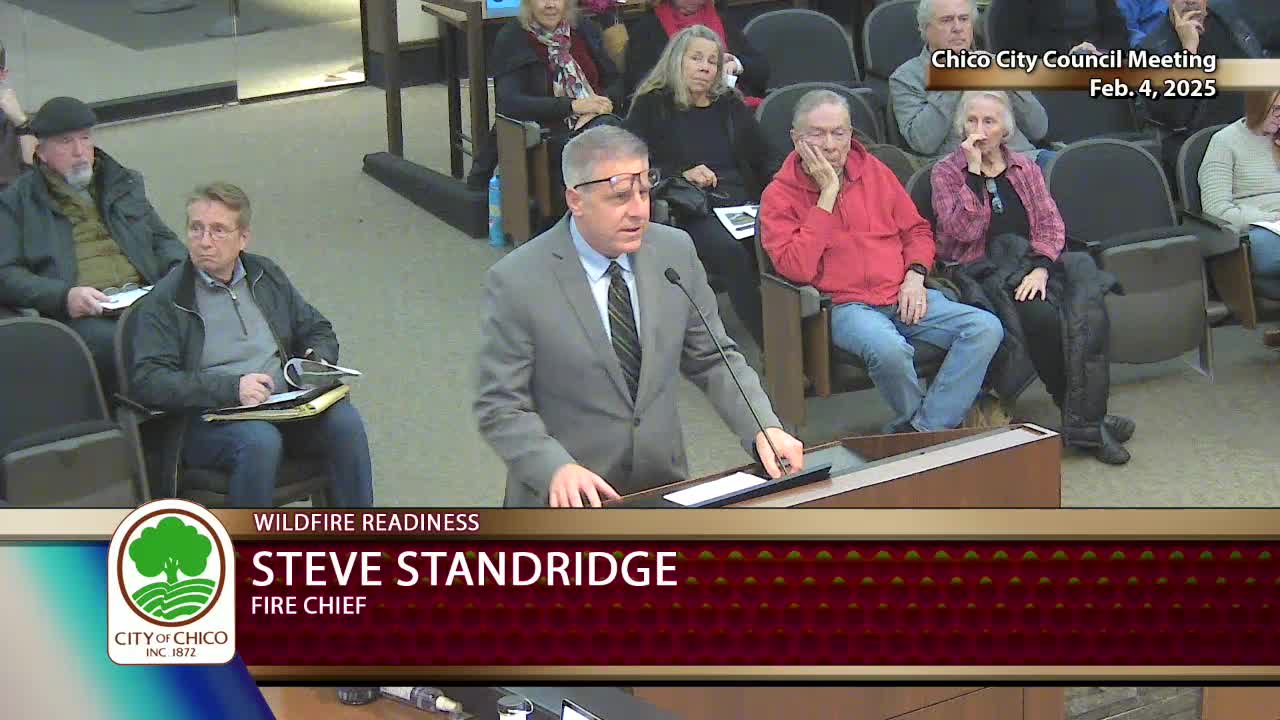
Chico Fire chief urges stepped wildfire strategy: mitigation, education and response
Summary
Fire Chief Standovich presented the city's Community Wildfire Protection Plan and related vegetation management work to the council on Feb. 4, saying wildfire resilience rests on mitigation, outreach/education and response capacity, and that gaps include staffing, outreach and equipment such as additional Type 3 apparatus.
Chico Fire Chief Standovich briefed the City Council on Feb. 4 about the city's wildfire readiness work, saying wildfire resilience relies on three interdependent elements: mitigation, outreach and education, and response capability.
Standovich described the city's existing Vegetation Fuels Management Plan (adopted in 2021) for city‑owned properties and a new, city‑level Community Wildfire Protection Plan (CWPP) meant to complement the county plan and give a finer‑grained, parcel‑level assessment of risk. He said the consultant Deer Creek Resources prepared the CWPP and modeled high‑risk parcels by combining topography, fuels and wind patterns.
Mitigation tools Standovich identified include hand thinning, mechanical equipment, goat grazing and dozer or shaded fuel breaks. He said Chico uses prescribed burns in coordination with Parks and regional partners and that two burns were completed last spring; he also said the airport burn is an annual activity. Standovich noted the city removed 125 hazard trees on Ten Mile House Road and has created pre‑attack lines and pile burns at several park locations.
On response, Standovich said the city has two Type 3 wildfire apparatus assigned for interface areas and that adding another is a prudent option; he warned that large or overlapping incidents can strip the city's resources, forcing triage. He called for grants, including those tied to Firewise designations, and for expanded outreach and education capacity to help homeowners and neighborhoods harden properties.
Gaps identified in the report included: limited staff capacity to carry out parcel‑level outreach; the need to pursue grant funding and Firewise community designations; weed‑abatement enforcement; and the constraint that the city's IPS parking/kiosk technology limits some parking enforcement features (not related to wildfire but noted in the presentation as a general staff capacity issue). He said Cal Fire is issuing updated local fire hazard severity zone maps and that the city will return to council if map adoption is required.
Council members asked about Firewise designation for neighborhoods; Standovich and Battalion Chief Mike Wotner pointed attendees to the Firewise Communities website and the Butte County Fire Safe Council for application assistance. Council members also discussed a possible dedicated outreach position for wildfire education, and Standovich said he had advocated internally for such a role.
No formal council action was taken on the presentation; Standovich recommended continued coordination with county, Cal Fire and federal partners and pursuing grants and prioritized mitigation work.