Get Full Government Meeting Transcripts, Videos, & Alerts Forever!
Get email alerts on the Education Lab School topic
No spam. Unsubscribe anytime.
Committee advances bill to reestablish University of Wyoming lab school as K‑8 public lab school
Summary
The Joint Education Committee voted 5‑4 to pass Senate File 126 as amended to create a K‑8 public lab school reporting to the committee, after hours of testimony that split parents, university officials and the Albany County School District over local control, facility condition and governance.
The Joint Education Committee voted 5‑4 to pass Senate File 126, a bill that would reestablish the University of Wyoming lab school as a K‑8 public lab school governed by an independent board and reporting annually to the joint committee.
Sponsor Senator Chris Rothfuss opened the hearing by saying the bill is an effort to preserve a 138‑year university institution and restore the lab school’s role in teacher preparation. "This legislation comes from, honestly, a little bit of conflict that took place with regard to the lab school," Rothfuss said, and described the measure as an opportunity "to really improve the lab school above and beyond what its best days were."
Supporters — including parents, alumni and current and former lab teachers — said the school provides hands‑on practicum opportunities for University of Wyoming education majors and a distinct learning environment for K‑8 students. "Lab has allowed us to work hands on with students and try out different teaching styles," testified Julia Crossland, a recent UW alum. Former and current parents said the lab school’s campus location makes frequent, short observations and practicum engagements possible in ways typical district schools do not replicate.
Opponents included the Albany County School District superintendent and a University of Wyoming representative, who said the university and the district had concluded the lab school no longer served its original mission and that the bill raises questions of local control and constitutionality. John Goldhart, superintendent of Albany County School District, said the process lacked transparency and raised numerous operational questions: "Do the current lab employees stay employed at the lab school, or do they have to reapply for these positions? Who hires the principal? Who evaluates the principal?" Mike Smith, representing the University of Wyoming, said the university had determined the lab school "serves no special purpose, as compared to any Albany County school district," and raised concerns about operational information sharing with the district, including security reporting.
Testimony also disagreed about the condition and cost of the building. Mike Smith referenced a prior estimate of roughly $20 million in needed work; other witnesses said a more recent estimate is about $40 million. The bill requires the public lab school to be located on the University of Wyoming main campus, caps the school’s statutory capacity at 200 students, and creates a governing board composed of district and university representatives, a teacher, a parent and an ex officio principal who would chair the board but not vote.
The bill adopts many charter‑style flexibilities: it permits the lab school to be "free from specified school district policies and may waive state board policies" where statute allows, and directs funding to flow via the education resource block grant directly to the school’s governing board unless the district and board agree otherwise in writing. The sponsor noted the bill includes a provision to treat the school as an ongoing school for funding purposes so it will not trigger the funding model’s "new school" provisions; the committee adopted an amendment changing the reference year used to calculate funding to 2023‑24 to avoid financial penalties tied to a post‑closure enrollment drop.
Committee debate focused on local control, accountability and whether the lab school has functioned as a lab school in recent years. Rothfuss said the university’s decision to close the school followed a breakdown in the historical, co‑located practicum relationship between the College of Education and the school, and that the legislature has a role as the elected body overseeing statewide institutions. Representative Steve Kelly and others said the committee should be cautious about overriding local governance.
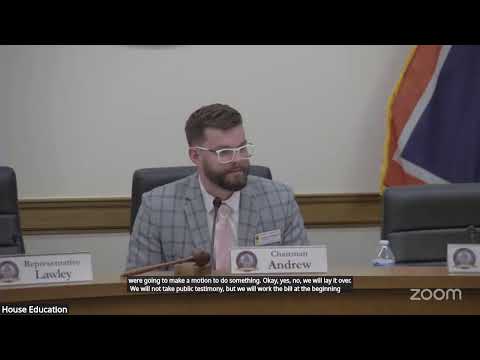
At the close of testimony Representative Strock moved to pass the bill as amended; Representative Guggenmoss seconded. The roll call recorded five ayes (Guggenmoss—absentee aye; Kelly; Singh—absentee aye; Strzok; Chairman Andrew) and four no votes (Bratton; Erickson; Lawley—absentee no; Williams—absentee no). The committee report reads: "Due passed as amended."
The bill now moves forward with committee approval; supporters emphasized the statute’s reporting requirement that the lab school provide student achievement data, enrollment and engagement metrics to the joint education interim committee as the primary accountability mechanism.
Questions left unresolved in testimony included: the precise operational relationship and duties between the governing board and the district, how staff employment and benefits will be handled, the district’s role in facilities maintenance, and whether the state or district will serve as the lab school’s local education agency if the governing board seeks statewide reach. Committee members said some of those implementation details could be worked out in follow‑up or during interim work by the joint education committee.