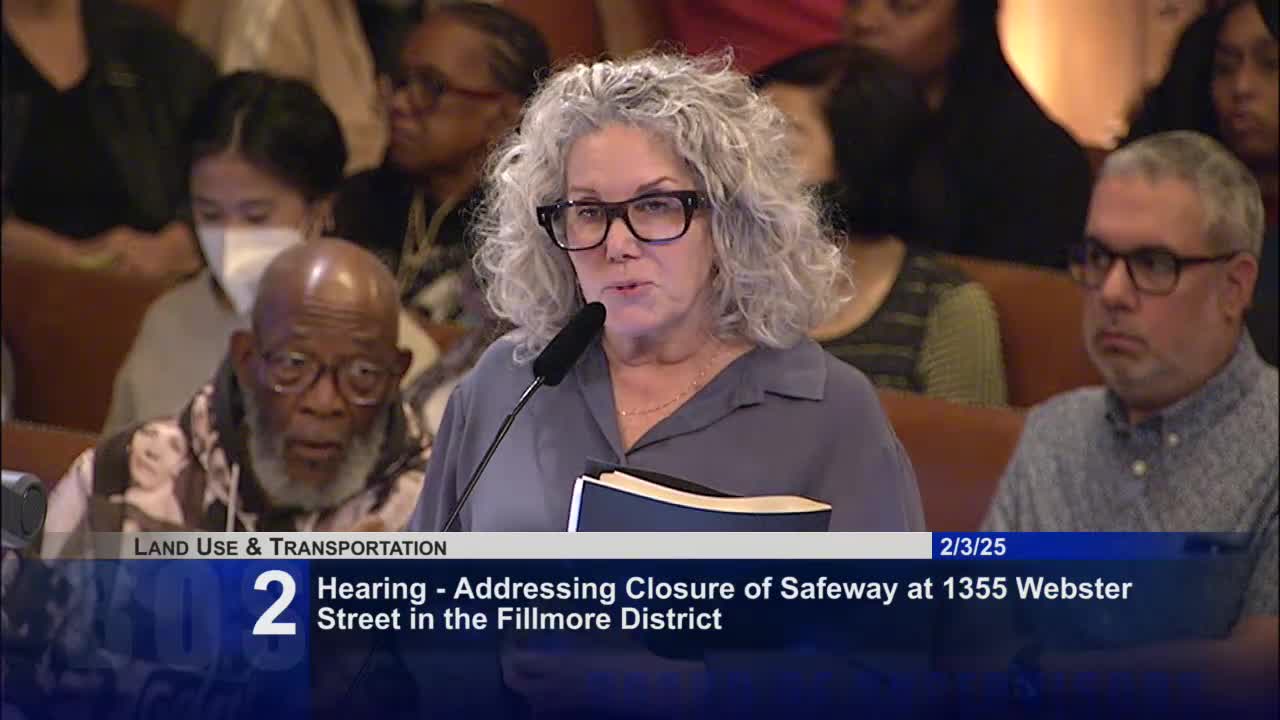
Hearing on Safeway closure at 1355 Webster highlights urgent food, pharmacy and banking gaps; city outlines short‑, medium‑ and long‑term options

2218025 · February 3, 2025

Loading...

AI-Generated Content: All content on this page was generated by AI to highlight key points from the meeting. For complete details and context, we recommend watching the full video. so we can fix them.

Summary

The Land Use and Transportation Committee held a hearing Feb. 3 to examine the closure of the Safeway at 1355 Webster Street in Fillmore and to collect short‑term and long‑term options to restore grocery, pharmacy and banking services to the neighborhood.

A special hearing of the San Francisco Board of Supervisors’ Land Use and Transportation Committee on Feb. 3 focused on the announced closure of a Safeway grocery store at 1355 Webster Street, in the Fillmore/Western Addition/Japantown area. The store’s closure, announced more than a year earlier and accelerated in recent weeks, removes a full‑service grocery store that community leaders say serves seniors, families, and residents with limited transportation options.

Supervisor Bilal Mahmood opened the hearing saying the closure has been “felt deeply throughout the neighboring communities,” and described the meeting’s goals: “to understand the scope of this closure and its impact on residents; to understand the facts around this site and its history; and to understand what the city has done and plans to do to mitigate impacts.” Committee members heard presentations from the San Francisco Food Security Task Force, the Office of Economic and Workforce Development (OEWD), the Planning Department, the Human Rights Commission (HRC), and the SFPD.

The Food Security Task Force’s chair, Cissy Bonini, described severe neighborhood food insecurity and underscored why the closure matters for public health: “One in four San Franciscans are food insecure,” she said in committee testimony, adding that the Western Addition’s zip code has higher rates of diet‑sensitive hospitalizations and a concentration of residents on fixed incomes. Bonini said the task force has recommended a community‑centered food security body and will continue to advocate restoring city food‑program funding cut in recent budgets.

OEWD staff said Safeway had sold inventory in mid‑January, continued pharmacy operations while prescriptions were transferred, and now intends to cease pharmacy services imminently. Planning Department staff said the parcel is privately owned, that the city has a small easement into the parking area, and that the site is zoned for a range of uses, including a grocery store. Planning did not confirm formal development plans; staff said announcements of a pending sale and a developer option exist but that no plans had yet been submitted to the city.

Officials gave a realistic timeline for replacing a chain grocery in the existing Safeway space: Planning staff explained that a new chain supermarket would likely require a conditional use authorization (formula‑retail/conditional use) and tenant improvements; combined, Planning and Building Department processes plus appeals could take roughly 12–18 months before a new grocer could open, assuming an operator signs an interim lease with the owner. Planning staff said reforms to conditional‑use and formula‑retail rules could shorten that timeline.

City agencies and community groups outlined short‑ and medium‑term mitigation steps already underway or under study: the Human Rights Commission and OEWD have held community outreach sessions, HRC has been coordinating enhanced food giveaways and pharmacy delivery options, OEWD and SFMTA are enrolling seniors and residents for paratransit shuttle and taxi‑voucher programs, and neighborhood nonprofits such as Booker T Washington Community Service Center and Farming Hope said they are expanding client‑choice markets, meal delivery and home‑delivered produce boxes.

Booker T’s executive director Shakira Simley said the center “serves over 1,500 folks every week” through produce markets, home deliveries and hot meals and that demand is rising with the Safeway closure. Farming Hope and other community organizations asked for immediate funding boosts to scale delivery and pantry programs and urged a rapid transition plan to avoid gaps in food access.

Public testimony was extensive: dozens of residents, business owners and community leaders described reliance on the store’s groceries, pharmacy and onsite banking; multiple speakers tied the closure to past redevelopment disinvestment in Fillmore and asked the city to prioritize community benefit, community ownership or a nonprofit cooperative market on the site. The community also pressed for the city to preserve Certificate of Preference (COP) protections for displaced families and to consider community right‑to‑purchase options.

SFPD Captain Jason Sawyer described enforcement work while the store remained open: the department had conducted repeated theft operations and said arrests showed “there was absolutely no pattern” confined to a single neighborhood; people arrested came from a wide area, Sawyer told the committee. He also said police work with property owners is constrained on private property and that owner cooperation is necessary to abate parking‑lot crimes and abandoned vehicles. HRC said Safeway had agreed to interim security and fencing for the site but that arrangements were limited in time and details remained unclear.

Several residents asked whether the city could use eminent domain to acquire the site. Deputy City Attorney Bridal Russi explained the eminent domain process: government must propose a public project, conduct environmental review, negotiate in good faith, and, if necessary, seek a resolution of necessity from the legislative body; if the owner refuses, court litigation over fair market value and public purpose can take years. Russi said eminent domain is possible but time‑consuming and would not produce an immediate grocery replacement.

Community members and nonprofit leaders proposed alternatives: (1) short‑term activation of the large parking lot for a temporary grocery or a farmer’s market; (2) rapid expansion of existing community grocery models such as the HSA Community Market pilot (a client‑choice market model used elsewhere in the city); (3) use of the Community Opportunity to Purchase Act (COPA/COPPA) or community acquisition tools to enable nonprofit or cooperative ownership; and (4) legislative reform to expedite conditional uses for full‑service grocers.

Outcome and next steps

Supervisor Mahmood moved to file the hearing; the committee voted to file the hearing with three ayes. Committee leaders said the meeting was a first step and committed to continuing coordinated work across OEWD, HRC, MOHCD, Planning, SFPD and community groups to pursue short‑term food access, explore interim leases or pop‑up grocery options, expand senior shuttle enrollment, and examine longer‑term land‑use and acquisition tools. Several community groups demanded continued public hearings and more direct engagement with Safeway, the property owner and any prospective developer. The committee did not adopt binding actions to acquire the property or compel interim leases during this hearing.

—Clarifying details from the hearing: the site is nearly 3.7 acres; community estimates cited the Fillmore/Western Addition zip code population at approximately 34,000 residents with several thousand households under severe economic strain; planning staff estimated a 12–18 month timeline for a new chain grocer to occupy the existing Safeway space absent reforms or an interim lease; the Deputy City Attorney described eminent domain as a multi‑stage legal path that can take years to complete.