Get Full Government Meeting Transcripts, Videos, & Alerts Forever!
Get email alerts on the Water Rights topic
No spam. Unsubscribe anytime.
Wyoming panel narrows temporary water-use agreements to finite terms; in‑stream flow exclusion debated and rejected
Summary
The Agriculture, State & Public Lands & Water Resources Committee on a voice vote moved Senate File 43, a bill that would limit the length of temporary water‑use agreements and add statutory clarity about how the agreements may be used.
The Agriculture, State & Public Lands & Water Resources Committee on a voice vote moved Senate File 43, a bill that would limit the length of temporary water‑use agreements and add statutory clarity about how the agreements may be used.
The bill, presented by Senator Steinmetz, would allow the state engineer to approve temporary transfers for successive periods not to exceed five years each, with a total maximum transfer length of ten years. Steinmetz said the goal is to prevent effectively permanent arrangements being processed as perpetual temporary renewals: "this bill seeks to limit those to 5 years," he told the committee.
Supporters said the measure codifies limits and reduces uncertainty for water users and regulators. Brandon Gilbert, state engineer, and Chris Brown of the attorney general's office told the committee the change grew from a multiyear review and that the revision clarifies the statute. Brown summarized the legal view on a recurring concern: "the opinion ... concluded that neither this statute, the temporary transfer statute, nor the in‑stream flow statutes allow for the temporary transfer for an in‑stream flow purpose," meaning the AG's office does not view temporary transfers as a vehicle for in‑stream flow rights.
Why it matters: temporary transfers have been used as a flexible tool to meet short‑term water needs for construction, oil and gas operations and other purposes, and some users said they rely on the legal certainty such agreements provide. Opponents worried repeated renewals could remove water from irrigated acres for extended periods.
Committee discussion and amendments
The committee heard from irrigators' and conservation groups that voiced two persistent concerns: (1) that language be explicit to prevent temporary transfers from being used to secure in‑stream flow rights; and (2) that repeated renewals should not permit the permanent removal of water from irrigated land without a formal change of use.
The Wyoming Stockgrowers Association and others proposed an amendment to reinsert a sentence excluding the "beneficial use of in‑stream flows" from temporary transfers (as had been included earlier in the bill's drafting). Multiple witnesses — including Jim McGavin of the Wyoming Stockgrowers Association, Jack Berger of Multi Generation Ranch, and Holly Kennedy of the Wyoming Association of Conservation Districts — urged the committee to restore the in‑stream flow exclusion to make the statute explicit rather than rely solely on AG opinion.
Senator Hicks and representatives of the state engineer's office urged caution about overconstraining property rights. Gilbert noted the temporary tool provides flexibility in an otherwise rigid appropriation system and said the office already investigates potential injury to other appropriators when a temporary transfer is in place.
The committee divided the stockgrowers' proposal into two parts. The first part, restoring explicit exclusion of in‑stream flow uses, failed on a committee division vote. The second part — language intended to require that, after expiration of a temporary transfer, irrigation water rights be returned to their adjudicated purpose for a period equaling at least half the prior temporary use period before another temporary transfer could apply — also failed on a subsequent division vote.
Votes and formal action
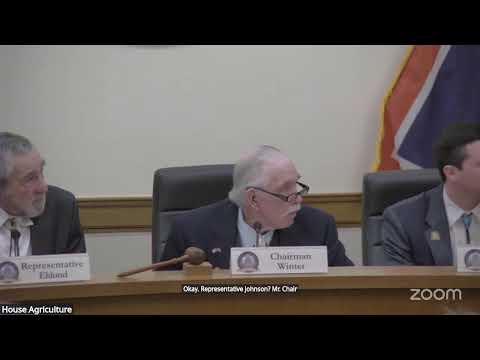
The committee approved Senate File 43 as engrossed, with the final roll‑call recorded as six ayes and three noes (Banks, Davis, Johnson, Otman, Provenza, Schmidt — ayes; Eklund, Strauch, Chairman Winter — noes). The committee record shows the motion to move the bill was made and seconded and that the committee accepted the bill without the stockgrowers' amendments.
What remained unresolved: multiple public witnesses and committee members asked for clearer guardrails on repeated use over time and how the statute would be applied in practice. Witnesses asked for explicit protections for junior appropriators; state staff explained the statute provides both front‑end review (assessment at application) and back‑end processes (commissioner investigation and suspension if injury is claimed). The AG's office and the state engineer emphasized that the statute, as revised, is intended to provide clarity but can raise policy tradeoffs between flexibility and protection of irrigation users.
Looking ahead: the bill will move forward from committee as approved; proponents said it provides clearer limits on temporary transfers, while opponents and several ranching and conservation groups said they will continue seeking statutory language that more tightly limits reuse and excludes in‑stream flow uses in the law itself.