Get Full Government Meeting Transcripts, Videos, & Alerts Forever!
Get email alerts on the Transportation topic
No spam. Unsubscribe anytime.
Niskayuna to pilot electric buses, seeks fleet electrification study and state incentives
Summary
The finance subcommittee received an update on the district’s electric‑bus pilot: two EV buses are expected in March 2025, a fleet electrification study is underway, and NY incentives and state aid could substantially reduce net cost if timed correctly.
The Niskayuna Central School District finance subcommittee on Jan. 17 received a status update on the district’s electric‑bus pilot and longer‑term fleet electrification planning.
District staff said the district ordered two electric (EV) school buses and expects delivery and registration to be complete in March 2025. Staff said the vendor completed DOT inspection and registration steps and that the district is close to selecting a cooperative‑purchasing vendor to install chargers. The district plans a first‑responder training on Feb. 3 at the high school with the vendor and local fire personnel in advance of bus arrival.
Staff described an initial utility assessment completed with National Grid to evaluate substation and on‑site power capacity. The district has contracted (through a Capital Region BOCES RFP) a firm to perform a fleet electrification study; Wendell Engineering (through the BOCES cooperative) will analyze routes, storage and charging locations and make recommendations about sequencing conversions and site‑level electrical upgrades.
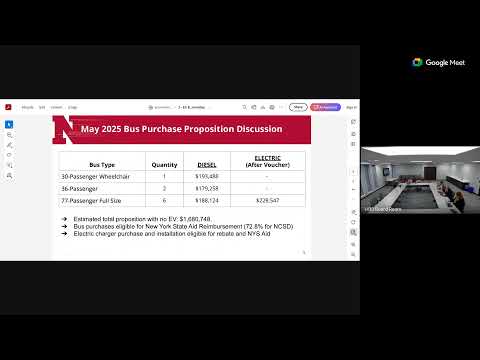
District staff explained the incentive landscape. Under the current New York incentive program for school buses (NYSERDA rebate program), a combination of a base voucher, scrappage payment and vehicle‑to‑grid add‑on currently amounts to $228,500 (the presenter described that total as the voucher amount available under program rules) to help offset the price difference between a diesel bus and an electric Type C bus. Charger purchase and installation incentives are available as well; staff said the charger rebate available through the program is about $55,000 per charger purchase/installation. Staff noted the NYSERDA vehicle rebate is point‑of‑sale and does not require the district to pay the full list price before rebate. The district’s current state aid rate for bus purchases is approximately 72.8%, and charger purchases and installation are also eligible for state aid.
Staff cautioned the NYSERDA point‑of‑sale bus incentive is currently available for up to six buses through Dec. 1, 2025; availability after that date will depend on statewide program funding. Staff said the total per‑bus incentive is substantial over several buses but does not fully eliminate the price gap between diesel and electric buses. The district’s current replacement plan calls for approximately nine bus purchases per year and a total vehicle fleet of roughly 92 vehicles of all types. Staff emphasized the district’s operational considerations — vehicle life cycles, route assignments and charging‑infrastructure needs — factor into whether to accelerate electric purchases now or phase them in as incentives and technology evolve.
Committee members asked whether the district should use available incentive capacity to maximize electric bus purchases now; staff said the district will take possession of the two pilot EV buses, gain operating experience and await the fleet electrification study before advancing a larger purchasing strategy. Staff added it may be possible to submit applications for incentives before Dec. 1, 2025 for vehicles ordered in a subsequent year, and that more detailed cost estimates would be provided as the study progresses.
What’s next: staff will bring the fleet electrification study results and updated cost estimates to the board and will continue to coordinate with the utility, vendor and BOCES on charger locations, installation and grant timing. The district will host the Feb. 3 first‑responder training and said it will share additional details about community events tied to the EV pilot.