Get Full Government Meeting Transcripts, Videos, & Alerts Forever!
Get email alerts on the Budget topic
No spam. Unsubscribe anytime.
Niskayuna finance subcommittee reviews ThoughtExchange feedback and draft 2025–26 budget priorities
Summary
On Jan. 17 the Niskayuna Central School District Board Finance Subcommittee reviewed community feedback collected through a ThoughtExchange, discussed top themes (phones, staffing, class size, meals, mental health and facilities) and considered a list of potential year-end investments should budget performance permit.
The Niskayuna Central School District Board Finance Subcommittee on Jan. 17 reviewed results from a two‑week ThoughtExchange held in December and discussed draft budget priorities for the 2025–26 school year and a list of potential year‑end investments.
District staff reported 694 participants, 546 submitted thoughts and participants recorded 22,105 ratings across items shared in the ThoughtExchange. Participation was divided among parents/guardians/community members (about 60%, roughly 400 participants), faculty and staff (about 25%, roughly 65 participants) and students (about 17%, about 121 students). The district has posted the full stakeholder reports and the full dataset to BoardDocs.
Committee members and staff said the exchange highlighted a broad set of community priorities. Topics most frequently mentioned included cell‑phone policy in schools, staffing levels (including support staff), class size, school meals, mental‑health/social‑emotional learning (SEL), and facilities/space constraints. Staff emphasized the tool was designed to surface topical priorities more than to measure sentiment: frequency drives visibility in the word cloud, not whether comments were positive or negative.
District staff outlined how the ThoughtExchange findings align with the five draft budget priorities the board reviewed earlier in January and said the priorities also map to the district strategic plan. Staff noted several recurring, budget‑relevant items: sustaining investments in professional development and SEL supports; continuing attention to class‑size guidelines at the elementary level and sectioning at the secondary level; and maintaining staffing levels to support programs. Staff said a deeper review will reconcile perceptions about class size with enrollment and student‑needs data and will report exceptions where class size exceeds district limits.
Free school meals was visible among community comments. Staff told the committee the ThoughtExchange data predated the governor’s recent proposal for universal free school meals, and that the district will evaluate implementation details if and when the state budget proposal is finalized. Staff added that larger reimbursements under a universal meals program could create capacity to invest in equipment, staffing and training for food service.
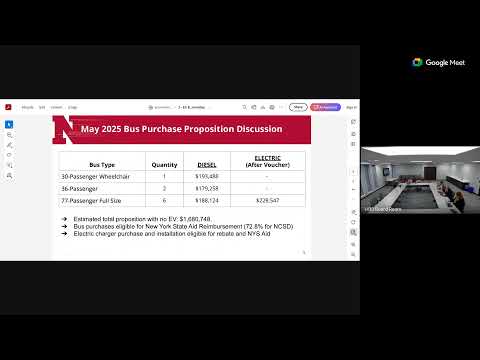
On facilities and one‑time, year‑end investments staff presented a prioritized list of potential projects the district could consider if positive budget performance continues. Items discussed included accelerated door‑hardware/security upgrades (badge access, alarms), pavement and parking‑lot work, replacement or upgrades to robotics and music ensemble hardware/software, exterior lighting upgrades, a possible replacement or refurbishment of the wrestling gym floor, replacement of the high‑school stadium turf lettering (deadline for compliance activity discussed by staff), audio/video upgrades for a small theater, replacement of an aging voice server and expansion of security camera storage, and school‑bus technology upgrades (tablet/GPS and route‑management systems). Staff said the board would receive a maintenance‑of‑effort budget and fund‑balance projection at the next board meeting to show capacity for any year‑end investments while preserving the district’s fund‑balance policy targets.
Committee members asked for specificity in two areas: a clearer implementation plan for any phone‑policy changes (communication, signage, rollout costs), and more detail on bus‑route technology. Staff said they will provide pricing and timelines so that any purchases could move earlier in the spring rather than waiting until the fiscal year end. Tony Lento, director of facilities, and the district’s business staff were identified as leads for facility and year‑end investment scoping.
The subcommittee also discussed communications staffing. Monica Lester, communications supervisor, was thanked for her role coordinating the ThoughtExchange outreach; staff noted the district currently uses a BOCES communications package and is recruiting a candidate to fill a district position to restore prior levels of public‑information capacity.
What’s next: staff will produce a revised version of the budget priorities for the full board later in January, include the maintenance‑of‑effort budget and fund‑balance projection, and return with cost estimates and timelines for any recommended year‑end investments. The finance subcommittee’s next meeting was announced for Feb. 28.
Ending: The committee did not take formal votes on budget priorities at this meeting; members asked staff to return with the requested data so the board can weigh one‑time investments against ongoing budget commitments.