Get Full Government Meeting Transcripts, Videos, & Alerts Forever!
Get email alerts on the Water Infrastructure topic
No spam. Unsubscribe anytime.
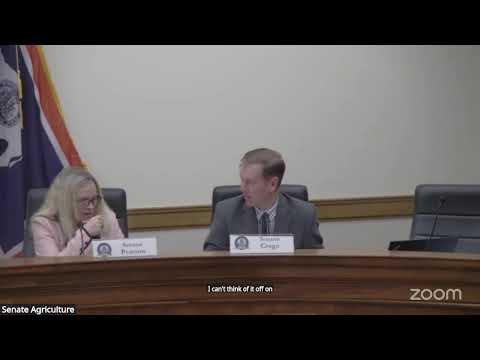
Senate committee debates House Bill 117: LaPrele Dam funding, Alkali Creek easements and deleted loan for temporary wells
Summary
The Agriculture, State & Public Lands & Water Resources Committee examined House Bill 117, the omnibus water-construction bill, focusing most heavily on funding shifts for LaPrele Dam rehabilitation, a long-running Alkali Creek Reservoir easement dispute and a short-lived amendment that would have created a $1 million grant and $19 million loan program for temporary wells.
The Agriculture, State & Public Lands & Water Resources Committee examined House Bill 117, the omnibus water-construction bill, focusing most heavily on funding shifts for LaPrele Dam rehabilitation, a long-running Alkali Creek Reservoir easement dispute and a short-lived amendment that would have created a $1 million grant and $19 million loan program for temporary wells.
The bill allocates state severance-tax money across multiple water development accounts and includes emergency infusions for two projects: a $20 million addition for a damaged irrigation tunnel and a funding package to address the condemned LaPrele Dam. Committee members debated transferring $50 million from the Alkali Creek Reservoir appropriation to fund LaPrele and discussed limits on state authority over dam decommissioning and reconstruction.
Why it matters: HB 117 would move tens of millions of dollars in state water-development funding and set deadlines and conditions that affect water users, infrastructure contractors and property owners in eastern Wyoming. The LaPrele project involves federal funds and a condemned dam whose decommissioning has already begun; the Alkali Creek funding has been stalled by unresolved easements with private landowners.
The committee heard from Jason Mead, director of the Water Development Office, and George Mosier of the Water Development Office, who walked members through the bill's account structure and project list. Mead told the committee that the Alkali Creek Reservoir project has been in planning and permitting stages for years and that roughly $59 million had been appropriated to it historically; about $5 million remained available for easement acquisition after prior expenditures. Mead said the Select Water Committee recommended sweeping $50 million from the Alkali Creek appropriation back to the statewide water accounts and redirecting it toward LaPrele because the money earning interest in the LSRA was producing more return than the water development account.
Committee members and multiple witnesses pressed on the Alkali Creek easements and the prospect of eminent domain. Senator Steinmetz said the Select Water Committee "put the brakes on" use of eminent domain and added, "eminent domain is not an option here." Jason Mead and Mosier described ongoing mediation efforts with affected landowners and confirmed some landowners remain unwilling to grant easements; Mosier said engineers found piping an existing ditch would raise costs by about $30 million, and that additional mediation is under way.
LaPrele Dam drew detailed comment from local officials and district representatives. Gary Shaddell, president of the LaPrele Irrigation District, told the committee the existing dam has been condemned by the state engineer and is being decommissioned; he urged full funding for a new dam, saying it stores about 20,000 acre-feet for roughly 11,462 acres of irrigated land and protects downstream infrastructure. Board members and the districts engineer, including Pete Rausch of ReSpec, described active demolition of buttress sections and said decommissioning had already begun before some of the House amendments were added.
A House amendment by Representative Yin had converted a proposed $20 million package for temporary mitigation into $1 million in exploration grants and a $19 million 30-year loan at 2 percent for "one or more wells or other water projects" to help LaPrele-area irrigators until a new dam can be built. Water Development Office staff and district board members raised concerns about the loan proposalnoting drilling costs, existing district governance (which requires a two-thirds vote to take a loan) and the risk that wells would not produce sufficient volume to meaningfully replace storage. Casey, a LaPrele board member, said: "I don't think we're gonna use it... I don't foresee a two-thirds vote occurring where we would be able to access $19,000,000 in loans." The committee voted to remove that Yin amendment (motion by Senator Craig, second by Senator Iden), approving the deletion on voice vote.
Another amendment, offered by Senator Bonar, sought to add special conditions to LaPrele funding including a requirement that the Water Development Commission ensure the new dam is constructed before decommissioning the old dam plus studies on hydropower, public access easements and recreation. Water Development Office staff said the office lacks authority to "ensure" reconstruction before decommissioning and that decommissioning had already begun. The committee voted to delete those special-condition provisions (motion seconded by Senator McEwen).
Committee members also addressed the Alkali Creek reversion timeline. The Select Water Committee had earlier set a later reversion date for remaining Alkali funds; Senator Craig moved (and the committee approved) an amendment to shorten the reversion so that unspent Alkali funds would revert on July 1, 2026 if easements are not secured.
Formal actions taken on HB 117 during the hearing included committee votes to delete the Yin amendment's grant/loan language, to remove the LaPrele special conditions from the bill, and to change the Alkali Creek reversion date. Committee members moved the bill for consideration and tracked several document amendments; the transcript records the successful passage of the three amendments described above. The Water Development Office noted that decisions about project time extensions and future funding would return to the Water Development Commission and the Select Water Committee if projects do not meet deadlines.
The committee also received public comment from multiple LaPrele representatives, Goshen Irrigation District staff, and state legislators from both the bill's House and Senate sides. Goshen Irrigation District general manager Kevin Strecker told the committee his district had secured most rights-of-way and anticipated early construction work if state funding were available.
What the committee left open: the committee revised and trimmed the bill but did not adopt a final floor engrossed text within the hearing transcript. Appropriators and sponsors indicated they may further refine language before floor consideration, particularly to clarify funding sources and the interplay of project-sponsor responsibilities.
Votes at a glance (as recorded in the hearing): the committee approved the motion to delete the Yin grant/loan language (mover: Senator Craig; second: Senator Iden), approved the motion to delete LaPrele special conditions (mover: Senator Bonar; second: Senator McEwen), and approved the motion to change Alkali Creek reversion to July 1, 2026 (mover: Senator Craig). The transcript records each of these amendments as "passed." The bill was moved for further consideration by the committee during the same hearing.