Get Full Government Meeting Transcripts, Videos, & Alerts Forever!
Get email alerts on the Homelessness topic
No spam. Unsubscribe anytime.
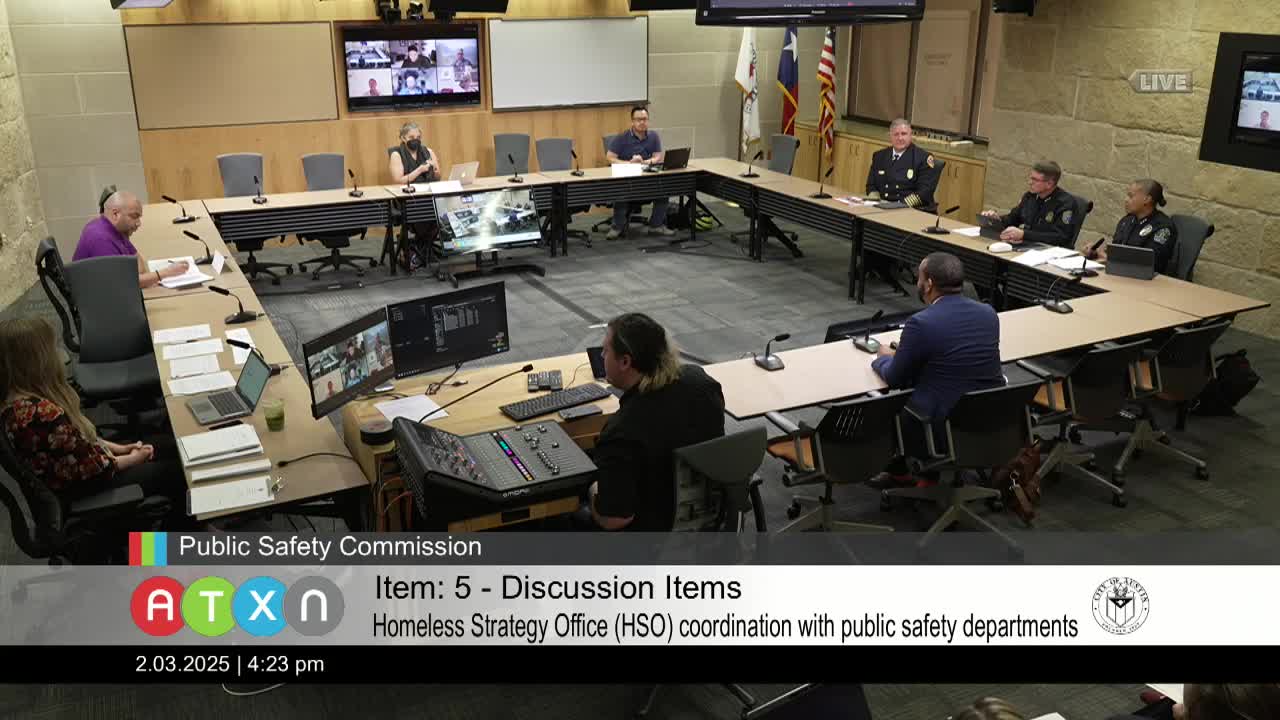
Homeless Strategy Office outlines HEAL encampment work, shelter capacity and outreach gaps
Summary
David Gray, director of Austin’s Homeless Strategy Office, told the Public Safety Commission the office used HEAL initiatives and partnership with public-safety agencies to move more than 400 people into shelter last year, but said shelter, mental-health and respite capacity remain insufficient.
David Gray, director of Austin’s Homeless Strategy Office, told the Public Safety Commission on Feb. 4 that the office was established in December 2023 and now administers roughly $30 million in annual service contracts for street outreach, case management and permanent supportive housing.
Gray described three core collaboration areas with public-safety partners — street outreach, public-space management and emergency shelter operations — and said the city’s HEAL (Housing-Focused Encampment Assistance Link) initiatives moved more than 400 people from encampments into shelter during the past year.
The office “conducted 12 HEAL initiatives” and four “supplemental sites,” Gray said, and the city’s work with Transportation, Public Works and Austin Police Department resulted in hundreds of clear-and-clean operations: 283 sites with city departments and 1,240 sites with APD.
Why it matters: Gray framed the office’s work as both public-safety and public-health — prioritizing wildfire risk, overdose prevention, shelter placement and transitions into rapid rehousing or permanent supportive housing. He told commissioners that outreach and shelter-flow capacity are the office’s limiting constraints.
Shelter operations and capacity: Gray described the marshalling-yard emergency shelter model, a triage-based “Embarkation Point” at One Texas Center used during cold-weather activations, and a text-alert system aimed at unhoused residents. The office reported a mass-text database with about 45,100 numbers for people experiencing homelessness; roughly 80% of those messages are successfully delivered and click-through rates increased from under 5% to over 26% during the most recent cold-weather activation.
Coordination with public-safety agencies: Gray detailed cross-agency work: APD officers assigned to an outreach street team, targeted prioritization of encampments in high wildfire-risk areas with firefighter input, and EMS drop-offs to the embankation point during weather activations. Gray also described a downtown-focused Heart Initiative that can send Urban Alchemy street outreach workers to calls that are not immediate safety risks before police arrive.
Technology and data: The office is revamping an internal Homeless Encampment Management tool intended to give city departments shared operational data about encampments, recent 911 calls, outreach visits and closure plans. Gray said the office uses the Homeless Management Information System (HMIS) for service tracking and is testing the encampment tool to provide public-safety partners with operational context.
Limitations and needs: Gray urged more shelter, medical-respite and mental-health beds. He said many interventions depend on partner capacity, such as Capital Metro buses for transport during activations, and on contracted outreach agencies. Commissioners pressed for better access to shelter registration — for example, decentralized embarkation points so residents who lack transportation can reach services without long trips downtown.
Ending: Gray said the office is still new — "if we were a baby, we'd just be learning how to walk" — and singled out training, data tools and additional shelter capacity as priorities for the coming year.