Get Full Government Meeting Transcripts, Videos, & Alerts Forever!
Get email alerts on the Simulcasting Permits topic
No spam. Unsubscribe anytime.
Committee pauses bill to give cities formal role in simulcasting approvals after extended debate
Summary
House Bill 85, which would change how simulcasting permits and historic horse‑racing machines are approved and give municipal governing bodies a formal approving role, received extensive testimony and was laid back for further work and amendments.
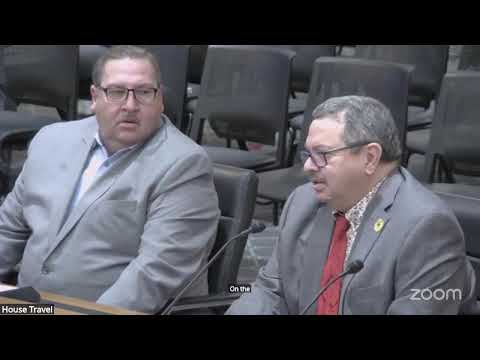
The House Travel, Recreation, Wildlife & Cultural Resources Committee heard extended testimony on House Bill 85, a measure that would change how simulcasting permits and historic horse‑racing (HHR) machine locations are authorized and regulated in Wyoming. After several hours of testimony from county and municipal associations, the Wyoming Gaming Commission, track operators and a privately financed track that opposes parts of the bill, the chair laid the bill back for additional drafting and stakeholder meetings.
Nick Laramendi, executive director of the Wyoming Gaming Commission, told the committee the bill would make the governing body of a municipality the local approving authority for simulcasting permits inside city limits while counties would continue to approve locations outside municipalities. The bill would require applicants to file with local approving authorities, require local public notice (two consecutive weeks and a website posting), allow local authorities to impose “reasonable conditions” (including hours of operation and the number of machines) and create grounds for revocation for good cause if conditions are breached.
The legislation would also amend existing definitions to clarify what a “historic horse racing machine” is and remove a requirement that a simulcast steward supervise each off‑track location. Perhaps the most contested change described in the hearing would repeal a statutory “hundred‑mile” protection that restricts simulcasting within 100 miles of a permitted racetrack unless the track agrees; the repeal and its consequences drew sharp disagreements in testimony.
County commissioners and the Wyoming Association of Municipalities (WAM) urged the committee to adopt the bill’s changes or to refine them through amendment, saying local governing bodies need explicit authority and notice to manage impacts on municipal services. Jeremiah Reeman, representing the Wyoming County Commissioners Association, argued county commissions have faced uncertainty about their legal authority to impose conditions and to revoke approvals, citing a Wyoming Supreme Court decision (Campbell County Board of Commissioners v. Wyoming Horse Racing) that found the Gaming Commission retains broad regulatory authority after an initial county approval.
WAM Executive Director Ashley Harpster told the committee the measure adds a notification process and local input mechanisms and said municipalities are responsible for day‑to‑day services that could be affected as gaming facilities expand.
Operators and industry representatives — including Wyoming Downs, Wyoming Horse Racing LLC and other permittees — generally supported the bill and the committee’s amendment package that was circulating during the hearing. Several operators said the bill provides clarity and a predictable local process.
Representatives of Cowboy Racing and its counsel opposed parts of the bill, particularly the removal of the hundred‑mile protection and language they said could apply retroactively to applicants mid‑process. Ryan Clement, a principal with Cowboy Racing, said the company has invested millions to build a full‑size racetrack and that the historical hundred‑mile rule supports purses and the business model for live racing: “The 100‑mile rule… is an industry standard and supports the legislature’s intent for HHR machines to support live horse racing,” he said. Counsel for Cowboy Racing also asked for a right of appeal to district court for new applicants if a local authority denies a site‑specific approval; the draft before the committee gave appeal rights only in limited circumstances.
Committee members heard a long list of proposed technical amendments and were told stakeholders on all sides wanted more time to resolve complex issues — jurisdictional conflict, appeal rights, retroactivity and the role of local conditions. Chairman Byron said, without objection from the committee, he would lay House Bill 85 back to the committee’s next meeting to allow more negotiation and to invite the Gaming Commission staff back for further Q&A.
No final vote was taken during the hearing; the measure remains under committee consideration.