Get Full Government Meeting Transcripts, Videos, & Alerts Forever!
Get email alerts on the Foster Youth Education Workforce topic
No spam. Unsubscribe anytime.
House committee hears overview of education and workforce supports for foster youth; $7.1 million in career‑planning grants announced
Summary
The Ohio House Workforce and Higher Education Committee heard an overview from Steve Dakin, director of the Ohio Department of Education and Workforce, about statutory protections, local liaisons and new state grants aimed at improving post‑high school outcomes for students in foster care.
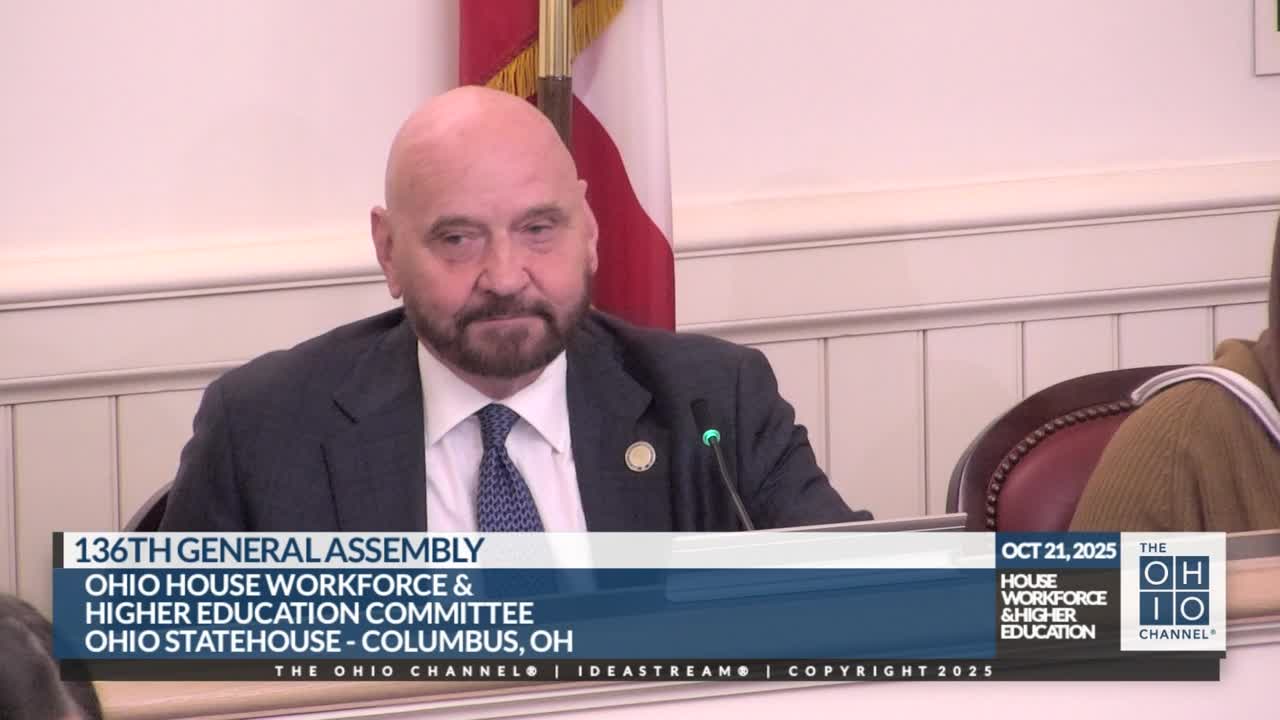
The Ohio House Workforce and Higher Education Committee heard Tuesday from Steve Dakin, director of the Ohio Department of Education and Workforce, who reviewed state and federal protections for K–12 students in foster care and described new state grants for career planning aimed at improving workforce outcomes for foster youth.
Dakin told committee members that Ohio public schools reported serving just over 14,000 students in foster care in the 2024–25 school year and outlined how federal and state rules are intended to protect educational continuity for those students. “Each student should see the relevance of his or her learning, be exposed to practical, real world work settings, and begin to define his or her future,” Dakin said.
The department highlighted the role of mandated local Foster Care Education Liaisons, staff members each district or community school must designate to coordinate with child‑welfare agencies, ensure proper identification of students in state data systems and facilitate enrollment, transfers and transportation when a change of placement occurs. Dakin said the department also maintains a foster‑care point of contact to support local districts and schools.
Dakin cited the federal Every Student Succeeds Act as the source of several protections — including the requirement that students in foster care be allowed to remain in their school of origin when that placement is in their best interest and that districts collaborate with child‑welfare agencies on transportation plans. He also referred to an Ohio statutory “bill of rights” for foster youth, identifying Ohio Revised Code section 2151.316 as setting out several educational rights, including participation in appropriate programs, access to vocational and postsecondary information, life‑skills preparation and access to extracurricular activities.
The department provided several statewide figures to the committee: just over 14,000 foster students statewide, roughly 800 in kindergarten, about 9,000 in elementary grades and about 4,700 in high school. Large urban districts have the highest counts: Columbus City and Cincinnati each have more than 500 foster students; Dayton about 400; Cleveland Municipal and Toledo just under 300. The department said roughly 90 foster students are using EdChoice scholarships in the current school year.
Committee members pressed Dakin on training, funding and accountability. Rep. John asked whether districts receive state funding specifically for liaisons; Dakin said districts may use federal Title I funds and typically designate existing staff in larger districts while smaller districts often assign the liaison role to staff with multiple responsibilities. “Typically, a lot of schools identify existing staff to do that,” Dakin said.
Several members asked about gaps in postsecondary access and workforce readiness. Dakin noted long‑standing statewide challenges: he said roughly 138,000 students enter high school in a typical year and that 68 percent of those students do not go on to earn a two‑ or four‑year degree within 10 years. To help address that, he described $7.1 million the legislature funded for career planning, an RFP the department recently issued and seven grant recipients selected to serve each JobOhio economic region.
Dakin said the grants are intended to build regional partnerships that braid public, private and nonprofit resources and to ensure local career planning is available beyond the districts that already provide it. “If every student can leave high school saying this sentence — ‘I know who I am, I know where I want to go, and I have adults who are gonna help me get there’ — think about the difference we would be making,” he said.
Lawmakers asked the department to provide follow‑up data and to work across agencies. Rep. Manning sought district discipline data for foster students; Dakin said he did not have that data in the hearing but would follow up. Rep. Williams raised regulatory conflicts with the Ohio Facilities Construction Commission that he said can constrain how schools use space for career and technical programs; Dakin said he was willing to convene agencies and work with administration to align efforts.
Members also discussed programs administered by the Ohio Department of Children and Youth that support foster youth after graduation, including a Bridges program and graduation stipends. Dakin and multiple members recommended using foster youth as a pilot population for broader regional partnerships because that population is already identified in district data and has persistent needs for coordination across education, human services and workforce systems.
The hearing was a discussion and information session; committee members did not take formal action during the meeting.