Get Full Government Meeting Transcripts, Videos, & Alerts Forever!
Get email alerts on the Property Tax Reform topic
No spam. Unsubscribe anytime.
’Flip the Script’ bill would give county auditors authority to decide valid sales for revaluations, sponsors say
Summary
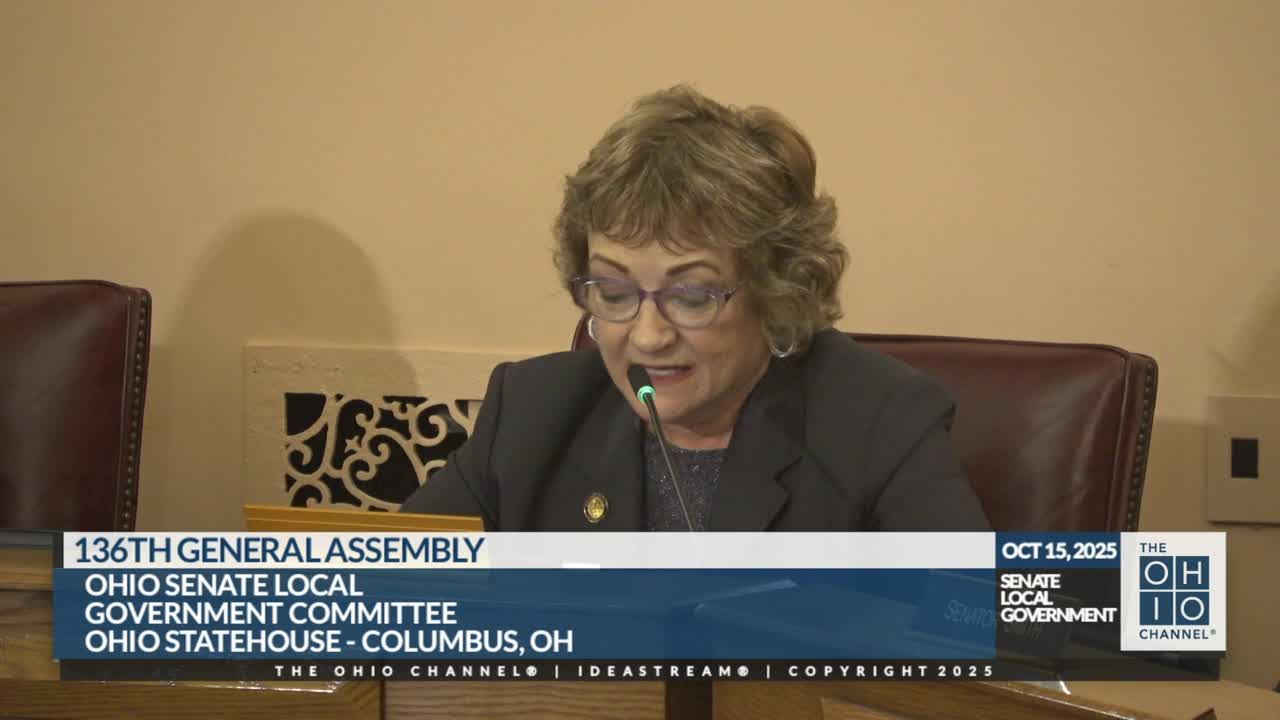
Amended House Bill 124, nicknamed "Flip the Script," would designate county auditors as the authority to determine which property sales count as valid arm's-length transactions for revaluation purposes, joint sponsors Representative Hall and Representative Thomas told the Senate Local Government Committee at a first hearing.
Amended House Bill 124, nicknamed "Flip the Script," would designate county auditors as the authority to determine which property sales count as valid arm's-length transactions for revaluation purposes, joint sponsors Representative Hall and Representative Thomas told the Senate Local Government Committee at a first hearing.
Representative Hall said the bill "would empower our locally elected county auditors" and argued that county auditors and their staff are better positioned to identify non-arm's-length transfers such as family sales, transfers involving personal property (he gave the example of a boat on a Lake Erie property), and wholesale flips that substantially change a home's character. "Local county auditor knows this and is best equipped to be able to say what's actually happening with the property," Representative Thomas told the committee.
Sponsors described the bill as a data-focused reform: property values should be determined using valid sales that reflect arm's-length transactions, they said, and county auditors routinely review sale details, contracts and photographs that the Department of Taxation may not be able to evaluate at scale. Representative Thomas said the Department of Taxation would remain "that sheriff" and retain "the power to appeal a decision by the auditor to the Board of Tax Appeals," preserving an oversight path.
Committee members raised practical and policy questions about scope and unintended effects. Senator Kaler asked whether the bill addresses LLC "drop and swap" transactions where property titled to an LLC is resold; sponsors replied that HB 124 does not address LLC transfers and that is a separate policy area. Ranking Member Senator Smith asked whether county auditors would review every sale in a month or only a subset; sponsors said auditors would review each sale to determine validity and that it is possible in some months many but not all sales would be treated as valid for market tracking.
Senator Smith also raised longer-term housing-stock concerns, noting research that older housing stocks may lead to increased flipping and market shifts. Sponsors responded that the revaluation process and auditor tools can account for renovated or effectively rebuilt homes so that a single flip does not improperly inflate values across an entire neighborhood.
Other committee members who spoke in favor drew on local experience. One sponsor said: "in my experience with the tax commissioner, for the most part, when I would argue that the sale is not valid ... usually he was like, okay, I didn't know that." That comment and others framed the bill as shifting the starting presumption to local knowledge while preserving state oversight by appeal.
Ending: The committee concluded the first hearing on amended House Bill 124; no committee vote or further action was recorded at the hearing.