
Frederick County supervisors and conservation easement authority discuss tools, water science and funding to preserve rural land
Get AI-powered insights, summaries, and transcripts
Subscribe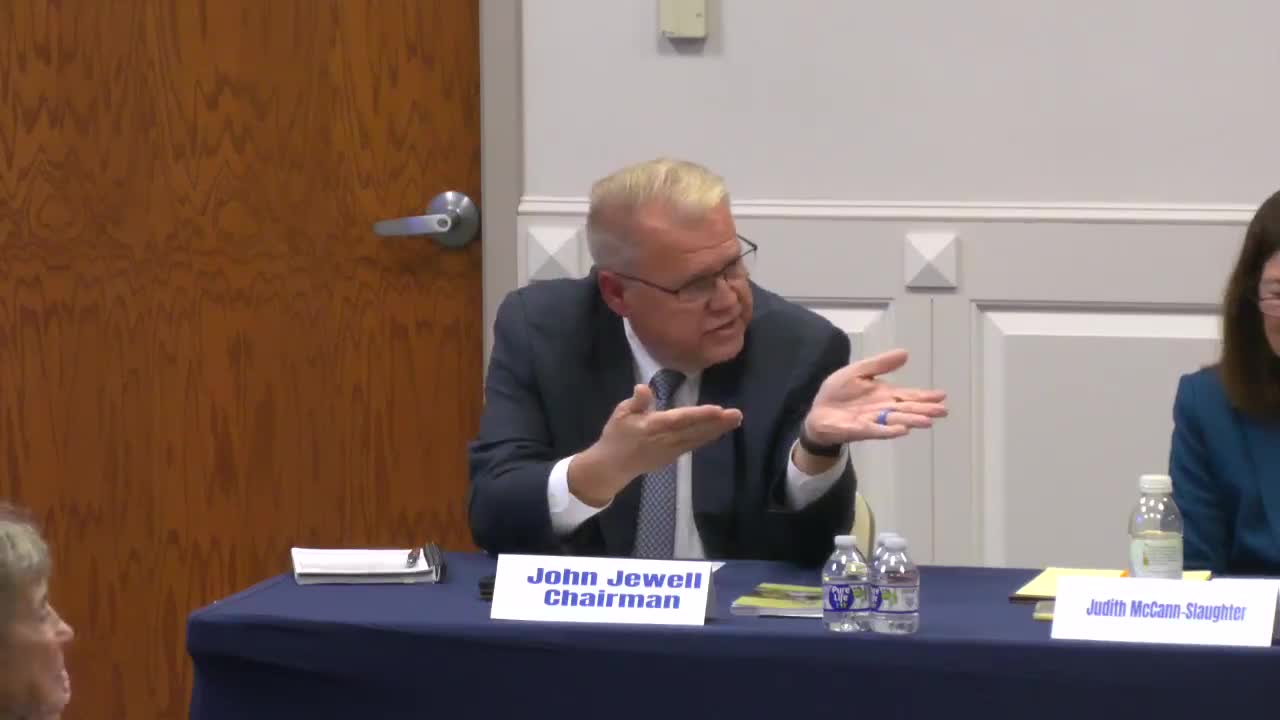
Summary
At a work session with the Frederick County Board of Supervisors and the Conservation Easement Authority (CEA), county officials, board members and CEA representatives reviewed the county’s current conservation toolbox and said clearer priorities, funding and updated water science are needed to preserve farmland and rural resources.
At a work session with the Frederick County Board of Supervisors and the Conservation Easement Authority (CEA), county officials, board members and CEA representatives reviewed the county’s current conservation toolbox and said clearer priorities, funding and updated water science are needed to preserve farmland and rural resources.
CEA Chair Diane Curran urged the board to adopt “a better vision for what we want Frederick County to be,” saying the authority will focus first on soil, water and air as it develops a strategy and metrics to “figure out, are we getting anywhere?”
The discussion centered on the mix of existing programs the county already uses to steer development: conservation easements (held by local authorities and outside groups), transfer of development rights (TDR) that move development into urban development areas (UDA), newly authorized purchase of development rights (PDR) policy, and agricultural and forestal districts that require periodic renewal. Planning staff outlined acreage figures and the scale of the remaining unprotected land to show the scope of the challenge.
Planning staff said Frederick County has nearly 10,000 acres in conservation easements, with the Virginia Outdoors Foundation holding just under 6,000 acres and Potomac Conservancy nearly 2,000. The George Washington National Forest covers about 7,600 acres in the county, parks roughly 700 acres and battlefield easements about 400 acres. Staff also reported about 6,000 rural acres preserved through TDRs and nearly 18,000 acres in ag and forestal districts. The county’s RA zoning permits “by right” development of one dwelling unit per five acres, and staff offered a rough, theoretical estimate that, without other constraints, remaining qualifying RA parcels could translate into tens of thousands of potential dwelling units, underscoring development pressure on rural parcels.
CEA members and several supervisors said the tools work in different ways and have tradeoffs. Curran and others described the PDR program as a way to permanently extinguish development rights — if money is available — and said the TDR program can push development into UDAs but may also circumvent proffers that offset development impacts. CEA member Leslie Spencer called for redefining what “rural” means to the county so the authority and planners can agree on what to prioritize.
County leaders and the CEA repeatedly raised water supply and groundwater recharge as a top technical question that must inform any conservation plan. Wyatt Pearson, the county planning director, noted the Northern Shenandoah Valley Regional Commission (NSVRC) will carry out the local portion of the statewide water supply plan update but said the NSVRC has limited funding and that its timeline for completion is 2029. Pearson and other officials warned the statewide water-supply plan is not designed to produce a single “carrying capacity” number for local groundwater extraction; staff pointed to a 2005 U.S. Geological Survey (USGS) report as the closest existing study of local recharge capacity.
Pearson said Frederick Water — the primary local water utility — recently completed a 20-year demand study and intends to bring it to the board in the coming months. He described standard groundwater testing methods used by utilities — for example, running pumps at full volume and monitoring drawdown in surrounding wells — to ensure individual permits do not produce immediate negative impacts. Board members asked for more public, regular presentation of water data so residents can better understand current conditions and what mitigations are needed.
Discussion returned repeatedly to funding: staff and CEA members said conservation programs typically require upfront matching funds to win state and federal grants, and the county’s limited staffing constrains outreach and grant-writing. Suggested local revenue options included general fund allocations, rollback tax revenues, and a previously adopted solar ordinance that earmarked some revenue for conservation; local leaders noted those avenues carry policy tradeoffs and require board direction.
Supervisors also discussed whether the UDA boundary east of Interstate 81 remains the right demarcation for concentrated development. Some said UDAs and receiving areas for TDRs should be revisited so receiving-area capacity better matches the county’s goals for concentrating growth and protecting rural lands. Several supervisors emphasized the need for a county strategic plan that ties conservation objectives to economic development, schools and infrastructure funding.
CEA members described planned public outreach and technical informational sessions — including an informational meeting scheduled for Nov. 20 — intended to educate landowners about conservation easements, riparian buffers and programs such as CREP (Conservation Reserve Enhancement Program). The authority said it will begin drafting a conservation “ethic” and program priorities tied to measurable metrics and will return to the board with proposals and requests for direction.
Board members and staff generally expressed support for continuing the conversation, asking CEA and planning staff to develop specific proposals, data requests and potential funding options. No formal votes were recorded during the session.
The meeting closed with supervisors stressing the need to act promptly. “If we don't model that and shoot for it, you're not going to get it,” one supervisor said, urging CEA and staff to prepare five- and 10-year plans that the board can review.
Ending: The CEA said it will begin framing a conservation strategy focused on soil, water and air and will return with recommended metrics, partnership options and possible funding sources for board consideration; staff said they will seek additional technical information about groundwater and bring Frederick Water and regional partners into future discussions.