Lifetime Citizen Portal Access — AI Briefings, Alerts & Unlimited Follows
Witnesses split over HB 10 provisions on cultivated meat labeling and public procurement
Loading...
Summary
The Senate Agriculture and Natural Resources Committee heard split testimony on House Bill 10's labeling and procurement provisions for cultivated meat, with an attorney urging the committee to oppose the bill and an industry scientist warning restrictions could harm innovation in Ohio.
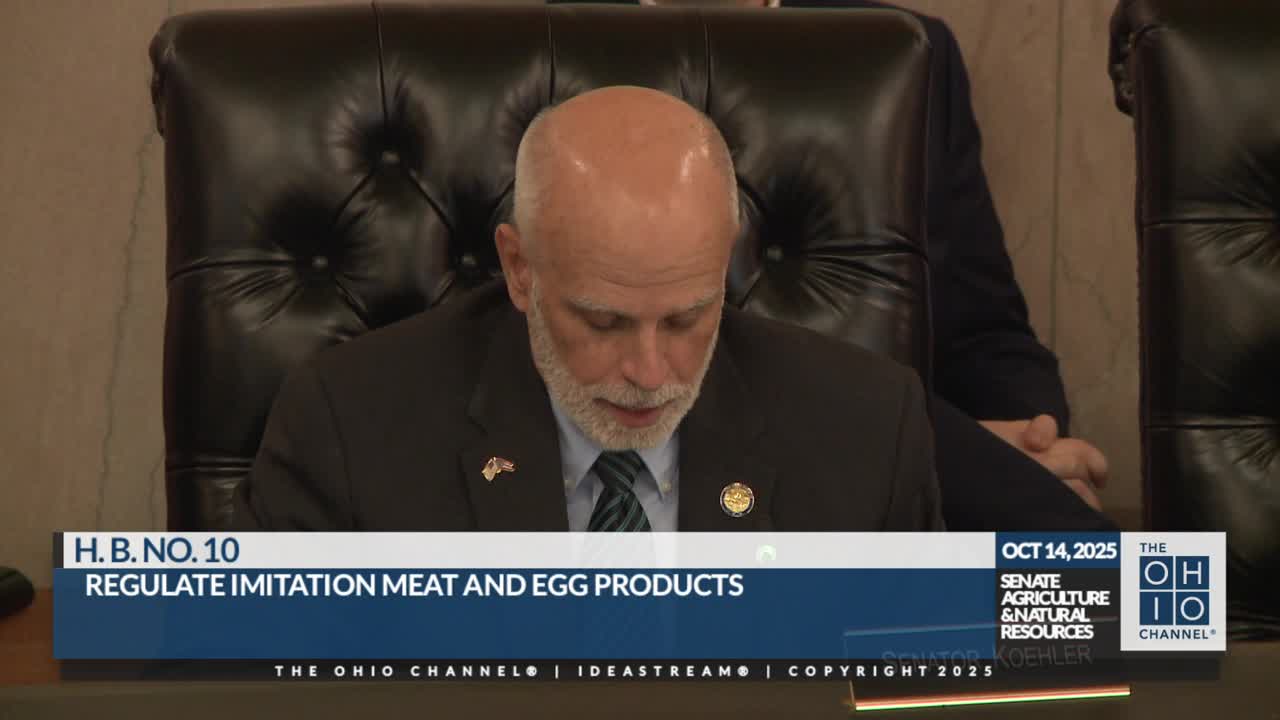
The Senate Agriculture and Natural Resources Committee heard in-person testimony for and against provisions of substitute amended House Bill 10 that address food labeling and procurement of novel products such as cultivated (cell-cultured) meat.
Rachel Kilgore, an attorney and New Albany resident testifying as an opponent, urged the committee to reject the bill "in its entirety as it is written with the amendments accepted today." Kilgore told the committee she was concerned the bill's "origin . . . would trace back to feelings and speculation, as well as statistics with no citations," and said the bill's language contained grammatical ambiguities. She argued the bill places burdens on parties other than those it purports to protect and questioned the practical relevance of some provisions: "But since when are they serving T bone steak in schools? And how do you know what types of diseases or illnesses a nonhuman animal had before you consumed it if no one ran the proper blood work or testing on said nonhuman bridal?" (testimony language as spoken).
Dr. Heidi Coia, PhD, representing Nexture Bio and testifying as an interested party, said cultivated meat (also called cellular agriculture) is produced from animal cells in sterile facilities and noted that some products have been reviewed by the U.S. Food and Drug Administration and the U.S. Department of Agriculture. She told the committee the bill's procurement provisions "will unintentionally discourage food innovation and therefore investment in Ohio," and urged clear factual labeling that aligns with federal labeling decisions (for example, labels approved by USDA such as "cultivated chicken"). She said Ohio could be a manufacturing hub for components and materials used in cultivated meat production and urged the committee to avoid broad procurement restrictions that would send an unwelcome signal to innovators.
Committee discussion also recorded two written opponent testimonies available to members: Erica Davidson of Columbus Bridal Advocates and Susanna Gerber of the Association for Meat, Poultry and Seafood Innovation. The transcript lists both as opponents; the committee did not call them for in-person remarks during this hearing.
The committee accepted a second amendment to House Bill 10, AM 136-09-64, which removed a requirement that the Ohio Department of Job and Family Services director and the director of health submit waivers to the U.S. Department of Agriculture to exclude fabricated egg products from purchase under WIC and SNAP; the amendment also included an LSC technical correction to update a section number changed by House Bill 96. Vice Chair Kaler moved to accept the amendment; with no objections, the amendment was accepted.
Why it matters: HB 10's labeling and procurement provisions touch on consumer information, school and public-institution food purchasing policies, and the economic development implications of emerging food technologies. Supporters of clear labeling cited consumer choice; industry witnesses warned procurement restrictions could limit local investment and innovation.
The committee concluded the hearing on the substitute amended bill after the testimony and recorded it as the bill's third hearing; no final committee vote on the underlying bill was recorded in the transcript.