Get Full Government Meeting Transcripts, Videos, & Alerts Forever!
Get email alerts on the Teacher Preparation Rules topic
No spam. Unsubscribe anytime.
PELSB staff propose streamlining unit and program approval, shifting emphasis to unit-level review
Summary
Staff proposed minor changes to the board's unit and program rules to concentrate evaluation at the unit approval stage, lengthen program reporting cycles, and better incorporate alternative assessments such as CPaaS into program evaluation.
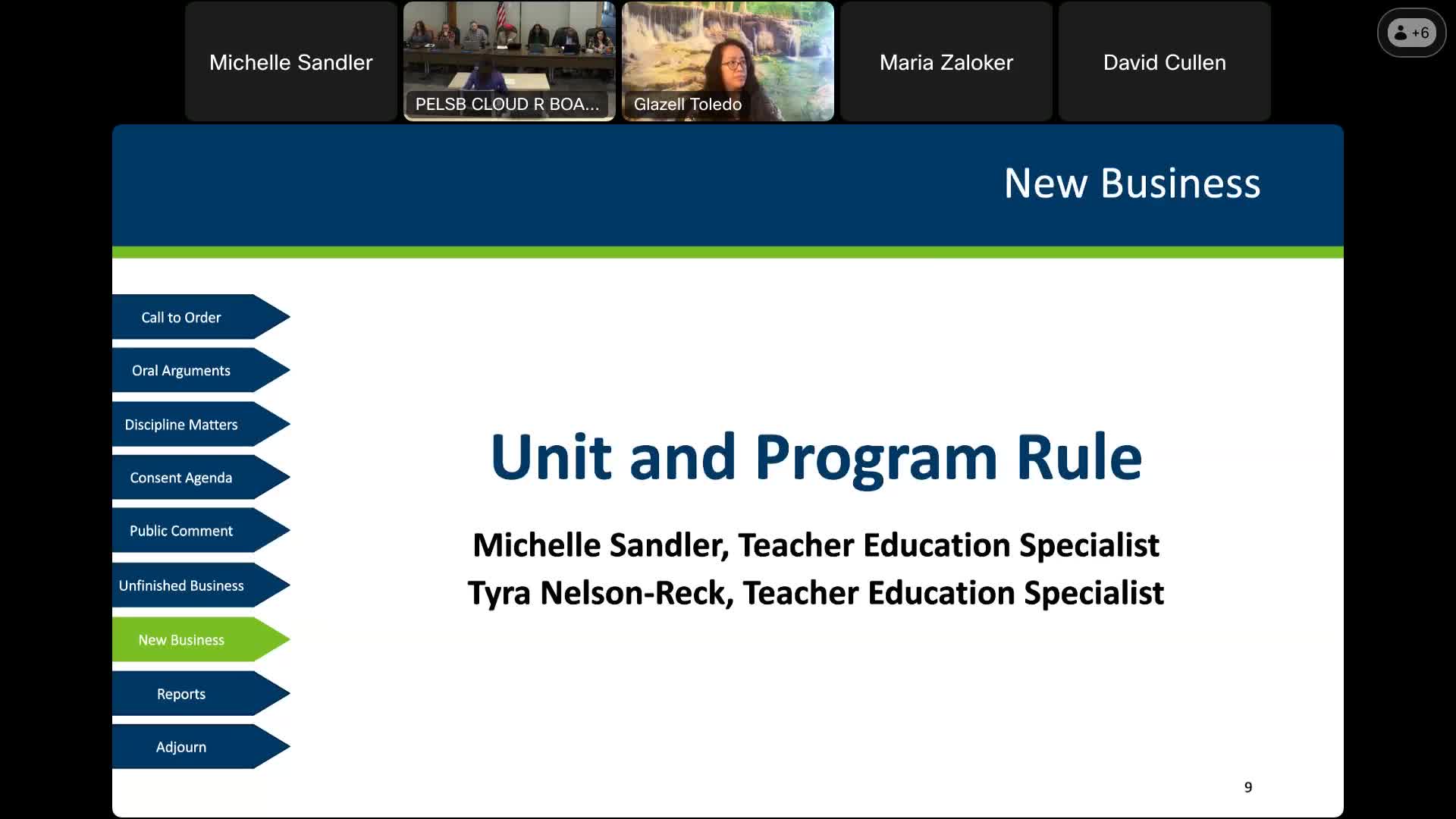
Staff at the Professional Educator Licensing and Standards Board on Feb. 21, 2025 proposed amendments to unit and program rules intended to shift more evaluative focus to unit-level review and reduce the reporting frequency for programs.
The proposal, presented by a PELSB staff member identified in the record as Miss Sandler, said the board's 2021 overhaul of unit and program rules remains the foundation but that subsequent changes — including the phase-out of the MTLE and the emergence of a CPaaS pilot and continued use of edTPA by some programs — mean the board now receives limited task-level edTPA data during program review. "We believe that by streamlining unit and program approval, so digging deeper at the unit approval time to get information about programs, there's just more context for all of that information," Sandler said.
Under the proposed approach, unit approvals would be the principal vehicle for collecting and evaluating a broader set of data (key assessment data, survey data, edTPA or CPaaS where used). Program review would focus primarily on whether teacher standards are met and only examine individual programs in depth when unit-level data indicate concerns. Staff also proposed extending the frequency between required program submissions (from three years to six years) to allow programs and reviewers to accumulate more meaningful data given declining candidate counts.
Board members who spoke in support said the changes should reduce duplicative burden on preparation providers and provide richer, disaggregated data for accountability. "Teacher preparation certainly has a huge load on their plate related to assessment," said one board member, adding the changes should "allow better and more clear assessment processes for us on the teacher prep side." Other members asked about the pace of remediation and the ability to address program problems between longer review cycles; staff answered that the unit review includes midpoint check-ins and that serious concerns would trigger earlier review of specific programs.
What was not decided The board did not vote on final rule text at the Feb. 21 meeting; staff presented draft language in the board packet and said additional details remain to be fleshed out regarding the process for investigating individual programs flagged during a unit review. Staff also noted that initial programs would still be required to use one of the recognized performance assessments (edTPA or CPaaS) for initial licensure measures.
Next steps Staff said rule-language edits and implementation details will be developed and returned to the board. PELSB members and the public were invited to submit input ahead of future rulemaking steps and unit/program approval changes.