Get Full Government Meeting Transcripts, Videos, & Alerts Forever!
Get email alerts on the Surplus Lines Fees topic
No spam. Unsubscribe anytime.
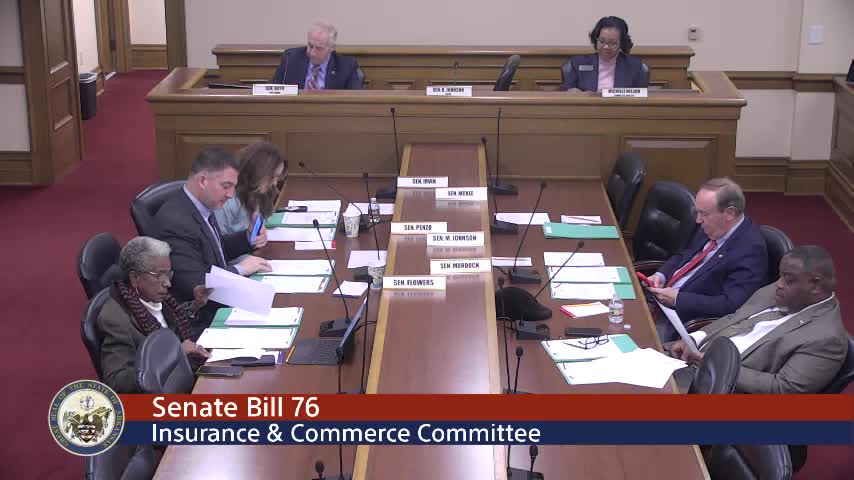
Committee approves bill to codify surplus-lines broker fee practice, exempting brokers from 20% cap
Summary
Senate Bill 76 was approved by the Senate Insurance & Commerce Committee to put into statute an exemption that allows surplus-lines brokers to charge fees beyond the 20% cap applied to agents, sponsors said this preserves access to coverage for hard-to-place risks.
The Senate Insurance & Commerce Committee approved Senate Bill 76 to place into Arkansas law an existing practice by the Arkansas Insurance Department that surplus-lines brokers are exempt from a 20% fee cap applied to agents.
Senator Johnson presented the bill, saying it "does not change existing public policy since 02/2015" but moves the Department's interpretation into statute. He said surplus-lines brokers face different costs than admitted-market insurers and often must charge separate fees to cover underwriting, inspection and placement costs. "For that reason, surplus lines brokers frequently charge fees in order to... find insurance solutions for hard to place risk after they are declined by the standard market," Johnson said.
Former Insurance Commissioner Alan Kerr testified to clarify rate effects. "The rate structure will not change. It does not, actually, this helps the rates, by brokers being able to, place those fees separately from the base premium. It is, they're required by law to show them on the policy, show them to the public, what the fees are, what the commissions are," Kerr said.
John Adams, identified as president of the Surplus Lines Association for Arkansas, explained how the separate-fee model prevents premiums from ballooning after brokers must pay upfront costs. He gave a calculation framework used in committee: for a hypothetical $1,000 premium with a 20% cap the broker might have $200 to cover commission, while inspection and data costs could exceed that amount; scheduling fees instead of rolling them into premiums keeps consumer costs lower in many cases, Adams said.
Members asked about consumer protections, how "reasonable" fees would be determined, and whether inspections and other placement costs would recur at renewal. Witnesses said fees must be disclosed on invoices and policies, the insurance commissioner retains authority to judge reasonableness, and renewal fees typically are lower but may still appear when ongoing underwriting or reporting is required.
The committee record notes that the Department of Insurance has applied the exemption since February 2015 and that 44 states have no statutory restriction on surplus-lines broker fees. After discussion, Senator Johnson moved to adopt the bill; the committee voice-voted in favor and the chair announced the bill passed.
Votes at a glance
- Senate Bill 76: Motion to adopt by Senator Johnson; second not specified in transcript; voice vote recorded; outcome announced as passed by the chair.