Get Full Government Meeting Transcripts, Videos, & Alerts Forever!
Get email alerts on the Public Comment Policy topic
No spam. Unsubscribe anytime.
Dickinson commission tables proposed public‑comment rules after lengthy debate
Summary
After more than two hours of discussion, the Dickinson City Commission voted unanimously to table a proposed policy that would have restricted when and how residents can speak during public‑comment periods and required advance sign‑ups.
The Dickinson City Commission voted unanimously on a motion March 11 to table a proposed policy that would have set new rules for the meeting public‑comment period, including advance sign‑up requirements, a five‑minute time limit per speaker and a prohibition on audio‑visual materials during comment.
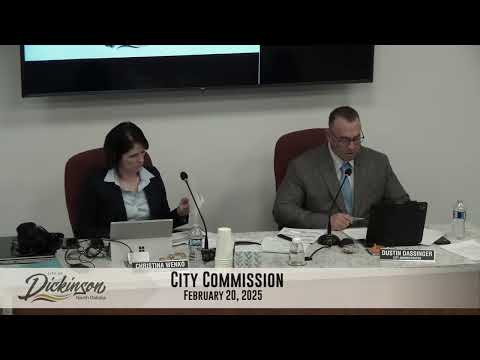
City Administrator Dossinger presented the draft rules and said the city wants public input while preserving “the integrity and professionalism of the City Of Dickinson’s commission meetings.” He told commissioners the proposal would require anyone who wishes to speak during the public‑comment period to sign up no later than 12 p.m. the day before the meeting, limit comments to five minutes (with a commissioner able to request an extension), restrict comments to matters within the scope of municipal business, and bar presentations and videos during the comment period.
The proposal included additional requirements: no late or in‑person signups immediately before or during the meeting, one comment per individual per meeting, and language that comments “should not be defamatory, abusive, harassing, or unlawful.” Dossinger also noted the city attorney’s review and told the commission the memo was not a reaction to any single speaker but grew out of a December work session.
Attorney Wanko (city attorney) opened with a legal overview, citing North Dakota statutory guidance and Attorney General opinions that, in her summary, distinguish public hearings required by statute from other meetings and allow municipal bodies to adopt neutral time, place and manner restrictions on speech. She said municipalities commonly adopt rules to limit disruptive, irrelevant or overly time‑consuming remarks and described practices in several North Dakota jurisdictions, including Bismarck, Mandan and West Fargo.
Commissioners pressed on specific elements. Multiple commissioners objected to the requirement that speakers sign up a day in advance, saying it would prevent spontaneous comments from people attending the meeting and could silence citizens who did not anticipate an issue beforehand. Commissioner Riddle and Commissioner Frederick both said they feared the sign‑up rule would deny useful, timely input; Commissioner Oderman said he would consider striking that portion or returning it for further discussion. Several commissioners raised concerns about whether residents who live in the city’s extraterritorial (ETZ) zone should be counted as city residents for comment purposes — noting that the commission controls zoning in the ETZ while some other services remain under county jurisdiction.
Several commissioners expressed support for limiting comments by time to keep meetings efficient; others said five minutes might be too short for topics that are complex or for speakers who are uncomfortable speaking publicly. Commissioners also debated whether the city should allow a process to place a speaker on a formal agenda at a future meeting (for example, by request of a commissioner) when the substance of a comment merits more staff or commission consideration.
Dossinger and Wanko told the commission that no specific city code currently governs the public‑comment format and that any change would be adopted as an internal policy unless the commission decides to place it in the municipal code. Dossinger additionally noted a bill pending in the North Dakota Legislature (Senate Bill 2180) that would require political subdivisions to provide opportunities for public comment at a portion of regular meetings and permit political subdivisions to adopt time limits or a formal policy — meaning state law may affect local procedure.
After the discussion, Commissioner Frederick moved and Commissioner Bair seconded a motion to table the draft policy. The motion carried unanimously: Commissioners Frederick, Bair, Riddle, Baer, and Oderman voted “aye,” and Chair Decker cast the deciding vote in favor. The commission asked city staff and the city attorney to produce a formal resolution or policy draft that reflects the discussion and return it for consideration at a future meeting.
Why it matters: Public‑comment rules define how residents access elected officials and can affect whether spontaneous, time‑sensitive concerns can be raised in public. Commissioners said they wanted both orderly meetings and the ability to hear residents’ concerns, and they asked staff to return with a written resolution that balances those aims.
Looking ahead: City staff will draft the proposed resolution incorporating commissioner feedback; the commission directed staff to return the written policy for a future meeting. Dossinger and Wanko indicated they will monitor the status of Senate Bill 2180, which could require local changes to any new policy.