Get Full Government Meeting Transcripts, Videos, & Alerts Forever!
Get email alerts on the Protected Speech Database topic
No spam. Unsubscribe anytime.
Panel debates bill to bar Department of Human Rights from keeping database of protected speech; bill laid over
Summary
Vice Chair Nolan Hudson told the Minnesota House Judiciary Finance and Civil Law Committee on Feb. 20 that House File 768 would bar the Minnesota Department of Human Rights from creating or maintaining a database that tracks constitutionally protected speech.
Vice Chair Nolan Hudson presented House File 768 to the Minnesota House Judiciary Finance and Civil Law Committee on Feb. 20, arguing the bill is intended to protect constitutionally guaranteed expression by barring the Minnesota Department of Human Rights (MDHR) from creating or maintaining a database that records protected speech.
"This bill reaffirms that protected speech cannot be monitored or tracked by the government," Vice Chair Hudson said, adding the measure "ensures that the government does not infringe upon free expression while continuing to enforce anti discrimination laws."
Rhianna Lee, legislative and coalitions director for Americans for Prosperity in Minnesota, testified in favor and said state-run databases of bias incidents can chill lawful speech. "No Minnesotan should have to worry that their words . . . might be catalogued by the state," Lee said.
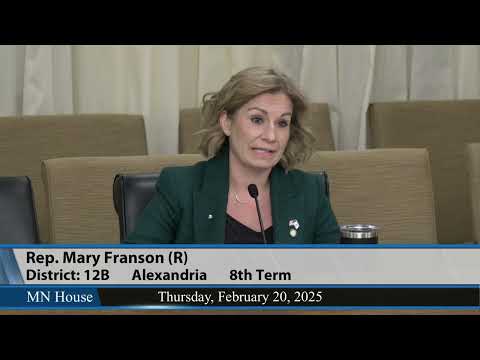
Members raised multiple concerns about the bill’s breadth and possible downstream effects. Representative Heather Finke and Representative Feist suggested ways to preserve aggregate trend reporting — for example, deidentified data or biennial trend reports by MDHR — while preventing identifiable monitoring of constitutionally protected expression. Representative Tina Liebling warned that overly broad language could inadvertently bar MDHR from retaining police reports or news clippings that ‘‘incidentally contain protected speech.’’
Vice Chair Hudson said the bill targets intentional collection and maintenance of databases focused on protected speech and that the committee has time to refine language. Hudson repeatedly referenced last session’s HF 181 (which became part of omnibus legislation) and argued that authorizing an MDHR database could be used later in ways that would chill speech.
Committee discussion also touched on the relationship between speech trends and criminal activity. Representative Curran and others argued that patterns of hateful or dehumanizing speech can precede or correlate with increases in violence against targeted groups, and that aggregate trend data can inform policy and prevention work. Hudson countered that MDHR is not a law enforcement agency and that prohibiting creation of a protected-speech database would not impede legitimate criminal investigations by the police.
After extended debate about definitions of "protected speech," aggregate versus identifiable data, and MDHR’s existing authorities and funding, the committee laid House File 768 over for further consideration and possible amendment.
Ending: Members said they are open to negotiated language that would protect free expression while allowing MDHR to perform investigative and trend-reporting tasks consistent with constitutional protections; the bill was laid over for further drafting and analysis.