Get Full Government Meeting Transcripts, Videos, & Alerts Forever!
Get email alerts on the Apportionment Constitution topic
No spam. Unsubscribe anytime.
Committee advances interim study on constitutional apportionment after wide public testimony from Weston County
Summary
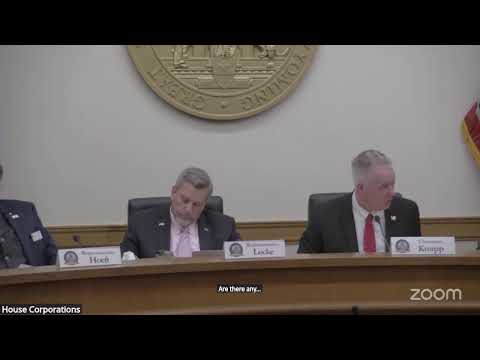
House Bill 296 passed the Corporations Committee unanimously to create an interim committee to study whether Wyoming's legislative apportionment conforms to the state constitution and the 14th Amendment; proponents from Weston County urged action to restore county-based representation.
Speaker Chip Nyman presented House Bill 296, asking the committee to authorize an interim study of legislative apportionment and to report back to the legislature by Dec. 1, 2025. "What we're attempting to do here…is to go back and to evaluate that and see if we can more align with what our state constitution asks us to do," Nyman said.
The bill would direct the management council to assign a committee (the draft envisions assignment to an existing or select committee) to study apportionment during the 2025 interim, conduct community meetings, and report recommendations for possible constitutional or statutory changes for introduction in the 2026 budget session. The sponsor cited specific provisions of the Wyoming Constitution—Article 3, Sections 3 and 48—and the equal-protection objectives of the U.S. Constitution's 14th Amendment in arguing the legislature should examine compliance.
Public testimony was concentrated and substantial. Several witnesses from Weston County said local voters and county governing bodies have repeatedly passed resolutions urging adherence to Article 3, Section 3, which they interpret as requiring legislative districts to follow county lines and to ensure each county has at least one senator and one representative. Trisha Baumann of Weston County said she had prepared multiple apportionment proposals for the interim committee and urged an "amicable solution." Carl Lacey, calling himself the county's "constitutional representative," and constitutional district senator Sue Morales testified the goal is to bring Wyoming into compliance with its constitution and the 14th Amendment.
Representative J.D. Williams (House District 2) and several public witnesses said the change responds to rural concerns about diminishing representation after redistricting; Williams described a scenario in which a county split between districts can feel effectively voiceless on particular votes. Secretary of State Chuck Gray also told the committee he supports the bill and recommended careful scheduling and sufficient meeting time; he suggested the committee might consider test-case options and that three interim meetings likely would be inadequate.
League of Women Voters testimony urged adherence to the principle of "one person, one vote" and cautioned the committee about the arithmetic tradeoffs: a strict county-based approach could, they noted, imply a far larger legislature if taken literally. The League said courts have long enforced equal-population principles and that the identification of practical, constitutional-compliant solutions is precisely the point of a study.
Committee members asked about possible remedies discussed in testimony, including increasing the legislature's size, merging counties, or applying a weighted-vote system so representatives of less-populated counties would have votes proportionate to the population they represent; the sponsor said he was open to a range of options and that the interim committee should explore alternatives. The committee voted to pass HB 296 to the next stage. Representative Brown moved the bill; Minority Leader Yin seconded. The roll call recorded nine ayes and no no votes; the chair declared the bill passed out of committee.
The bill directs that the assigned committee conduct meetings across the state in the 2025 interim, collect public input, and report back with draft legislation for the 2026 budget session if warranted. Supporters from Weston County said they plan to participate and present multiple draft proposals to the interim study panel; several noted that county commissions and local party bodies had adopted resolutions urging conformity with Article 3, Section 3.
The committee did not adopt specific remedial language; instead it advanced the bill as a study directive so legislators and stakeholders can develop options over the interim.