Get Full Government Meeting Transcripts, Videos, & Alerts Forever!
Get email alerts on the Elections Runoffs topic
No spam. Unsubscribe anytime.
Wyoming committee approves bill to require runoffs for top statewide and federal primaries
Summary
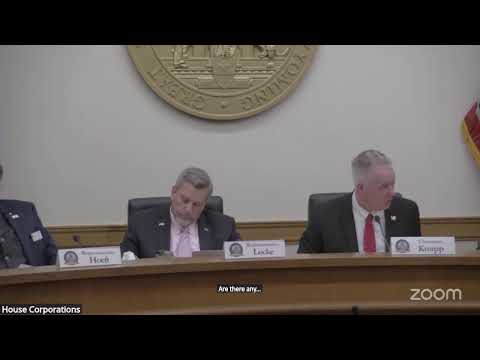
The Wyoming House Corporations Committee voted 8-1 to pass House Bill 249, which would require a runoff when no primary candidate for specified statewide or federal offices receives a majority; the bill would move the primary earlier and create a reimbursement account for counties.
Speaker Chip Nyman, sponsor of House Bill 249, told the Corporations, Elections & Political Subdivisions Committee the measure would require a runoff when no candidate for certain statewide or federal offices receives 50% plus one vote in a partisan primary. "It concerns me, that we're electing people that do not have over half the vote," Speaker Nyman said during his opening remarks.
The bill would apply to the state's top five statewide elected offices and federal offices, not to legislative races, Nyman said. Under the proposal the primary would move to May and, if needed, a runoff would be held on the first Tuesday after the second Monday in August in general-election years. The bill adds statutory language throughout current election law to create the runoff process, specifies ballot and notice requirements, allows write‑in candidates in runoffs, and creates an account to reimburse counties for the cost of a runoff.
Secretary of State Chuck Gray testified in support and said the office can implement the bill. Gray provided two agency cost estimates: upgrades to the voter registration system (YOReg) at about $247,000 and campaign finance system (YCIFS) changes at about $35,218, and said those expenses could be paid from the runoff election account created in the bill. "This bill would require a runoff election to be held if a candidate for statewide or federal office in a primary election does not receive 50 of the vote," Gray said.
Opponents and supporters from the public and organizations offered differing practical concerns. Gail Simmons of Sheridan, representing Civics 307 and Y Vote, opposed the bill and cited turnout and cost concerns, saying a study of congressional primary runoffs found turnout fell in 96% of cases, with a median decrease of about 40 percent. "That would translate to a 25 to 30% participation in a Wyoming runoff," Simmons testified, and she urged alternatives such as opening the primary or using a top-2 general election.
County election officials said administratively the change is workable but would accelerate deadlines. Mary Langford, speaking for Wyoming county clerks, and Malcolm Irvin, Platte County clerk and president of the County Clerk's Association, said the association had worked with Nyman and that the bill is implementable as written but could require small timeline changes in years with redistricting. Irvin asked for planning lead time: if parties could opt out, clerks said they would need notice (they suggested party decisions be set in odd-numbered years so clerks had about six months to plan). Brett Moline of the Wyoming Farm Bureau said his members support runoffs as the best option for determining a majority winner.
Committee debate included a failed amendment to appropriate $200,000 for voter education. The committee then voted to move the bill forward. Representative Weber moved passage; Representative Johnson seconded. The roll call recorded eight ayes and one no: Representatives Brown (aye), Locke (aye), Heft (aye), Johnson (aye), Lucas (aye), Webb (aye), Weber (aye), Yin (no), and Chairman Knapp (aye). The chair declared House Bill 249 passed the committee.
If implemented, the bill would change filing and timeline dates (Nyman noted changes to candidate filing windows from 96 to 90 days and 81 to 80 days in the draft), require additional campaign finance filings for runoff candidates, and create a runoff account in the Secretary of State's office to reimburse counties for the direct costs of a runoff election. The bill also explicitly allows registered electors who did not vote in the primary to register and vote in the runoff.