Get Full Government Meeting Transcripts, Videos, & Alerts Forever!
Get email alerts on the Rezoning topic
No spam. Unsubscribe anytime.
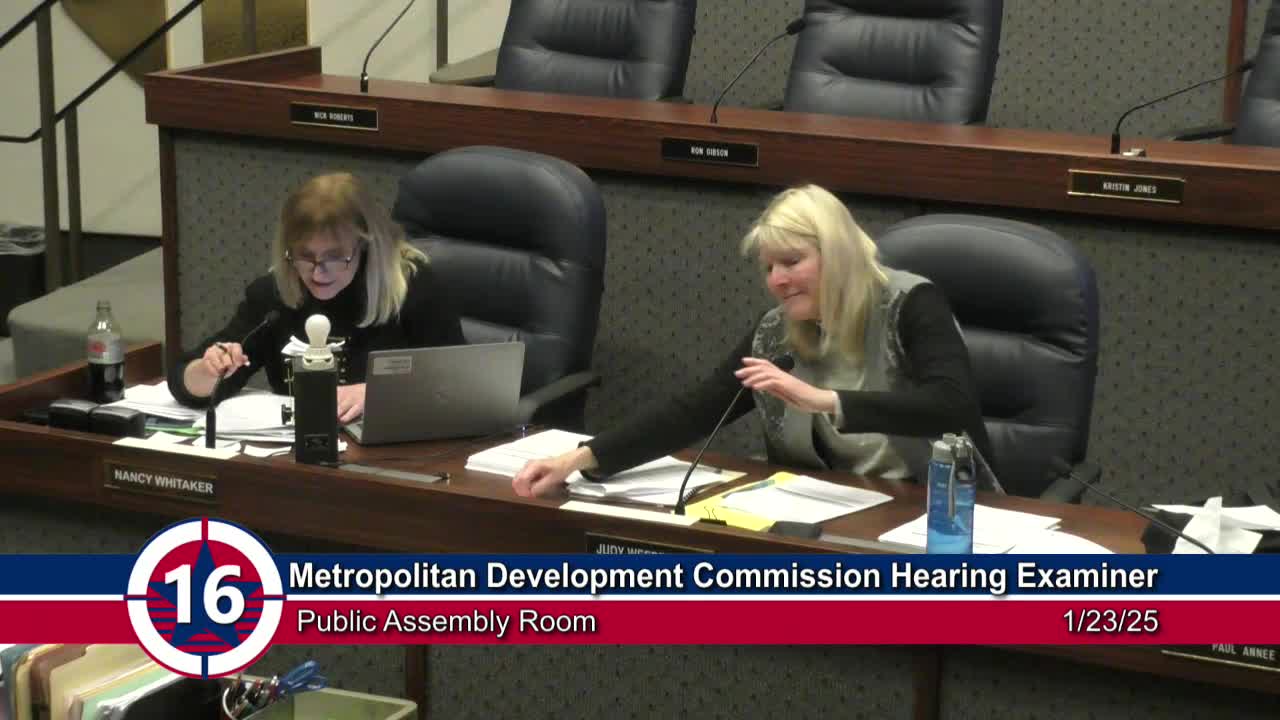
Hearing examiner recommends denial of Broadmoor Country Club rezoning after sustained neighborhood opposition
Summary
On Jan. 23, 2025, the hearing examiner recommended denying rezoning requests to convert about 13.7 acres near Broadmoor Country Club to higher-density residential districts after staff and multiple neighbors said the proposal conflicts with the comprehensive plan and neighborhood character.
The hearing examiner recommended denial Friday of two rezoning petitions from Broadmoor Investments LLC that would reclassify roughly 13.69 acres near Broadmoor Country Club to allow higher-density single-family development.
The recommendation covers petitions filed as 2024 ZON 073 and 2024 ZON 073B, which sought to rezone portions of the property from SU-34 to D4 and D5.2 to permit an alley-fed subdivision and a cluster of smaller lots. The hearing examiner said the petitions will be forwarded to the Metropolitan Development Commission for final action on Feb. 19, 2025.
Why it matters: Staff, neighborhood representatives and the hearing examiner said the density and lot pattern proposed are not consistent with the comprehensive plan’s “regional special use” designation for the site and with adjacent DS-zoned properties, which are low-density and largely wooded. Opponents said the plan would remove large areas of mature urban forest, create traffic concerns along Knowlton Road and alter the long-established character of the neighborhood.
The petitioner’s case: Russell Brown, an attorney for Broadmoor Investments, presented a concept plan that would create 43 lots across the two rezoning areas, including a 50-foot buffer yard and a central pond and trail area. Brown said buyers would likely be “move-down” or higher-end buyers and that lot pricing and house plans would place finished homes in the $750,000-to-$1,200,000 range. Mark Nottingham, a local broker who testified for the petitioner, said market demand exists in Washington Township for infill product at that price point.
Neighbor opposition and staff concerns: Greg Zubac, an attorney representing an unincorporated neighborhood association and multiple homeowners, said the property was designated “regional special use” in the 2018 comprehensive plan and has functioned as a golf course for nearly a century. Longtime residents, including homeowners Jason Mackey and Scott Monk, described narrow sightlines on Knowlton Road, mature canopy trees and one-acre-plus lots immediately south of the parcel. Mackey said the petitioner’s proposed lot widths (many as narrow as 35 feet, others 40 feet) and setbacks “are completely out of character” with the existing neighborhood.
Kathleen (Planning staff) told the hearing examiner that staff is recommending denial “primarily because it does not meet the comprehensive plan,” citing the plan’s regional special-use designation and the low-density character of adjacent DS zoning. Staff also asked for right-of-way dedication along Knowlton and Kessler and for a horizontal and vertical sight-distance analysis at permitting if access changes are proposed.
Traffic and access: The petitioner submitted a traffic impact study that staff had requested; the TIS recommended a westbound left-turn lane at the Kessler/Knowlton intersection, a mitigation the petitioner agreed to provide. Petitioner representatives said the existing Kessler entrance would become a secondary/emergency access while the new development would align the club entrance with its clubhouse as originally envisioned in the 1990s.
Decision and next steps: After hearing testimony and discussing the competing arguments, the hearing examiner found the proposal incompatible with the character and land-use expectations for the immediate area and recommended denial. That recommendation will be transmitted to the Metropolitan Development Commission for its Feb. 19 meeting; the commission will make the final decision.
Context and reaction: The record includes letters and a petition of roughly 52 nearby residents opposing the rezoning, plus testimony from petition representatives and a developer team. The petitioner emphasized willingness to negotiate commitments but said a substantially smaller lot plan would be economically infeasible. Opponents urged a DS or similarly low-density outcome consistent with surrounding lots and the comp plan.
What’s next: The hearing examiner’s written recommendation will go to the MDC on Feb. 19, 2025, where commissioners will decide to adopt, modify, or reject the hearing examiner’s recommendation.