Get Full Government Meeting Transcripts, Videos, & Alerts Forever!
Get email alerts on the Budget Commission Overhaul topic
No spam. Unsubscribe anytime.
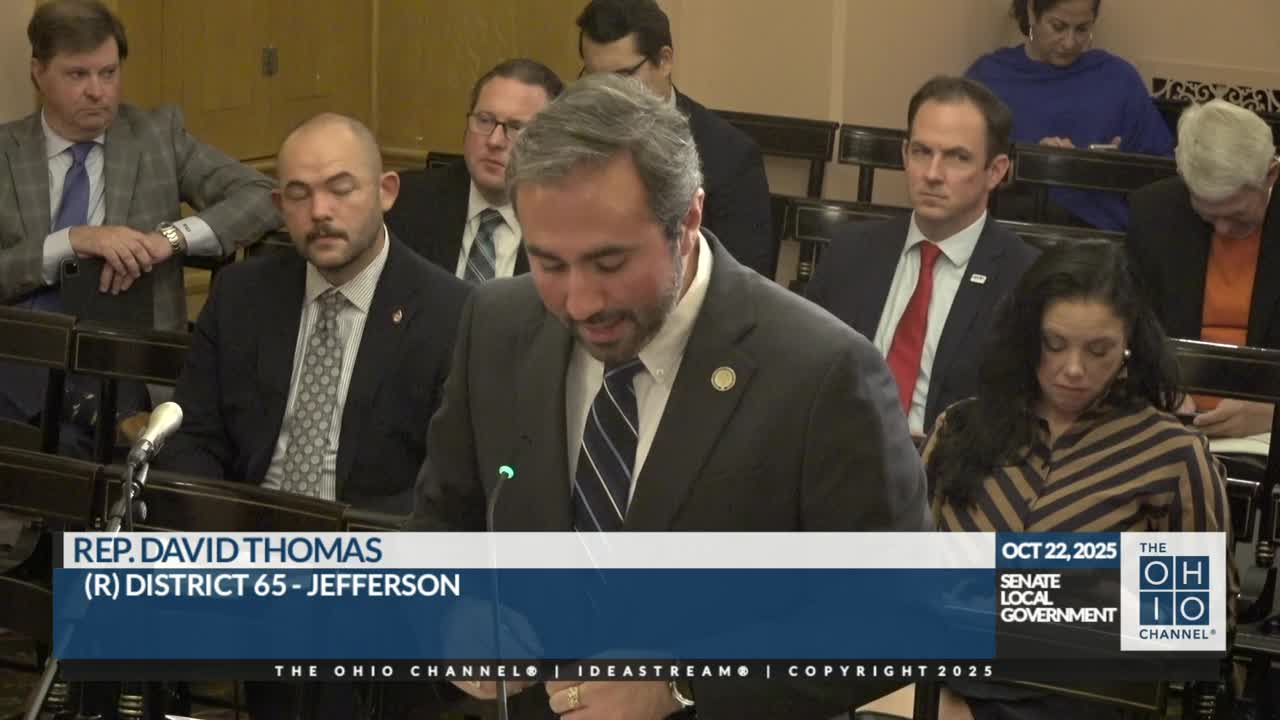
Representative Thomas urges stronger budget commissions to check excessive property-tax collections under House Bill 309
Summary
Representative Thomas testified that House Bill 309 would clarify and strengthen budget commissions' authority to review property-tax revenues and require hearings and guardrails to limit "unnecessary" or "excessive" collections. Proponents cited county examples (Geauga, Lake, Ross) and emphasized appeal rights to the Ohio Board of Tax Appeals.
Representative Thomas told the Senate Local Government Committee that House Bill 309, the "Budget Commission Overhaul Act," would give clearer authority and guardrails to county budget commissions so they can act as a check on excessive property-tax collections.
Thomas said the bill would confine budget-commission review to property-tax revenue (not income or sales tax), require hearings, and add statutory definitions and standards so commissions can ask questions about cash balances, receipts, and expenditures in open meetings. He described the current patchwork of practice across counties and used Geauga and Lake counties as examples: Geauga's budget commission, he said, uses its authority to reduce tax-rate increases after revaluation, while Lake County officials read ORC differently and largely do not exercise the same oversight.
The bill, as explained in testimony, would include several provisions meant to increase transparency and limit what the sponsor described as unnecessary collections: - Provide explicit authority for budget commissions to review property-tax funds and require public hearings on budgets and tax levies; - Add clearer statutory language and guardrails defining "excessive" and "unnecessary" collections, following recommendations from the governor's study committee; - Preserve an administrative check: affected local entities may appeal budget-commission decisions to the Ohio Board of Tax Appeals; - Preserve that the budget commission is composed of elected county officials (the county auditor, prosecutor and treasurer) and must meet in public; and - Include a five-year protection window after a levy passes during which the budget commission may not decrease that levy rate (a compromise added during negotiations, according to testimony).
Representative Thomas and other proponents told the committee the bill would not allow unelected officials to unilaterally defund services; rather, the commission would examine whether a fund is collecting more property-tax revenue than needed for the services tied to that levy. Thomas gave an example about a township fire-contract and said in some counties courts have introduced uncertainty about the commission's authority (the witness cited a Clark County case).
Committee members raised concerns about concentrating power in a small group of elected county officials and about the bill's practical impact on schools and other locally funded services. Proponents responded that the commission members are elected, that appeals are available to local entities, and that the bill includes definitions and hearings to ensure transparency.
The hearing concluded with committee discussion and no formal vote on House Bill 309 recorded during the session.